


Google Ads remains one of the most measurable and scalable digital advertising platforms available, but strong ROI requires precise tracking, structured optimization, and a deep understanding of user intent.
Many brands miscalculate ROI because they:
- Track only “lead submissions,” not conversion value
- Use revenue instead of profit, inflating ROI
- Overlook hidden costs (software, creative, agency time)
- Use incorrect attribution models that distort measured return
- Allow Google Ads to optimize toward the wrong metric (e.g., clicks instead of revenue)
- Not using the correct conversion tracking
When these errors compound, ROI reporting becomes unreliable — and business decisions suffer as a result.
According to recent HubSpot research, organizations consistently achieve high returns when they use proper conversion tracking and strategically allocate budget. Meanwhile, WordStream’s 2025 Google Ads Benchmarks reveal significant differences across industries—proving that ROI can’t be generalized. This expanded guide provides a complete, educational breakdown of how to calculate ROI, understand the levers that impact profitability, optimize campaigns, and present ROI in a leadership-ready format.
What Is Google Ads ROI?
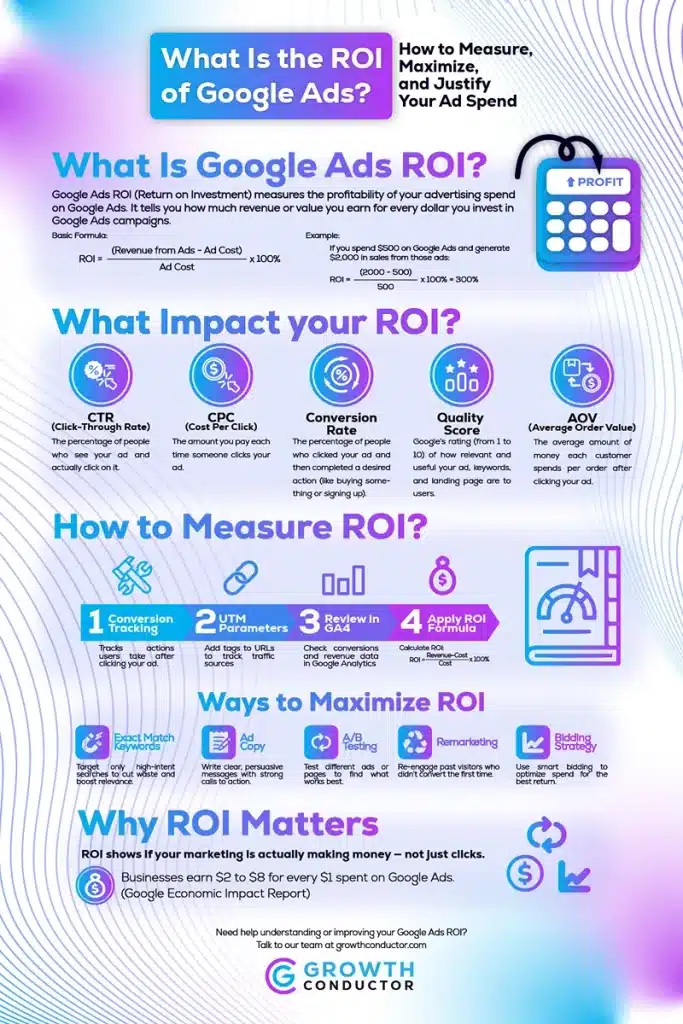
Google Ads ROI (Return on Investment) measures how much profit your advertising generates after subtracting your ad spend and related costs. It’s the single most important financial metric for evaluating PPC performance because it tells you whether Google Ads is producing real business value — not just clicks, impressions, or even revenue, but profit.
This distinction matters. Many marketers mistakenly rely only on ROAS (Return on Ad Spend), which measures revenue generated relative to spend. But revenue doesn’t equal profitability — especially for businesses with variable margins, fulfillment costs, or long sales cycles. ROI expands the lens by accounting for the actual profit retained after all costs.
ROI Formula:
(Revenue – Ad Spend) ÷ Ad Spend
Example:
Revenue: $12,000
Spend: $3,000
Profit: $9,000
ROI = 300%For more information, review the official guidance in the Google Ads Help Center
How to Calculate Google Ads ROI (Correctly)
Accurate ROI depends on reliable tracking, complete cost accounting, and correct attribution. Many advertisers underestimate costs or assign inaccurate conversion values, which leads to misleading ROI calculations.
1. Track True Conversion Value
Accurate ROI starts with accurate conversion value. If the value attached to each conversion is wrong (or missing), every ROI calculation downstream becomes unreliable. Most advertisers fall into one of two traps: they either don’t assign any value to conversions, or they assign values that do not reflect the actual revenue impact of the action.For ecommerce, this is straightforward — you pass real transaction revenue to Google Ads. But for lead generation, professional services, healthcare, education, and B2B businesses, the true value of a conversion is not the form fill itself. It’s the expected revenue from that lead, based on:
- Historical close rate
- Sales cycle length
- Average deal size
- Customer lifetime value (LTV)
- Margin per customer
To calculate accurate lead value, a simple formula is:
Lead Value = Close Rate × Average Deal Size
If your team closes 20% of leads at $5,000 each, your true lead value is:
0.20 × $5,000 = $1,000 per lead
Google Ads isn’t optimizing for leads — it’s optimizing for the value signals you give it. If Google receives no value data, smart bidding strategies will optimize toward the cheapest leads, not the most profitable ones. This is where advertisers accidentally teach Google to chase vanity metrics (low CPC, high CTR) instead of business outcomes (profit, revenue, LTV).Tracking true conversion value ensures your ROI calculation is rooted in actual business impact, not surface-level activity.
2. Include All Advertising Costs
Most ROI calculations dramatically overstate success because advertisers only include media spend (cost per click) in the equation. But Google Ads campaigns have multiple cost layers — and all of them impact profitability.
Your true advertising cost should include:
• Media Spend (Google Ads PPC cost)
This is obvious, but it’s only one piece.
• Creative and production costs
Ad copywriting, graphics, video, landing page assets — all influence performance and are part of the true cost to acquire a customer.
• Landing page development and tools
Whether internally built or outsourced, landing page creation has real costs that impact profitability.
• Performance Max asset production
PMax campaigns require additional visual and creative assets, adding to cost.
• Bid strategy automation costs / tech stack
Tools like Optmyzr, Marin, or automation layers carry licensing fees that must be included.
• Agency or freelancer management fees
This is often the largest cost brands forget to include. If a company pays $6,000/month for PPC management, and media spend is $10,000, the true cost is actually $16,000.
Example of incorrect ROI:
Revenue: $30,000
Ad Spend only: $10,000
ROI = 200%
Example of correct ROI:
Revenue: $30,000
Total Cost = $10,000 ad spend + $6,000 agency fee + $2,000 landing page enhancements = $18,000
Profit = $12,000
ROI = 67%
This is why counting all advertising costs is essential — the real ROI story often changes dramatically when all costs are included.
3. Use Profit, Not Revenue
Revenue tells you how much money came in.
Profit tells you how much you get to keep.
In industries with high margins (software, digital services), the difference between revenue and profit may be small.
But in product-based or labor-heavy businesses (ecommerce, home services, healthcare), margins can vary from 10% to 70% — completely changing the ROI calculation.
Example:
Two campaigns each generate $10,000 in revenue on $2,000 spend.
Campaign A: 70% Margin
Profit = $7,000
ROI = (7,000 – 2,000) / 2,000 = 250%
Campaign B: 20% Margin
Profit = $2,000
ROI = (2,000 – 2,000) / 2,000 = 0%
Same revenue.
Two radically different profits.
This is why ROI must use profit, not revenue — especially when:
- COGS (cost of goods sold) vary by product
- Different services have different fulfillment costs
- Discounts, promotions, or returns reduce profitability
- Labor or supply costs fluctuate
Using revenue-only ROI paints an artificially rosy picture, leading brands to scale campaigns that are not actually profitable.
When Google Ads performance is evaluated in terms of profit, not just revenue, companies can confidently scale the campaigns that truly drive financial impact — and cut the ones that don’t.
4. Choose the Correct Attribution Model
Attribution determines which keywords, ads, and touchpoints get credit for a conversion. Most advertisers rely on last-click attribution, which only credits the final interaction before a user converts. This creates three major problems:
1. Upper- and mid-funnel contribution is hidden
Users rarely convert after a single click. Last-click ignores:
- Research keywords
- Competitor comparisons
- Informational queries
- Performance Max discovery surfaces
- Retargeting interactions
This leads advertisers to pause the very campaigns that assist in producing conversions downstream.
2. Smart bidding learns the wrong signals
If last-click undervalues early-stage interactions, Google Ads learns that those keywords “don’t work.”
So Smart Bidding reduces bids on them — and performance weakens further.
This causes:
- Lower impression share on important research terms
- Higher dependence on branded keywords
- A misleadingly inflated ROI snapshot
3. DDA (Data-Driven Attribution) reveals true ROI
DDA assigns credit based on actual user behavior patterns. This often shows:
- Awareness keywords contributing to pipeline
- Upper-funnel terms supporting high-value conversions
- Assist keywords driving long-term revenue
- Higher ROI than last-click indicated
- Better understanding of the profit drivers throughout the funnel
With DDA:
- Keywords previously marked “non-performing” show real revenue impact
- Optimization models become far more accurate
- Budget allocation becomes smarter
- ROI calculations become true to the customer journey
Metrics That Impact Google Ads ROI
CPA (Cost Per Acquisition)
Lower CPA means more conversions for the same spend, directly improving ROI.
Conversion Rate (CVR) & Landing Page Experience
Landing pages heavily influence conversion rates. Improvements in message match, UX, speed, and trust factors can double ROI even without increasing spend.
Quality Score
Higher Quality Scores reduce CPC and improve ad rank, significantly influencing ROI.
How to Track ROI Accurately
Keyword Intent
High-intent keywords produce stronger ROI than broad, exploratory terms.
Attribution Modeling
DDA provides clearer ROI insights than last-click models, especially in long sales cycles.
How to Improve Google Ads ROI
Prioritize High-Intent Keywords
Focus budget on bottom-funnel queries that demonstrate purchase intent, and reduce spend on non-converting broad queries.
Strengthen Landing Pages
High-performing landing pages improve ROI through better relevance, clearer CTAs, faster loading speed, and optimized mobile experiences.
Use Smart Bidding Strategically
tCPA and tROAS outperform manual bidding when supported by accurate conversion tracking.
Eliminate Wasted Spend
Use negative keywords, audit search terms, refine match types, and remove low-performing placements.
Growth Conductor’s AdVelocity PPC Services specialize in ROI-first optimization frameworks.
What Is a Good Google Ads ROI?
A “good” Google Ads ROI varies significantly by industry, margin structure, and sales cycle. Because ROI measures profit—not revenue—industries with higher margins or larger deal sizes typically see stronger ROI. While results vary by brand and maturity, the following ranges represent realistic expectations based on common margin profiles and performance patterns:
- Ecommerce: 120–250% ROI
Leaner margins and fulfillment costs keep ROI modest but scalable. - B2B Services: 200–500% ROI
Larger deal sizes and strong LTV potential support higher ROI outcomes. - SaaS (Subscription Models): 100–300% ROI
CAC payback periods and LTV dynamics produce more conservative short-term ROI. - Professional Services: 250–600% ROI
High-margin, high-value services often generate above-average ROI when targeting is strong.
Across industries, ROI tends to stabilize and improve with larger budgets because Google’s machine learning systems optimize more effectively with higher, more consistent conversion volume.
When implemented with precision, Google Ads becomes far more than a traffic channel — it becomes a predictable, scalable revenue engine. ROI is the signal that separates organizations who guess from those who grow. By grounding your strategy in accurate conversion value tracking, full-funnel attribution, profit-based measurement, and ongoing optimization, you gain the ability to make decisions that compound over time.
Strong ROI isn’t a one-time achievement; it’s the result of a deliberate system. When your campaigns are structured around intent, powered by high-performing landing pages, guided by smart bidding strategies, and continually refined through data, paid search transforms into a controllable lever you can adjust as the business scales. This is how high-growth teams turn ad spend into predictable pipeline — and pipeline into revenue momentum.Organizations ready to operationalize ROI at this level benefit from working with a performance partner who understands both the strategic and technical layers of PPC. Growth Conductor’s AdVelocity™ PPC Services apply a rigorous, ROI-first methodology built around continuous optimization, intelligent attribution, and financial discipline. If your goal is to scale profitably, reduce wasted spend, and bring clarity to your paid media investments, our team can help you build the PPC engine your growth goals demand.