


The AI Shift Is Reshaping the Agency Model
Artificial intelligence is not a feature upgrade for agencies. It is a structural shift.
An AI-driven marketing agency integrates artificial intelligence into research, targeting, personalization, optimization, and reporting while maintaining human strategic oversight and creative direction.
That distinction matters. AI does not replace agencies. It raises the standard.
Clients now expect faster insights, predictive optimization, and measurable ROI across channels. AI makes that possible. But technology alone does not create outcomes. Architecture does.
If you explore the broader conversation about the future of marketing agencies, one pattern becomes clear: the agencies that thrive are those that redesign their systems around AI — not those that merely adopt tools.
Why AI Is Not Just Another Tool
AI changes the economics of decision-making.
When audience insights are surfaced in minutes instead of weeks, and performance signals are detected in real time instead of quarterly, the speed of intelligence reshapes expectations. Campaign testing cycles shorten. Optimization windows narrow. Attribution improves.
This compresses execution and elevates strategy.
Agencies that position themselves around tasks feel pressure. Agencies that position themselves around orchestration gain leverage.
What an AI-Driven Marketing Agency Actually Means
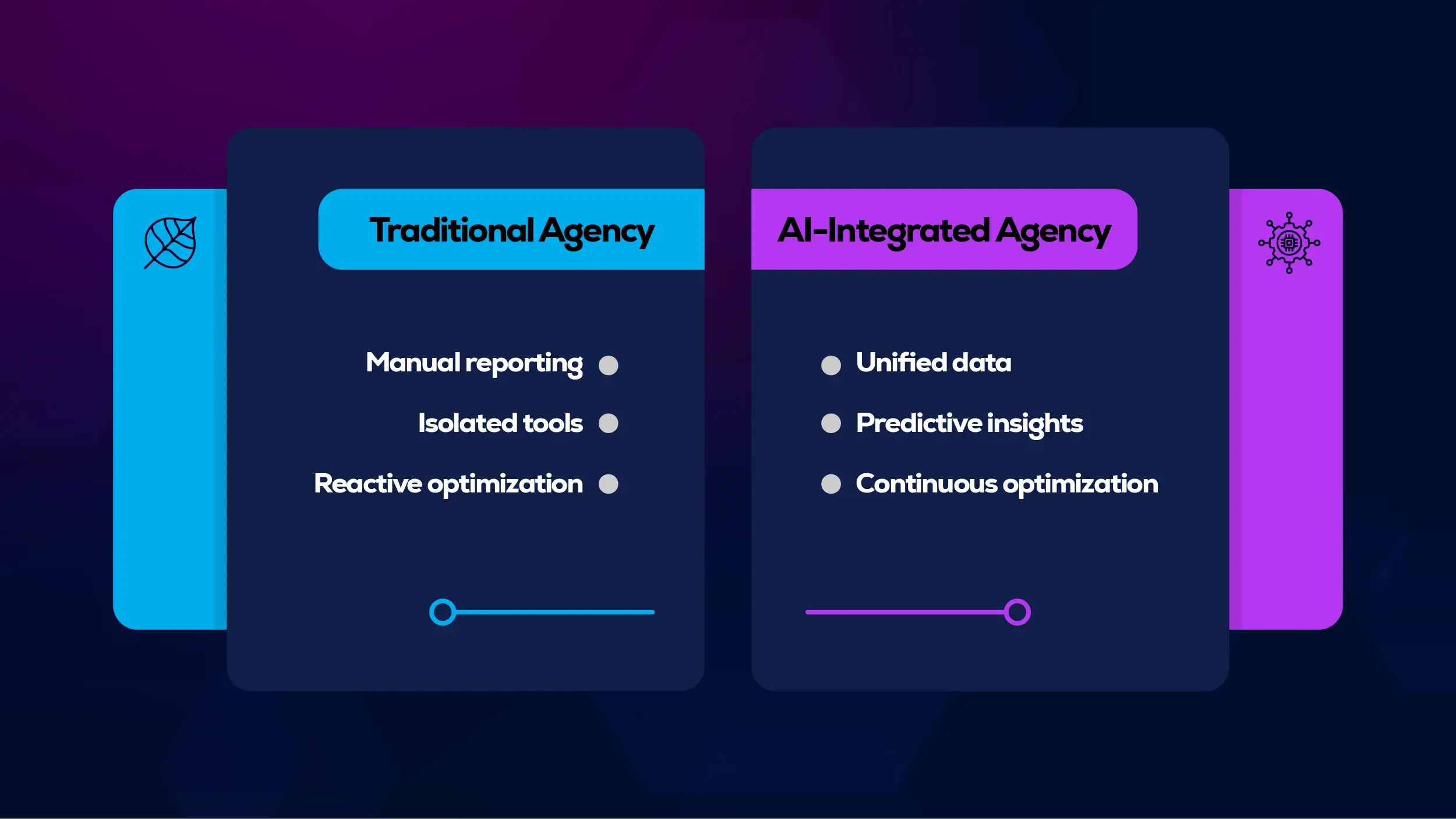
An AI-driven marketing agency is not defined by the tools it uses. It is defined by how intelligence flows through its system.
That system integrates:
- A unified data foundation
- An AI insight layer
- Continuous execution feedback loops
- Strategic governance and oversight
AI accelerates insight. Humans define direction. Systems create repeatability.
That is evolution.
Where Traditional Agencies Break in an AI-First Market
AI strengthens agencies that evolve. It exposes weaknesses in those that do not.
Agencies That Only Sell Tasks Struggle to Stand Out
Content drafting, bid adjustments, reporting aggregation — these activities are increasingly automated. When an agency’s value is framed primarily around execution, differentiation shrinks.
This is not a threat. It is a filter.
Value is moving upstream toward:
- System design
- Intelligence orchestration
- Cross-channel integration
- Measurable growth architecture
The agency is not disappearing. The low-leverage model is.
Tool Stacking Without Integration
Many agencies adopt AI tools without redesigning workflows. The result is fragmentation: isolated dashboards, disconnected automation, and reporting that does not inform creative decisions.
Without integration, AI increases activity but not clarity.
Integrated performance marketing services demonstrate how paid media, analytics, and predictive optimization must operate within a shared intelligence layer rather than in silos.
AI must be embedded into infrastructure — not layered on top.
Strategy Without Data Depth
Creativity remains central. Brand remains critical. But intuition alone is insufficient in a real-time ecosystem.
Modern agencies align scalable content marketing services with performance signals, allowing creative direction to evolve based on measurable outcomes rather than assumptions.
This is the difference between reactive campaigns and predictive growth systems.
The 3 Stages of Agency Evolution

Agency transformation typically follows a predictable path.
Stage 1 — Experimentation
AI tools are used tactically. Content drafting improves. Bidding becomes more automated. Reporting speeds up.
But systems remain siloed. Intelligence does not flow across departments. AI improves efficiency without altering structure.
Stage 2 — Integration
In the integration phase, workflows change.
CRM systems connect to paid campaigns. Content performance informs audience segmentation. Reporting consolidates across channels.
Research from Deloitte’s AI strategy insights shows that organizations gain significantly greater value when AI tools are integrated across functions rather than deployed independently.
At this stage, agencies begin aligning:
- Data
- Creative
- Media buying
- Automation logic
AI transitions from tool to infrastructure.
Stage 3 — Orchestration
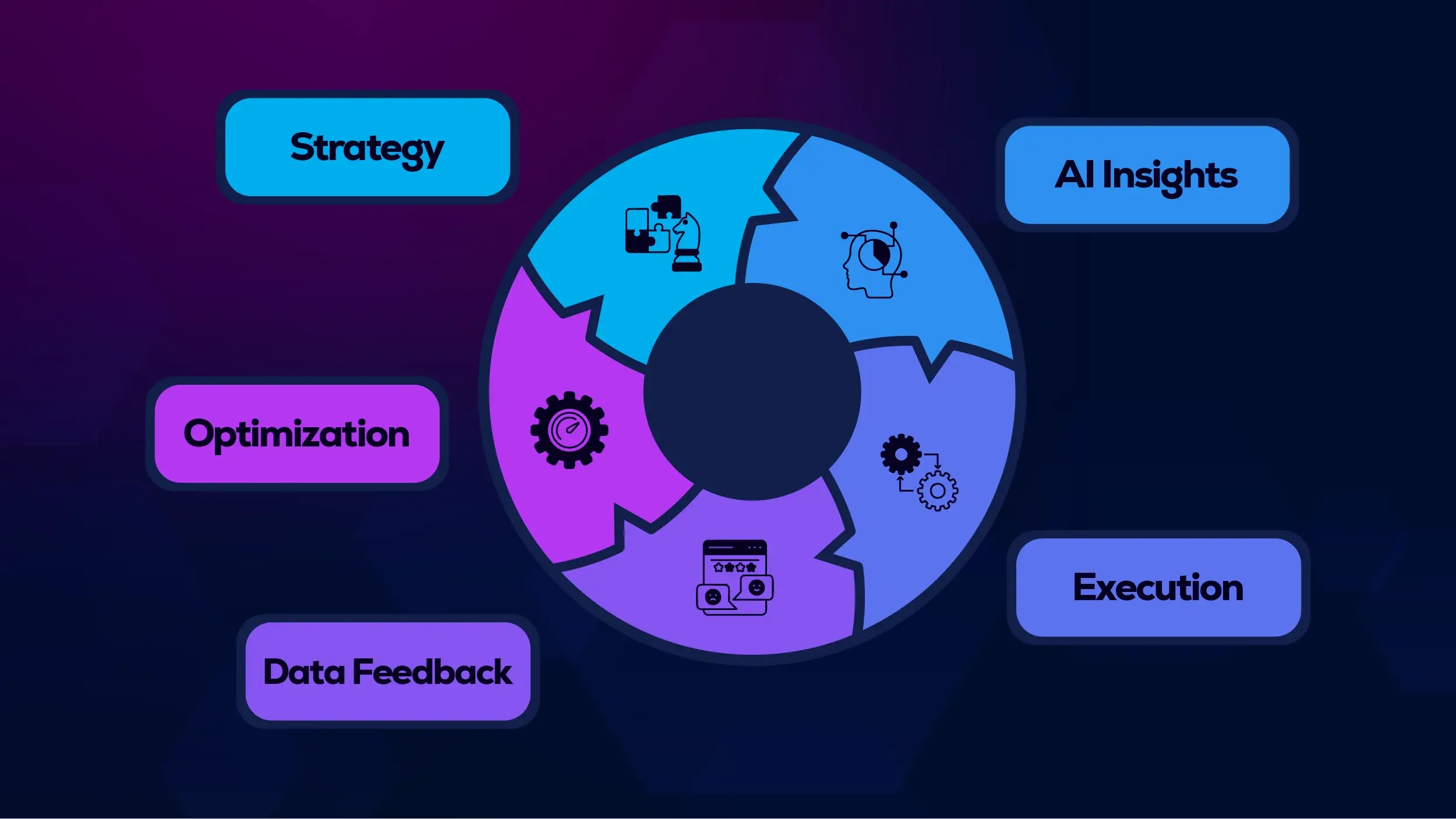
Orchestration is where evolution becomes structural.
In this phase:
- Data feeds a centralized intelligence layer
- AI surfaces predictive insights continuously
- Execution adapts dynamically
- Feedback loops refine strategy weekly
- Human oversight governs every layer
The agency operates as a system, not a collection of services.
The Modern AI Agency Operating Model

To understand true evolution, we need to move from stages to structure.
A modern AI agency operating model consists of four interconnected layers.
Layer 1 — Unified Data Foundation
Everything begins with data.
Paid media metrics, CRM insights, website analytics, and content performance must flow into a centralized reporting environment. Without a single source of truth, AI insights fragment.
The data foundation eliminates guesswork. It aligns departments. It supports forecasting.
Layer 2 — AI Insight Layer
AI processes raw data into intelligence.
Predictive audience modeling identifies high-value segments. Performance signals reveal creative trends. Budget allocation logic adapts in near real time.
This layer transforms information into advantage.
AI is not automating randomly. It is interpreting patterns at scale.
Layer 3 — Execution + Feedback Loops
Execution becomes cyclical rather than campaign-based.
Creative is tested continuously. Budgets are adjusted dynamically. Content themes evolve based on conversion signals.
Feedback flows back into the data foundation, strengthening future insights.
Optimization becomes continuous.
Layer 4 — Governance + Strategic Oversight
At the top sits human direction.
Research from MIT Sloan Management Review on human–AI collaboration consistently shows that organizations achieve stronger outcomes when AI systems are paired with structured human oversight and clearly defined decision frameworks.
That includes:
- Human-in-the-loop review
- KPI discipline
- Brand guardrails
- Ethical AI standards
AI enhances agency performance. Governance protects strategic integrity.
Common AI Implementation Mistakes Agencies Make
Evolution requires discipline. Many agencies misstep during transition.
Automating Before Defining Strategy
AI can optimize only what is clearly defined. Without KPI clarity, automation accelerates noise.
Speed without direction creates chaos.
Hiring for Tools Instead of Systems Thinking
Owning tools does not equal orchestration capability. Agencies need architectural thinking — professionals who understand how data, AI, creative, and performance connect.
Treating AI as a Cost-Saving Shortcut
When AI is positioned purely as efficiency, agencies risk underinvesting in integration and oversight.
AI should increase leverage, not dilute strategic depth.
Overbuilding Instead of Partnering
Building internal AI infrastructure requires data architecture, automation design, performance modeling, and ongoing governance.
Many agencies strengthen their model by collaborating with AI-forward partners who provide backend orchestration while allowing agencies to retain client leadership and brand authority.
Strategic partnership often accelerates maturity faster than isolated experimentation.
How Agencies Can Pitch AI Without Devaluing Themselves
AI strengthens agencies when positioned correctly.
Sell Outcomes, Not Tools
Clients do not buy software. They buy growth.
When AI is framed as an acceleration layer within a strategic system, it enhances credibility rather than replacing expertise.
Build Trust Through Strategy and Guardrails
Transparency, oversight, and structured governance build confidence.
Clients want innovation — but they also want accountability.
Agencies that lead with strategic oversight demonstrate maturity.
When to Strengthen Your Model Through Strategic Partnership
Not every agency needs to build infrastructure from scratch.
Specialized partners can provide:
- Cross-channel performance orchestration
- Data integration architecture
- AI-informed optimization frameworks
- Scalable content and performance alignment
The agency retains client relationships and strategic leadership. The system behind it becomes stronger.
The Future Agency Operates as an Integrated Growth System
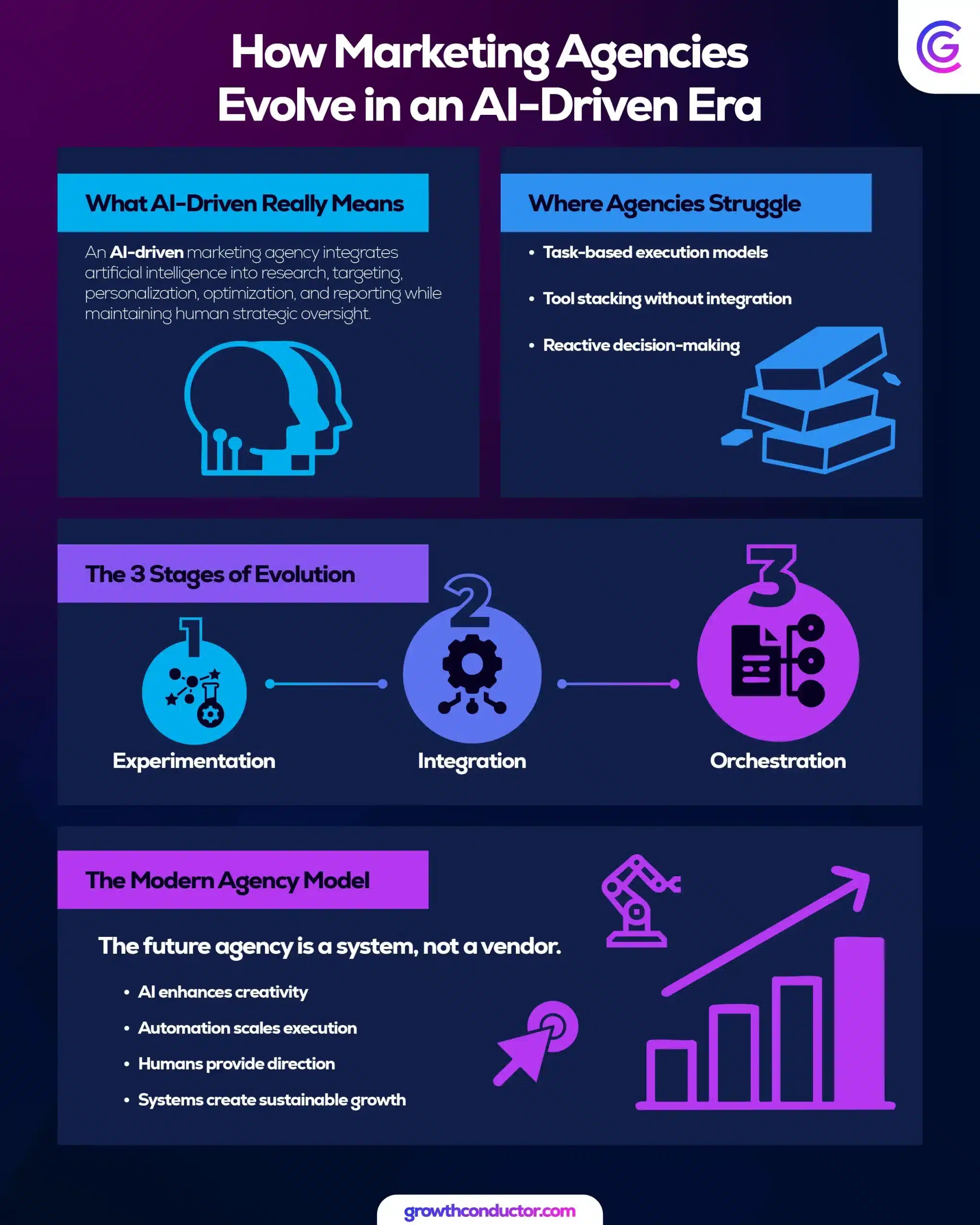
The agency model is not shrinking. It is maturing.
AI adoption is accelerating across industries, and marketing is no exception. As artificial intelligence becomes embedded into everyday business operations, expectations shift. What once felt innovative becomes baseline.
What Clients Will Expect in the Next 3–5 Years
According to the World Economic Forum’s Future of Jobs Report, AI-driven transformation is reshaping professional services by increasing demand for data fluency, systems thinking, and structured oversight. The agencies that succeed will not simply “use AI.” They will demonstrate that they understand how intelligence flows across an entire growth ecosystem.
In practical terms, clients will increasingly expect agencies to deliver:
Predictive insight rather than retrospective reporting.
Real-time optimization instead of quarterly adjustments.
Integrated reporting that connects paid media, content, CRM, and revenue performance.
Continuous performance refinement driven by measurable feedback loops.
This expectation shift changes the competitive landscape.
Agencies that redesign their operating model around intelligence and oversight will compete on strategic value rather than price sensitivity. They will not be selling deliverables. They will be managing growth systems.
AI does not eliminate agencies. It rewards those who build architecture around it.
The future agency is not defined by the tools it uses. It is defined by how intelligently it orchestrates data, automation, creativity, and governance into a unified operating model that produces consistent, scalable results.
That is the shift. Not replacement. Integration.
If you’re evaluating your next step, working with the right team can make all the difference. You can learn more about how we approach this as an Austin growth marketing agency, then focus on building a growth plan that fits your business and goals. If you’d like to learn more about our approach, or you’re ready to move forward, you can start by mapping out your next steps with a project planning strategy call.
FAQs
AI will automate repetitive tasks and accelerate insight generation, allowing agencies to focus more on system design, strategy, and performance orchestration.
It operates with a unified data foundation, an AI insight layer, continuous feedback loops, and structured human oversight guiding decisions.
Yes. Smaller agencies can leverage AI tools and strategic partnerships to compete effectively without building complex infrastructure internally.
No. AI strengthens agencies by increasing efficiency and intelligence. Agencies that evolve structurally become more valuable, not less.