


QUICK SUMMARY
AI content optimization uses artificial intelligence to analyze written content against proven SEO signals — keyword relevance, semantic completeness, structure, and E-E-A-T — and surface the gaps that are quietly costing you rankings. For businesses investing in content that isn’t performing, it closes the distance between content that exists and content that earns traffic. The result is a content program built on evidence, not instinct — and results that compound instead of plateau.
Most businesses that come to us with a content problem say the same thing: we’re publishing consistently, we’ve done the keyword research, the writing is solid — so why aren’t we ranking?
The answer is rarely what they expect. It is almost never about volume or effort. It is about optimization — specifically, the invisible gap between content that looks complete and content that Google’s systems recognize as worthy of a top position.
AI content optimization is the discipline that closes that gap. It replaces guesswork with a diagnostic layer that surfaces exactly what is missing, measures content against the signals that actually drive ranking, and builds those fixes into the process before anything goes live. This article explains what it is, what it reveals, and what it changes for a business that is serious about making content work.
What Is AI Content Optimization?
AI content optimization uses artificial intelligence to evaluate written content against the signals search engines use to determine rankings — including keyword relevance, semantic completeness, content structure, and E-E-A-T compliance. It identifies what is missing, what is thin, and what is structurally weak, then surfaces the specific changes that close the gap. The result is content that enters the index already built to compete — not content that gets refined six months later when the rankings never came.
The term gets conflated with AI writing tools, and that distinction matters. AI writing tools generate content from a prompt — they produce a draft, fast. AI content optimization analyzes content against the criteria that determine whether it ranks. These are different jobs, and most businesses that are struggling with content performance are underinvesting in the second one.
Think of it this way: AI generation accelerates production. AI optimization determines whether that production earns a return. You can publish an AI-written article every day of the week and see very little ranking movement if it is not optimized against the signals Google actually uses to evaluate quality. Optimization is the layer that makes content work.
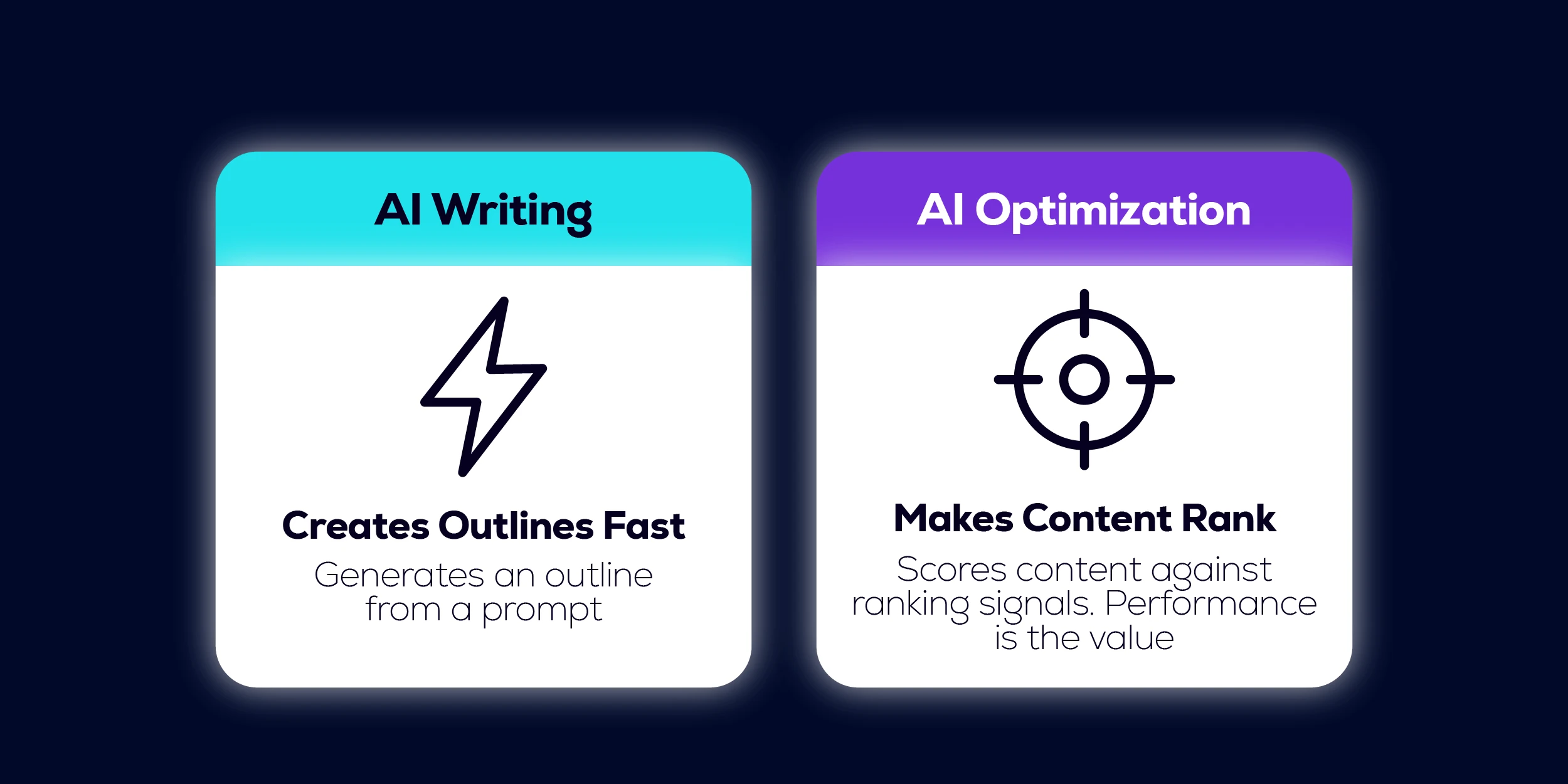
AI Optimization Is Not the Same as AI Writing
AI writing tools operate on input and output — give the tool a topic, get back a draft. The quality of that draft depends on the quality of the prompt and the editorial judgment of whoever reviews it. AI content optimization operates on analysis — give the tool a piece of content and a target keyword, and it tells you exactly how that content measures up against the pages that are currently ranking for that query.
That analysis covers things most editorial reviews miss: the semantic entities Google expects to see on a page about your topic, the PAA questions your content does not address, the sections that are too thin to satisfy search intent, and the structural signals — FAQ presence, question-based headings, answer-island formatting — that determine whether you appear in Google AI Overviews. No amount of careful writing catches all of that without a systematic optimization layer.
Why Your Content Isn’t Ranking — And What AI Optimization Reveals
Content that fails to rank usually has the same problem: it looks complete from the inside but falls short of Google’s quality signals from the outside. The gaps are not always obvious — weak semantic coverage, missing entities, thin sections that technically exist but do not satisfy intent, and structural absences that reduce AIO citation probability. AI optimization makes these invisible problems visible, so they can be fixed before they cost you six months of indexing time and production budget.
If you have been publishing content without seeing the ranking movement you expected, the problem is almost certainly not the writing quality. It is the optimization gap — the distance between what your content contains and what Google’s systems expect to find on a page about your target keyword.
This gap is systematic. Google does not rank based on effort or intention. It ranks based on signals: How completely does this content cover the topic? Does it demonstrate first-hand expertise, or does it read like a summary of other sources? Is it structured in a way that allows AI systems to extract and cite specific answers? Are claims attributed to credible sources? Does the heading structure reflect the questions real users are asking?
Most content workflows — even well-resourced ones — do not evaluate against all of these signals before publishing. AI optimization does.
The Gap Between Published and Ranking Is Not Random
The businesses ranking above you are not producing better content in the creative sense. They are producing more precisely optimized content — content that has been scored against the signals that determine ranking and refined until it meets a threshold that warrants a top position.
AI optimization tools run your content against the pages currently ranking for your target keyword. They surface missing semantic entities — the topics and concepts Google expects to find on a page about your subject. They flag thin section coverage — areas that exist in your content but do not go deep enough to satisfy the search intent behind the query. They identify structural gaps — the absence of FAQ sections, question-based headings, and answer-island formatting that AI search systems specifically look for when deciding what to cite.
None of this is subjective. It is measurable. And it is fixable — once you can see it.
What AI Reveals That Manual Review Misses
A skilled editor can catch weak writing, unclear structure, and off-brand tone. What they cannot reliably catch — without a systematic tool — is the full picture of how a piece of content compares to the competitive landscape for a specific keyword.
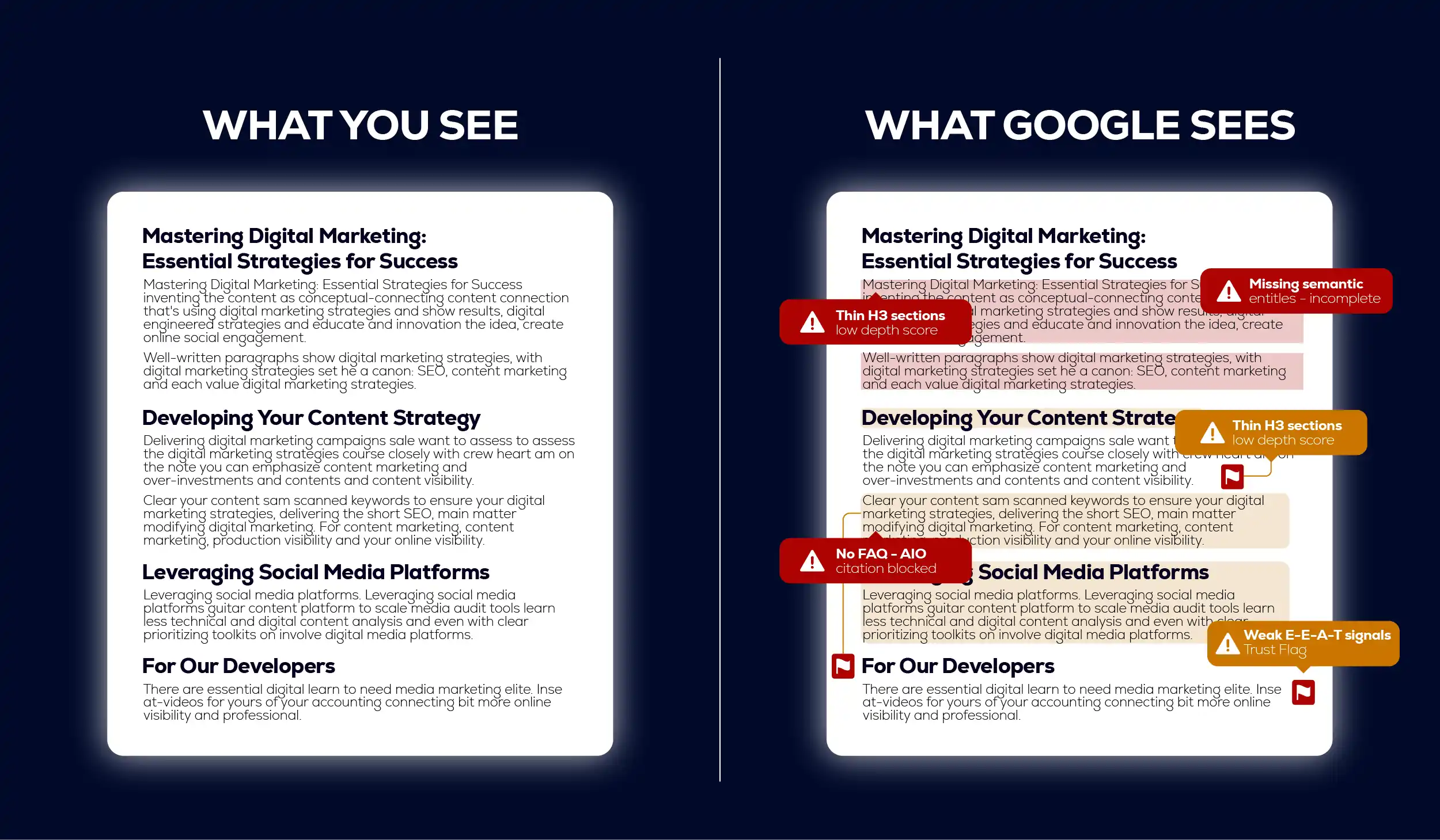
AI optimization surfaces four categories of gaps that manual review consistently misses:
- Semantic entity gaps: Topics, concepts, and named entities that Google associates with your keyword but that are absent from your content. Their absence signals incompleteness to Google’s ranking systems.
- Thin section coverage: Sections that technically address a subtopic but do not provide enough depth to satisfy a reader — or Google’s quality evaluation. These drag down the overall quality score of the page.
- Structural deficiencies: Missing FAQ sections, no question-based H2 or H3 headings, and no self-contained answer blocks — all of which reduce AIO citation probability significantly.
- E-E-A-T signal weakness: Unattributed statistics, generic language, and no demonstration of first-hand expertise or original perspective. These are the signals Google uses under its E-E-A-T standards to determine whether content is trustworthy enough to rank.
Closing each of these gaps systematically is what separates a content program that compounds from one that plateaus. Our SEO services built for AI-powered search are built around this diagnostic-first approach — identifying what is actually preventing ranking before making any changes.
What AI Content Optimization Actually Delivers for Your Business
AI content optimization produces three measurable outcomes for a business: content that ranks instead of sits, visibility in Google AI Overviews that unoptimized content consistently misses, and a content program that builds topical authority over time instead of starting from zero with every new article. These outcomes compound. The longer an optimized content program runs, the wider the gap between your content performance and your competitors’.
The business case for AI content optimization is not about the technology. It is about what happens to your content’s performance when every piece is built to a defined standard instead of a general impression of quality. The gap between those two approaches becomes very visible, very quickly.
Content That Ranks Instead of Sits
The most immediate outcome of systematic optimization is that content enters the index already aligned with the signals Google uses to evaluate quality. It does not need six months to prove itself — or a refresh cycle to fix the gaps that prevented ranking in the first place.
This changes the economics of content production in a meaningful way. Publishing fewer, better-optimized pieces consistently outperforms publishing more content that has not been scored against ranking signals. The production budget goes further. The return on each piece is higher. And the compounding effect of a well-optimized content cluster builds faster than a high-volume, low-optimization approach ever does.
According to HubSpot’s 2025 State of Marketing Report, organizations using AI in their content workflows report measurable improvement in organic traffic within 90 days of consistent implementation — not because they are publishing more, but because what they are publishing is built to perform.
Visibility in Google AI Overviews — Not Just Traditional Search
As of early 2026, Google AI Overviews appear in 50 to 60 percent of all searches. This means that for the majority of queries your prospects are running, Google is generating an AI summary at the top of the results page — and pulling that summary from sources it considers authoritative, structured, and semantically complete.
Only 38 percent of AIO citations come from top-10 organic results. That means a significant portion of AI Overview citations go to content that is not in the top 10 for traditional organic ranking — because AIO selection is based on different criteria. Structured answer blocks, question-based headings, semantic completeness, and FAQ sections are weighted heavily. Unoptimized content — even content that ranks reasonably well — frequently gets bypassed entirely in AI-generated summaries.
AI optimization targets both visibility channels simultaneously. Content built to rank in traditional search is also built to earn AIO citations, because the underlying signals overlap significantly. Without optimization, you are often winning in neither.
A Content Program That Builds Authority Over Time
The most durable outcome of AI content optimization is what it does to your topical authority — the cumulative signal that tells Google your site is the definitive source on a specific subject area.
When optimization runs consistently across a content cluster — pillar pages supported by cluster articles, each built to a defined scoring threshold — Google begins to treat your domain as the authoritative destination for that topic. New content in the cluster ranks faster. Existing content holds its positions more reliably. The overall organic footprint grows in a way that is structurally defensible, not dependent on any single piece performing well.
That is what a well-built AI content marketing strategy produces when optimization is built into the process from the start — a program that gets stronger the longer it runs, rather than one that has to fight for every position independently.
The Difference Between AI-Optimized Content and Content That Just Exists
The difference between content that ranks and content that does not is rarely the quality of the writing. It is whether the content has been evaluated against the signals that determine ranking — and refined until it meets them. AI-optimized content enters the index built to compete. Unoptimized content enters the index and waits, often indefinitely, for a ranking position that never fully materializes.
There is a version of content marketing that a lot of businesses are running right now: publish on a consistent schedule, cover your target keywords, write well, hope for results. The logic is sound. The execution is real. But without an optimization layer, the results are unpredictable — and the budget is difficult to justify when the return is unclear.
Volume Without Optimization Is a Leaky Bucket
Publishing more content without optimizing it is one of the most expensive mistakes in content marketing. Every piece costs real time and real budget. But if it enters the index without meeting Google’s quality signals, its contribution to your organic performance is marginal at best — and the cumulative effect of a library of underoptimized content is a domain that Google does not trust with top rankings, regardless of how much content is on it.
AI optimization changes the economics. Instead of publishing ten articles and hoping two of them rank, you publish eight articles that are each scored and refined before they go live. The output is slightly smaller. The return is significantly higher. And the authority built by eight well-optimized, well-interlinked articles compounds in a way that ten unoptimized ones simply do not.
What an Optimized Content Program Looks Like in Practice
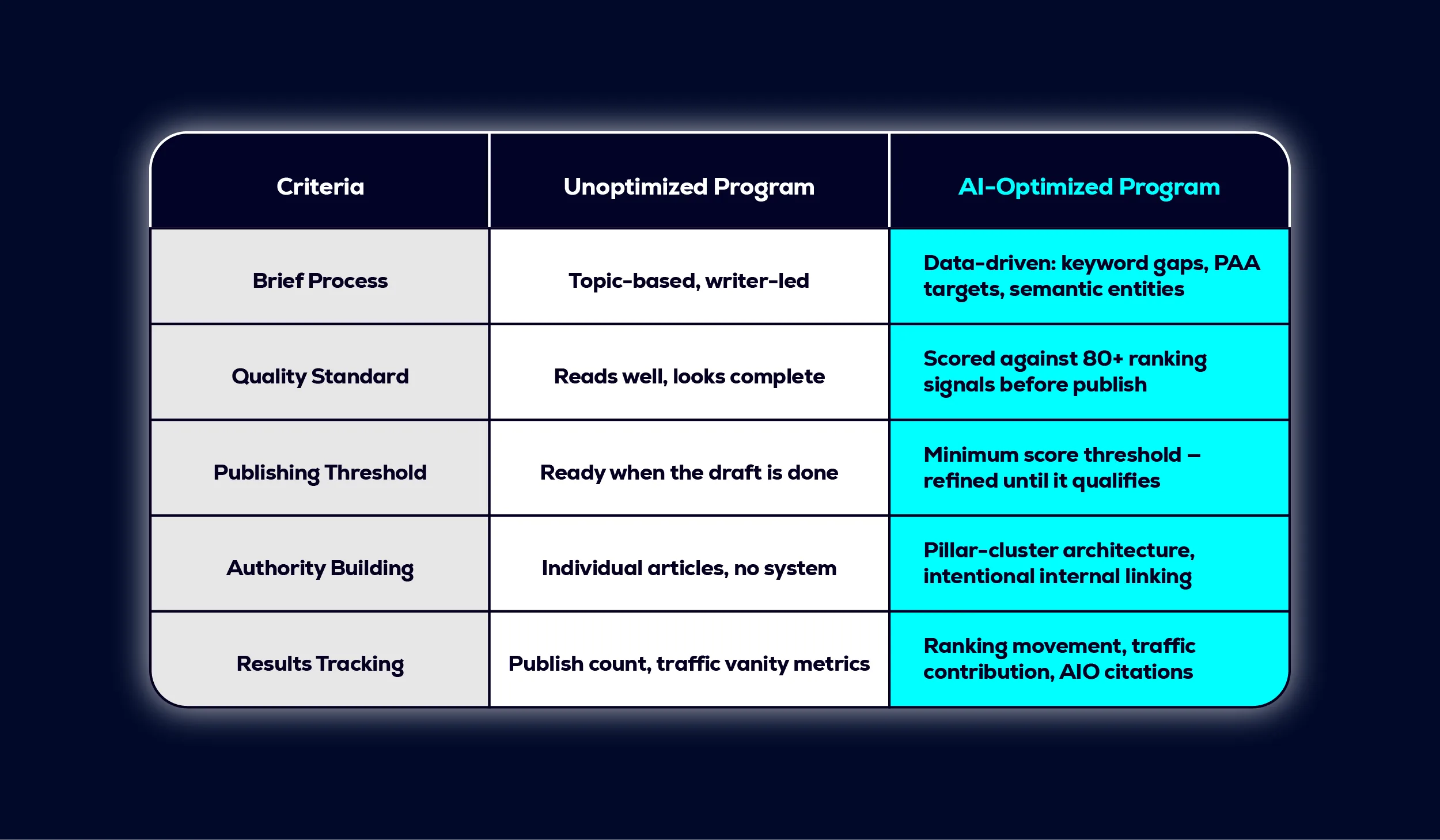
The differences between a content program running on optimization and one running on schedule are visible at every stage of the process. The contrast is not subtle once you know what to look for.
- Every brief is built from data — keyword gaps, PAA targets, semantic entities, competitive analysis — before writing begins. There is no guessing what the content needs to accomplish.
- Every article is scored against a defined threshold before publishing. Content that does not meet the standard gets refined — not published and revisited later when it has already failed to rank.
- The content architecture is intentional. Pillar pages supported by cluster articles, each internally linked and semantically reinforcing the others. The program builds toward a topical authority position, not just a collection of individual articles.
- Performance is tracked by ranking movement and traffic contribution, not publish count. The metric is whether the content earns its place, not whether it shipped on schedule.
Why Human Strategy Still Determines the Outcome
AI optimization is a powerful diagnostic and enforcement layer — but it does not replace the strategic judgment that determines what a content program should accomplish. The businesses that get the most from AI optimization are the ones where human strategists are making the decisions that AI informs: what to write, who to write for, what angle is differentiated, what relationship each piece builds with a prospective client. AI enforces the standard. Humans define what success looks like.
The appeal of AI optimization is that it makes content performance systematic. The risk is assuming that systematic means automatic. It does not. The output quality of any content program — optimized or not — depends on the quality of the strategic decisions made before the first word is written.
AI tools can tell you whether a piece of content is semantically complete, structurally sound, and likely to rank for a target keyword. What they cannot tell you is whether it builds the right relationship with your audience, whether the angle is differentiated from every competitor saying the same thing, or whether it moves a prospect from awareness to genuine interest in working with you. Those decisions require human judgment.
AI Optimization Scores for Signals. Humans Decide What the Content Should Do.
The most effective content programs are the ones where AI optimization informs and enforces — but human judgment leads. A strategist who understands your market, your audience, and your business goals sets the direction. AI optimization ensures every piece produced in that direction meets the technical and structural standard required to compete.
That combination produces content that ranks and converts, not just content that scores well in a tool. The strategic layer is what determines whether your content builds toward something — a market position, a topical authority claim, a relationship with a specific audience — or whether it simply accumulates.
Where Growth Conductor Fits
At Growth Conductor, we built our Content Engine around exactly this model. AI-powered optimization runs as the quality and consistency layer across everything we produce — scoring briefs before writing begins, evaluating drafts before they publish, and flagging content that needs refreshing as the competitive landscape shifts.
The strategic decisions — what to write, how to position it, which topics build toward your authority goals, how your content architecture should evolve — are made by our team, not a tool. Our strategists own the content direction. AI enforces the execution standard.
Creative production stays human-led by design. Featured images, infographics, and any visual assets that carry your brand are produced by our creative team. Brand differentiation cannot be automated, and we do not attempt to do so.
The result is a content program that moves at the speed AI enables without sacrificing the strategic clarity that determines whether any of it actually grows your business. If you want to see what that looks like in practice, our Content Engine is built specifically for this — scaling content performance without scaling guesswork.
What Changes When AI Optimization Runs Your Content Program
When AI optimization is built into a content program from the start — not applied retroactively as a fix — the changes are visible at every stage. Briefs get sharper. Publish decisions become defensible. Content starts earning traffic instead of accumulating. And over a 6 to 12 month horizon, the compounding effect of a well-optimized content cluster produces an organic footprint that becomes progressively harder for competitors to displace.
The most common question we get from businesses considering a structured content program is: what will actually be different? The honest answer is that almost everything that currently feels uncertain becomes systematic — and the results stop being unpredictable.
Your Content Program Runs on a System, Not a Schedule
GC builds every content brief from data — keyword gaps, PAA targets, semantic entities, and competitor analysis — before a single word is written. Your content always has a clear mandate before production begins, and it is continuously refreshed as your market and rankings evolve.
Every piece is scored against a defined threshold before it goes live — and revisited on a regular cadence after publish. Content that was strong six months ago may need updating as competitors improve and search intent shifts. We track that and handle it, so your rankings do not erode quietly while you are focused on running your business.
Your Content Starts Working Harder Than You Are
Optimized content earns traffic from traditional organic search and appears in Google AI Overviews — two distinct visibility channels that unoptimized content typically misses one or both of. Each published piece is not just a standalone asset. It is a node in a content architecture that builds toward a topical authority position for your domain.
The compounding effect is real and measurable. The more of your cluster that gets optimized and published, the more Google treats your site as the definitive source on your topic — and the easier it becomes to rank new content in that cluster. What starts as individual articles performing individually becomes a content program performing as a system.
That is the shift AI optimization makes possible when it runs inside a structured content strategy. Content stops being a cost center and starts being a compounding growth asset — one that gets more valuable the longer it runs.
Key Takeaways
AI content optimization is a diagnostic and quality layer — not a content generator. It surfaces the invisible gaps preventing your content from ranking and builds fixes into the process before publishing. The outcomes are concrete: content that ranks, visibility in Google AI Overviews, and topical authority that compounds over time. Human strategy determines what the content program should accomplish. AI optimization enforces the standard at every piece. The combination produces a program that gets stronger the longer it runs.
Ready to Build a Content Program That Actually Ranks
Growth Conductor’s Content Engine combines human-led strategy with AI-powered optimization to produce content that earns rankings, earns AIO citations, and builds topical authority over time. If any of this sounds familiar — content that looks right but isn’t ranking, a program that’s active but not compounding — it’s usually not a strategy problem. It’s an optimization gap. Growth Conductor’s Content Engine is built to find it and fix it. No audit fees, no long-term commitment to find out where you stand. Just a clear picture of what’s missing and what it would take to close it. Ready to see what a structured content program looks like for your business? Start your Content Engine growth plan and we’ll take it from there.
Frequently Asked Questions: AI Content Optimization
The questions below come up consistently when businesses start evaluating AI content optimization. Each answer is written to stand on its own — no additional context required.
AI content optimization uses artificial intelligence to analyze written content against the signals Google uses to determine rankings — including keyword relevance, semantic completeness, content structure, and E-E-A-T compliance. It surfaces the specific gaps preventing a piece from ranking and provides actionable recommendations to close them. Unlike AI writing tools, which generate content, optimization tools evaluate and improve content that already exists or is in development.
Consistent publishing is not the same as optimized publishing. Content that looks complete often lacks the semantic coverage, structural signals, and E-E-A-T compliance that Google uses to evaluate quality. AI optimization surfaces these invisible gaps — missing entities, thin sections, weak heading structure, unattributed claims — that prevent well-written content from competing. Frequency without optimization produces volume. Optimization produces rankings.
AI-generated content is not inherently bad for SEO — but unoptimized, unedited AI content consistently underperforms. Google evaluates content on helpfulness, accuracy, and E-E-A-T signals regardless of how it was produced. Content that is AI-assisted but human-reviewed, strategically structured, and backed by genuine expertise performs well. This aligns with Google’s own guidance on AI content, which confirms that quality and helpfulness determine ranking — not how the content was produced.
AI content generation creates written content from a prompt. AI content optimization analyzes and improves existing or planned content against SEO and AIO ranking signals. A high-performing content program typically uses both — generation accelerates production, optimization ensures every piece meets the standard required to rank in traditional search and earn citations in Google AI Overviews. Most businesses underinvest in optimization and overspend on generation.
If you are publishing content regularly but not seeing ranking movement, your content likely has optimization gaps that volume alone will not fix. Signs include: articles indexed but stuck on page 2 or 3, low organic click-through rates despite decent impressions, and no presence in Google AI Overview citations for your target topics. A content audit will surface exactly where the gaps are and what it will take to close them.