Commodity vs. Non-Commodity Content: What Google’s AI Search Update Really Means
Heather
Read Time
18 mins read
Published
May 11, 2026
Sources
4 Verified
Commodity vs. Non-Commodity: What Google’s AI Search Update Really Means. A visual breakdown of how AI is reshaping search and content value.
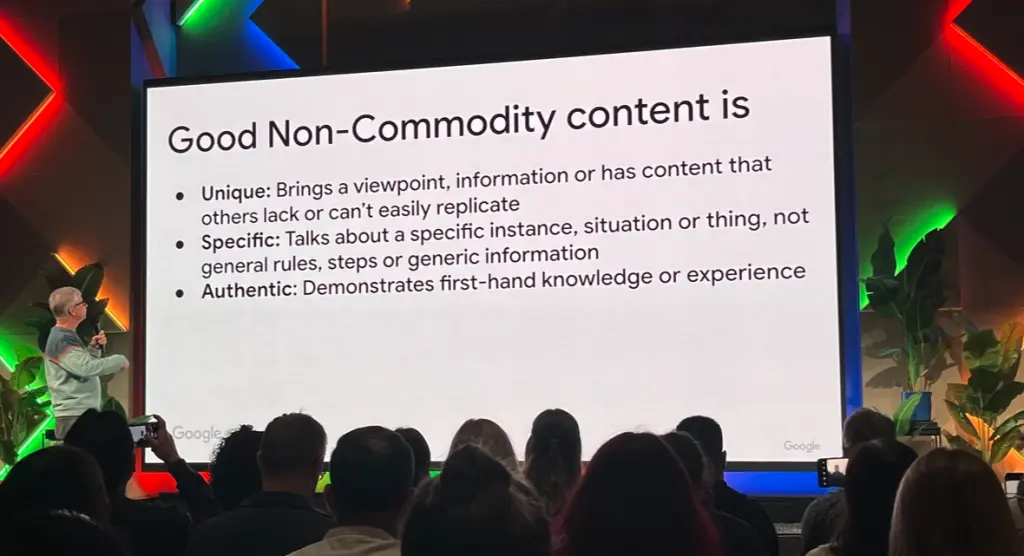
At Google Search Central Live Toronto in April 2026, Google’s Danny Sullivan drew a line that every content marketer needs to understand. On one side: commodity content — the kind of generic, interchangeable advice that floods the internet. On the other: non-commodity content — experience-based, specific, and impossible to replicate without genuine expertise. With AI Overviews now appearing on 48% of all searches, Sullivan’s message was direct: non-commodity content is no longer just preferred. It’s the only type that earns AI citations, wins organic visibility, and builds lasting authority.
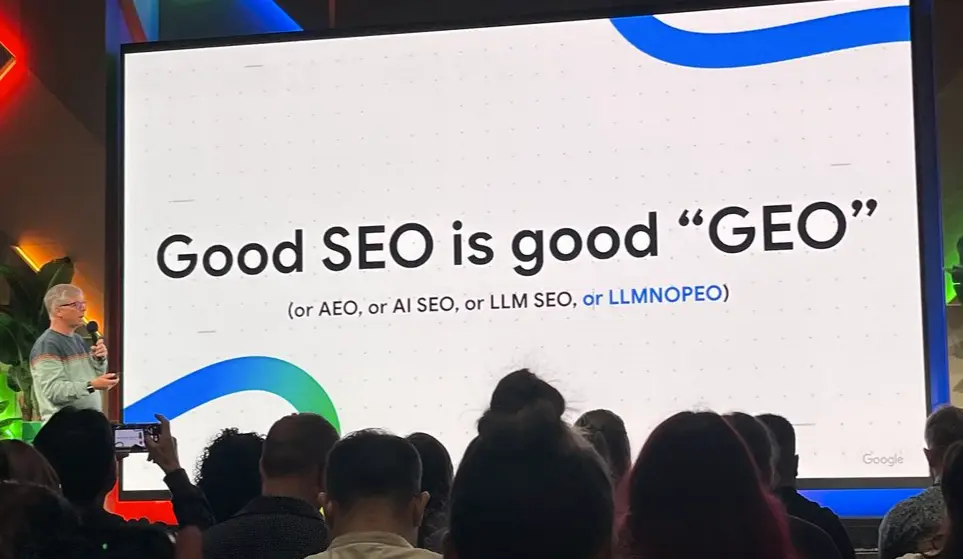
The good news? The same approach that wins in AI search also wins in traditional SEO. There’s no split strategy to manage. There’s just one standard — and it’s a higher one than most content teams are currently meeting.
Quick Summary
Danny Sullivan of Google defined two content types at Google Search Central Live Toronto, April 2026: commodity and non-commodity
Commodity content = generic advice anyone could write without real-world experience
Non-commodity content = experience-based specificity from real clients, real decisions, and real results
AI Overviews now appear on 48% of all searches — generic content is disappearing into AI summaries
Google’s four tips for AI search success align with traditional SEO — no split strategy needed
The ‘bland tax’ is real: AI systems are actively filtering out sameness
What Is the Difference Between Commodity and Non-Commodity Content?
Commodity content is generic, interchangeable advice that any writer — or any AI — could produce without real-world experience. Non-commodity content is the opposite: it is experience-based and specific, documenting real client situations, real decisions, and real outcomes that are impossible to replicate without genuine practitioner knowledge. Google now treats this distinction as a primary quality signal for AI search visibility.
Commodity Content — What It Looks Like
Commodity content is the article that could have come from anywhere. It mirrors every other piece on the same topic, relies on generic advice, and offers no original perspective. Danny Sullivan illustrated this at the Toronto event with examples that will feel uncomfortably familiar to most marketers:
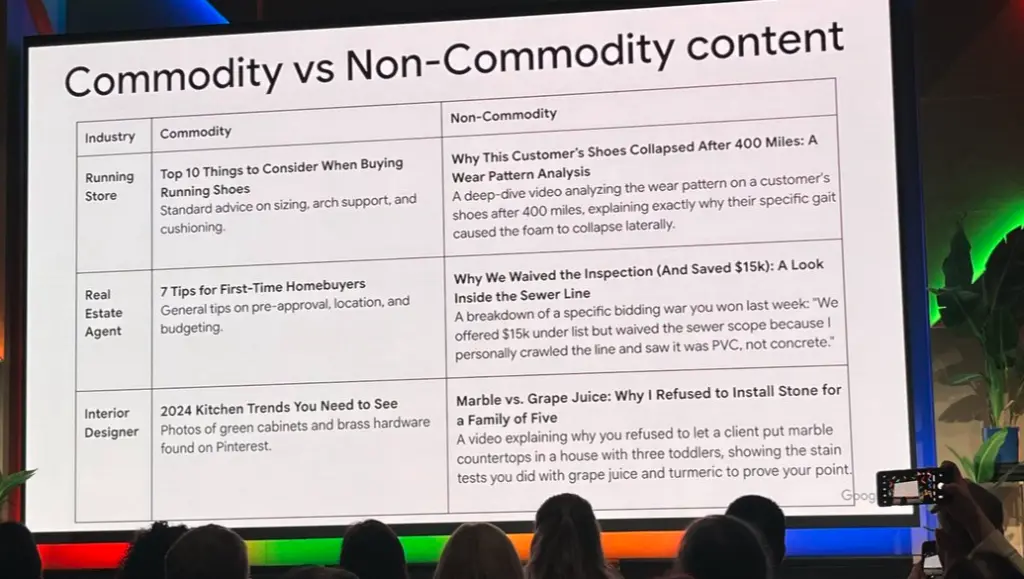
“Top 10 Things to Consider When Buying Running Shoes” — standard advice on sizing, arch support, and cushioning
“7 Tips for First-Time Homebuyers” — general guidance on pre-approval, location, and budgeting
“2024 Kitchen Trends You Need to See” — photos of green cabinets and brass hardware found on Pinterest
What these have in common: zero first-hand perspective, no real examples, and no original data. They could have been written by anyone — or, increasingly, generated by any AI tool given a 30-second brief. That is precisely the problem. The cost of producing commodity content has fallen to near-zero, which is exactly why Google is raising the bar for what actually earns visibility.
Non-Commodity Content — What Sets It Apart
Non-commodity content is specific in ways that only a genuine practitioner can be. Sullivan’s examples from the Toronto slides illustrate the contrast sharply:
A running store analyzing the wear pattern on a customer’s shoes after 400 miles, explaining exactly why their specific gait caused the foam to collapse laterally
A real estate agent detailing how they waived the inspection on a specific bidding war because they personally crawled the sewer line and confirmed it was PVC, not concrete
An interior designer explaining why they refused to install marble countertops for a family of five with three toddlers — showing the actual grape juice and turmeric stain tests they ran to prove the point
None of those could be written by an AI working from research alone. Each one reflects a decision made by a real practitioner, in a real situation, with real stakes. That irreplaceable specificity is exactly what Google’s AI systems are now rewarding.
Why Google Is Prioritizing Non-Commodity Content in AI Search
AI Overviews now appear on 48% of all tracked searches — up from 31% just one year ago. As AI systems increasingly synthesize answers directly from web content, generic content has nothing unique to offer. AI extracts answer passages from pages it can cite. If a page contains only the same information as a thousand others, there is no distinctive passage to pull. Non-commodity content, with its specific examples and first-hand insights, gives AI systems something worth citing.
The Scale of AI Search in 2026
The shift is happening faster than most marketers realize. AI Overviews appeared on approximately 31% of tracked queries in February 2025. By February 2026, that figure had reached 48% — a 58% increase year over year (BrightEdge). At peak periods, AI Overviews appeared on more than half of all tracked queries.
48% of all tracked searches now trigger a Google AI Overview — up from 31% just one year ago (BrightEdge, February 2026)
This matters because AI Overviews change the competitive dynamic entirely. Traditional organic results sit below an AI-generated summary. Users who get their answer from the summary never scroll to the blue links. For content that is purely informational and entirely generic, that means one outcome: invisibility.
The Bland Tax — What Happens to Generic Content Now
Search industry experts have given this dynamic a name: the “bland tax.” AI models are actively conditioning themselves to filter out sameness. When a large language model can instantly synthesize the top 10 results on any topic into one coherent summary, publishing an 11th version of the same advice adds zero value — to the user and to the AI system deciding what to cite.
The economics have inverted. In the ten-blue-links era, commodity content still drove traffic. It ranked for generic queries, attracted backlinks, and filled the top of the funnel. In AI search, commodity content collapses into a single summarized paragraph the user never clicks through to read. Your traffic disappears into the summary. The page that contributed to that summary gets no citation, no click, and no credit.
“The bland tax is real: AI models are actively conditioning themselves to ignore sameness. When an AI can instantly synthesize the top 10 results into one summary, publishing an 11th version of the same advice adds zero value.”
The Performance Stakes — What the Data Shows
The impact is already measurable. Following the March 2026 core update, search visibility data showed a clear divide between content types:
Pages featuring proprietary data or first-hand case studies: 15–25% visibility gains
Templated or rewritten content: 30–50% visibility drops
Generic AI content farms: up to 80% visibility loss
The pattern is consistent with what Google has been signaling for over a year. In May 2025, Google’s John Mueller stated: “Focus on making unique, non-commodity content that visitors from Search and your own readers will find helpful and satisfying.” Sullivan’s Toronto presentation was not a new direction — it was confirmation of a standard Google has been applying for more than 12 months.
What Google Actually Said — The Four Tips for AI Search Success
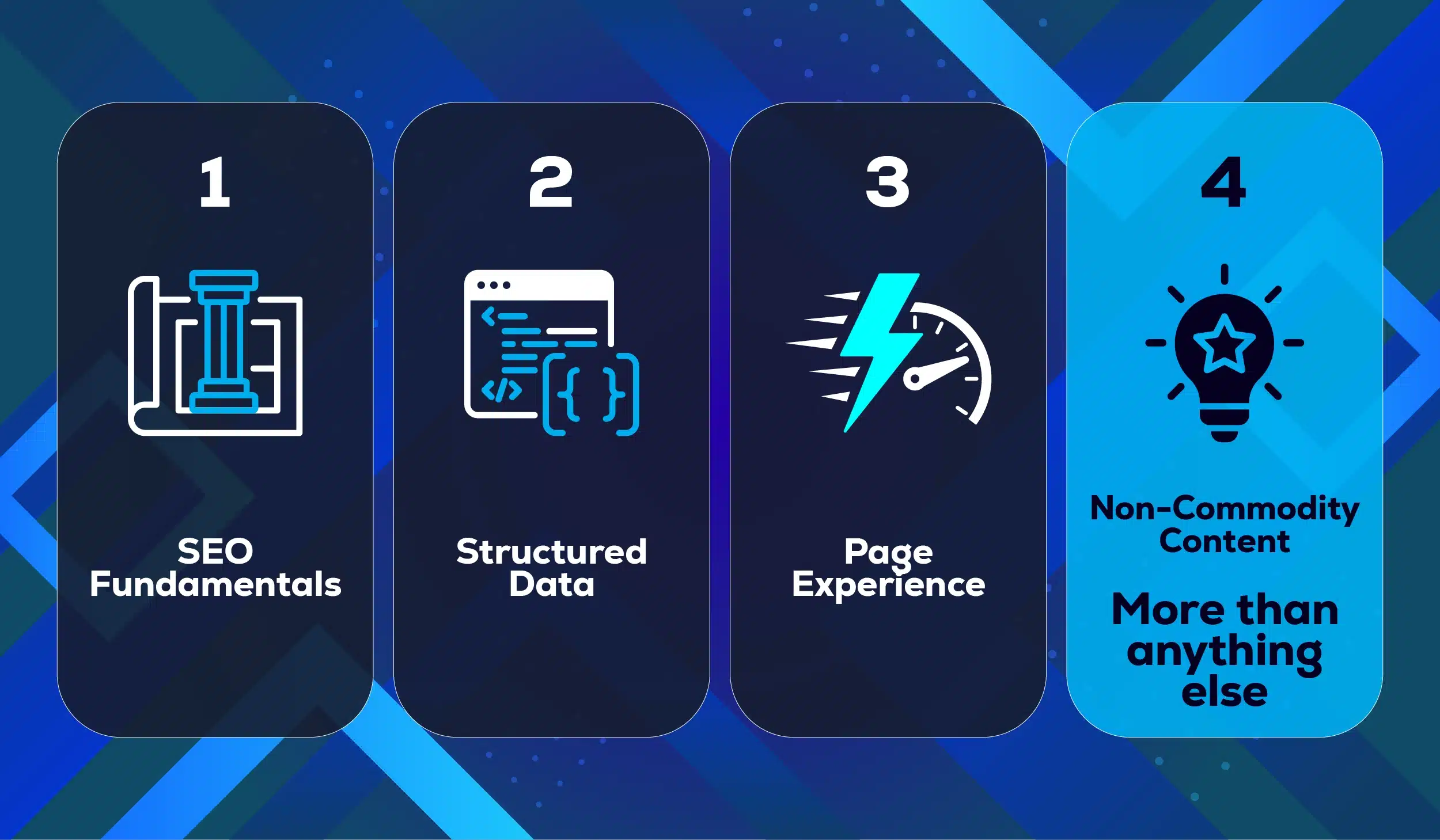
Sullivan’s presentation at Google Search Central Live Toronto outlined four specific tips for success in AI search. Notably, he confirmed that all four also align with traditional SEO — meaning there is no need to choose between optimizing for AI and optimizing for organic:
Follow SEO fundamentals. Technical health, keyword research, internal linking, and meta optimization remain the foundation.
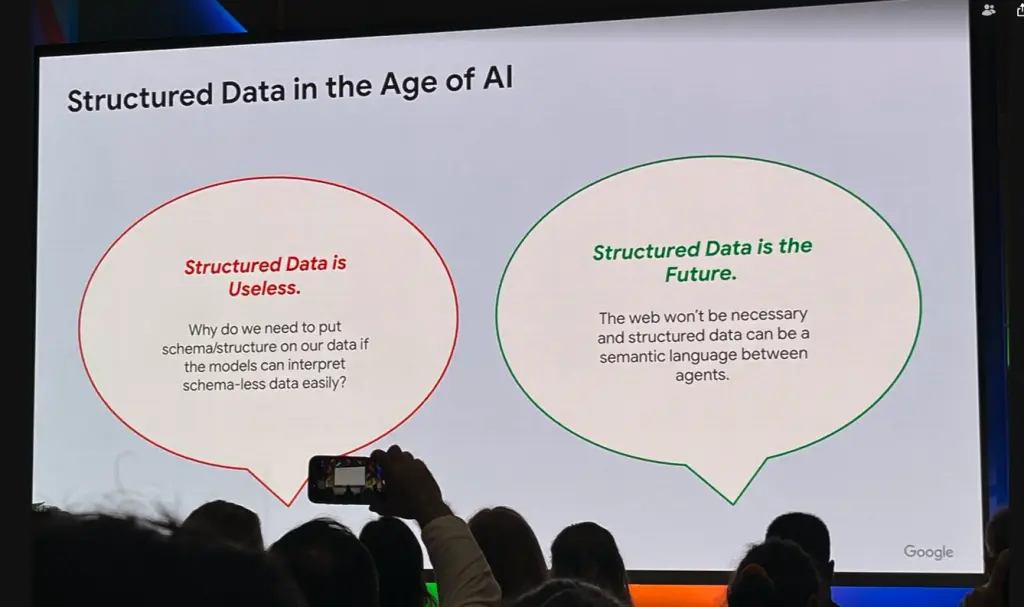
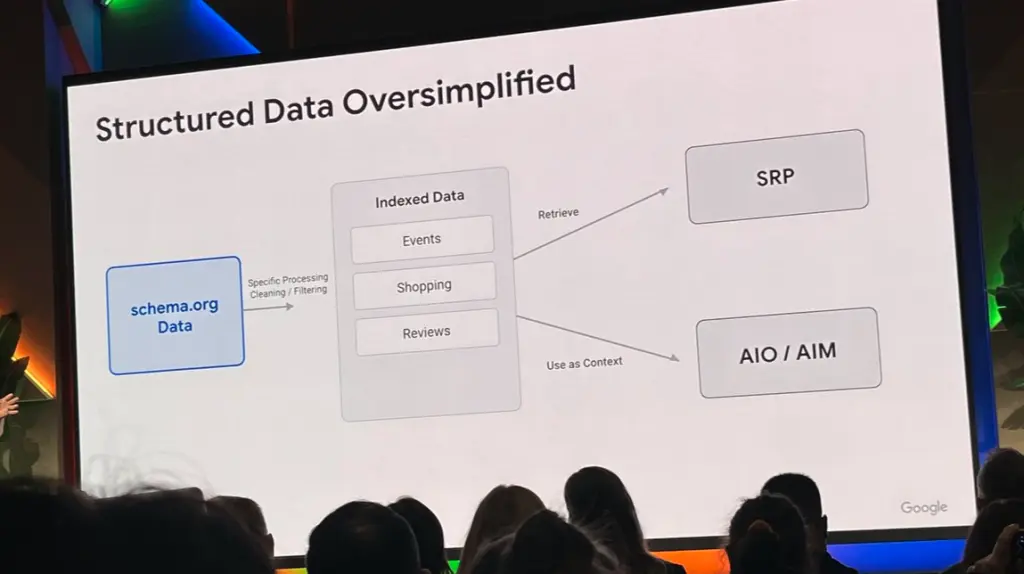
Make use of structured data. Schema markup helps AI systems understand and extract your content accurately.
Have a great page experience. Speed, mobile optimization, and Core Web Vitals are trust signals for both users and AI systems.
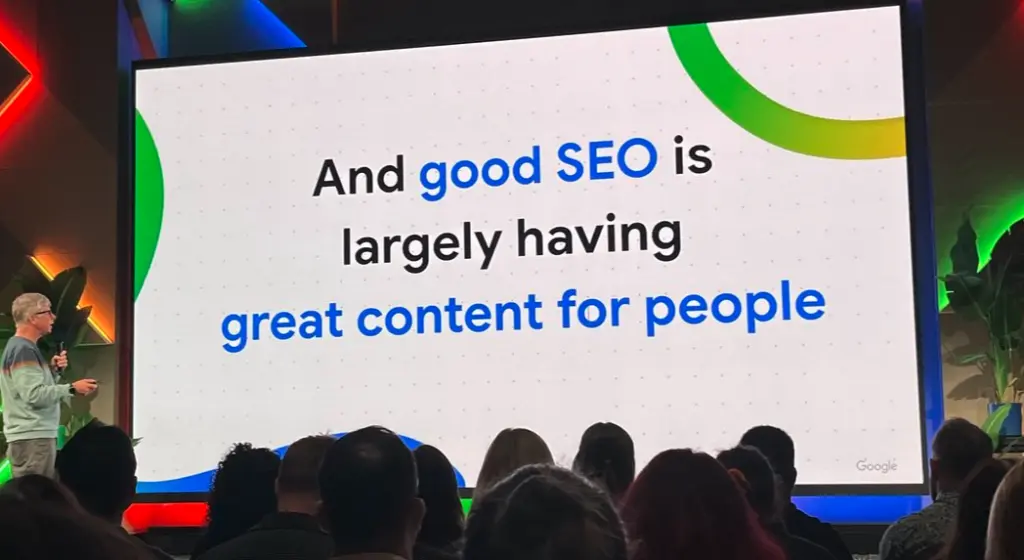
Create unique, authentic, non-commodity content. Sullivan’s emphasis: “more than anything else.” This is the differentiator that the other three tips cannot compensate for.
An Important Nuance — Google Is Not Banning Commodity Content
Google has not declared commodity content off-limits. Sullivan acknowledged at the Toronto event that commodity content is sometimes expected and appropriate for certain audiences. The issue is competitive viability, not punitive policy. Commodity content is a weak play for earning AI citations or search clicks in 2026 — not because Google penalizes it explicitly, but because non-commodity content consistently outperforms it for visibility, citation, and engagement.
What Google’s Actual Position Says
It’s worth being precise about what Sullivan said — and what he did not say. Google is not issuing a penalty for every listicle or how-to guide on the internet. The commodity/non-commodity framework describes a competitive reality, not a spam policy.
John Mueller reinforced this nuance in May 2025, framing the goal as creating content that “visitors from Search and your own readers will find helpful and satisfying.” That standard can be met by different content types. A well-written definition article, a clear FAQ, or a concise step-by-step guide can still serve a user well and rank accordingly.
The strategic risk is not producing commodity content at all. The risk is building your primary content strategy on it — expecting it to drive traffic, earn citations, and establish authority in a search environment that is actively rewarding something better.
You Can Create Both — But Know What Each One Does
Commodity and non-commodity content serve different functions, and a mature content strategy uses both intentionally:
Commodity formats: product descriptions, basic definitions, FAQs, standard how-to guides. Functional, necessary, not your authority-builders.
Non-commodity content: pillar pages, cluster articles, analysis pieces, case studies, and any content where you want AI citations, organic authority, and long-term traffic compounding.
The danger is treating those two categories as interchangeable. They are not. Commodity content fills gaps. Non-commodity content builds the business.
How to Audit Your Content for Commodity vs. Non-Commodity Status
A simple three-question audit identifies whether existing content is commodity or non-commodity. Ask: Could any agency or AI tool have produced this without real-world experience? Does this document a real situation, decision, or result? Is there a practitioner perspective here that cannot be found anywhere else? If the answer to all three is no, the content is commodity — and its visibility in AI search will reflect that.
Three Questions to Ask About Every Piece of Content
Run this test on your top 20 pages before investing in any new content production:
Could any other business in your industry — or any AI given a 30-second brief — have written this without real-world experience?
Does this document a real customer situation, a real business decision, or a real outcome with specific details only your team would know?
Is there a perspective here — from your team, your customers, or your operations — that cannot be replicated from research or aggregated sources alone?
If any business in your space with a similar brief and an AI writing tool could produce an identical piece, the page is commodity. That’s not a moral judgment — it’s a visibility forecast.
Warning Signs Your Content Library Is Commodity-Heavy
Statistics cited without context, original interpretation, or any perspective that couldn’t be found in the source itself
Listicles and tip articles with generic advice and no specific client examples
No named methodology, proprietary framework, or documented process
Articles that could appear on any competitor’s blog without the brand name being noticeable
Content produced entirely from desk research with no practitioner input
Pages stuck in “Crawled — Currently Not Indexed” status — Danny Sullivan confirmed at the Toronto event this is almost always a quality signal, not a technical error. Google crawled the content, evaluated it, and decided it wasn’t valuable enough to index. Commodity content is the most common reason.
What Non-Commodity Content Looks Like for Marketing Agencies
For a marketing agency, non-commodity content documents what actually happened — not what the textbook says should happen. It includes specific campaign decisions with named outcomes, real performance data tied to a defined strategy, and honest analysis of what worked and what did not. This type of content is not just better for AI citations. It is the only content that demonstrates genuine expertise to a prospective client who is evaluating whether to trust you with their budget.
The Human Layer That Creates Non-Commodity Content
Growth Conductor is built on a different model than a traditional agency. ConductorIQ — our proprietary AI infrastructure — processes campaign data, identifies patterns, and surfaces insights at a speed and scale no human team can match alone. But ConductorIQ does not write strategy. It does not make judgment calls. It does not know what happened in the room when a client pivoted their entire Q3 plan two weeks before launch. That layer is human — and it is irreplaceable. Our content is non-commodity because it is built on real decisions, real client data, and real outcomes that ConductorIQ surfaces and human strategists interpret. That’s the combination that produces content AI search systems cite and prospective clients trust. See how our content marketing strategy is built on this model.
Non-commodity content for a marketing agency is not about writing longer articles or adding more statistics. It is about documenting decisions. Real campaign choices, real budget allocations, real optimizations — with the context that explains why those decisions were made.
Five Sources of Non-Commodity Content for Agencies
Proprietary data: performance benchmarks, campaign results, and trend analysis from your own client base
Named case studies: specific numbers, timelines, and decisions — not anonymized summaries
Original tests and teardowns: real campaign experiments with documented hypotheses and results
Counterintuitive positions: expert stances you can defend with evidence — not consensus opinion repackaged
Behind-the-scenes process: methodology documentation that only practitioners with real operational experience could produce
Examples of Non-Commodity Content in Digital Marketing
To make this concrete, here are the types of articles that qualify as non-commodity for a growth marketing agency:
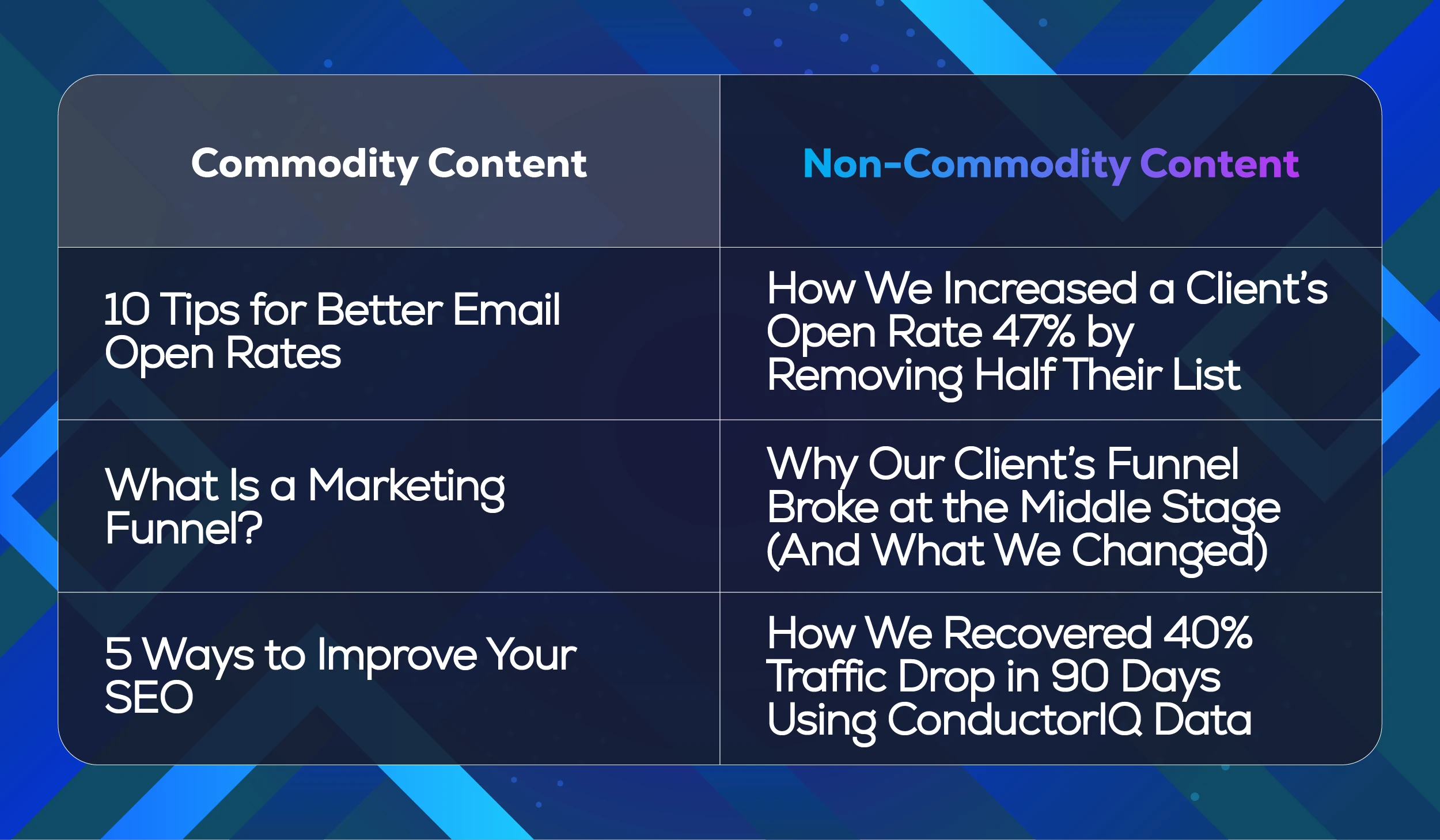
“Why We Paused a Client’s Top-Performing Campaign Mid-Month — And What Happened Next”
“Our 90-Day SEO Recovery Plan After a Core Update: What Worked, What Didn’t, and What We Changed”
“How We Diagnosed a 40% Traffic Drop in 48 Hours Using ConductorIQ”
These are not hypotheticals. They reflect the kind of specific, decision-based content that no AI can generate from training data alone — because the situations, the clients, and the outcomes are real.
Structured Data, Page Experience, and SEO Fundamentals — Why the Four Tips Work Together
Non-commodity content is the foundation, but it works best when paired with the other three elements of Google’s AI search framework. Strong SEO fundamentals ensure the content is discoverable. Structured data gives AI systems a clear map for extracting and citing it. A great page experience signals trust to both users and algorithms. Together, the four tips create a compounding advantage — non-commodity content that is technically optimized and properly structured earns citations at significantly higher rates than strong content alone.
SEO Fundamentals Still Matter
Google confirmed at the Toronto event what practitioners already know: the fundamentals have not been replaced, they have been augmented. Keyword research, internal linking, meta title and description optimization, and technical site health remain the baseline. Without them, even exceptional non-commodity content is harder to surface. Our SEO services are built on this integrated approach — technical excellence as the foundation, non-commodity content as the authority-builder.
Schema markup is not optional in an AI search environment. Research shows that properly implemented schema is associated with 73% higher AIO selection rates. For a blog article, that means BlogPosting schema at minimum, FAQPage schema for any FAQ section, and BreadcrumbList schema for category structure.
The logic is straightforward: AI systems need to parse and extract content quickly across millions of pages. Structured data provides the labeling that makes your content machine-readable. Non-commodity content gives AI systems something worth extracting. The combination is what earns citations at scale.
Page Experience as a Trust Signal
Core Web Vitals, mobile optimization, and page speed are trust signals for both human users and AI systems. A slow, poorly structured page with excellent content will lose to a fast, well-structured page with equally excellent content. Page experience is not a differentiator — it is a threshold. Falling below it limits everything else you do well.
The measurable performance outcomes you are working toward in paid media are equally dependent on the underlying technical infrastructure. The same principle applies to content: execution quality determines whether strategy translates into results.
Frequently Asked Questions About Non-Commodity Content and AI Search
Non-commodity content is content that reflects genuine, first-hand expertise and cannot be replicated without real-world experience. It documents specific situations, decisions, and outcomes from actual practice rather than synthesizing general advice from existing sources. In SEO, non-commodity content earns higher AI citation rates, stronger E-E-A-T signals, and more durable organic rankings than generic content covering the same topic.
The bland tax is the visibility penalty that generic content now pays in AI-powered search. When AI systems can synthesize the ten most popular articles on any topic into a single summary, publishing an eleventh version of the same information adds no value to the user — and earns no citation from the AI. The content disappears into the summary without attribution. Industry experts coined the term to describe how AI models are actively filtering out sameness in favor of specific, experience-based sources.
AI-generated content is a production method, not a quality category. Content produced with AI tools can be non-commodity if it incorporates genuine practitioner expertise, real client data, and original analysis. Content produced with AI tools is commodity if it simply synthesizes existing public information without adding first-hand perspective. Google has been clear: the issue is not whether AI helped create the content, but whether the content is genuinely useful and original. AI that assists human strategy produces non-commodity content. AI that replaces human judgment produces commodity content.
Google AI Overviews cite sources that contain specific, self-contained answer passages. Non-commodity content — with its practitioner-specific examples and documented outcomes — is more likely to contain the kind of distinctive, citable passage that AI systems extract. Generic content that mirrors thousands of other pages offers no unique passage to cite. With AI Overviews appearing on 48% of all searches, the citation gap between commodity and non-commodity content is directly affecting traffic and visibility at scale.
Google does not impose an explicit penalty for commodity content. Danny Sullivan acknowledged at Google Search Central Live Toronto that commodity content is sometimes expected and appropriate. The competitive disadvantage is structural rather than punitive: non-commodity content consistently earns better AI citations, stronger E-E-A-T signals, and more durable rankings. Building a primary traffic strategy on commodity content in 2026 means competing on a rapidly compressing playing field.
Any business with genuine operational experience can create non-commodity content — which means virtually every business. A plumber who documents why a specific pipe configuration fails in older homes. A nutritionist who shares what actually changed when a patient switched from one approach to another. A marketing agency that shows real campaign data from a real client challenge. Non-commodity content does not require a research department. It requires a willingness to document what actually happens in practice, not what the standard advice says should happen.
Start with an audit of your top 20 pages using the three-question test: Could any AI or competitor produce this without real experience? Does it document a real situation or decision? Is there a perspective here that cannot be replicated? For pages that fail the test, identify the real practitioner knowledge behind the topic — campaign decisions, client outcomes, methodology details — and rebuild the content around that. For new content, build the brief around a real situation before you write a single word.
Key Takeaways
Google has drawn a clear line. Danny Sullivan of Google defined the commodity vs. non-commodity content distinction at Google Search Central Live Toronto, April 2026 — and confirmed it applies to both AI search and traditional SEO.
Non-commodity content is experience-based. It reflects real clients, real decisions, and real outcomes that no AI can generate from training data alone.
The stakes are significant. With AI Overviews on 48% of all searches, pages featuring first-hand expertise are seeing 15–25% visibility gains while generic content is dropping 30–80%.
The bland tax is real. AI systems are filtering out sameness. Commodity content collapses into AI summaries without attribution or clicks.
Google is not banning commodity content. The risk is strategic, not punitive. Building a primary traffic strategy on commodity content is a compounding competitive disadvantage.
The four tips work together. Non-commodity content + SEO fundamentals + structured data + page experience = the highest AI citation probability available.
Human judgment is the non-commodity layer. ConductorIQ handles data and pattern recognition at scale. Human strategists interpret what it surfaces and make the decisions that become non-commodity content. That combination is what AI search systems cite — and what clients hire for.
Most agencies produce content. Growth Conductor’s Content Engine produces non-commodity content — built on ConductorIQ data, shaped by human strategy, and optimized for both AI citations and organic authority. If your content library isn’t earning citations or compounding traffic, that’s the gap we close.