



Every lean marketing team feels the same squeeze right now. You are expected to publish more, rank higher, and sound more expert than ever, usually with a small team and no dedicated content operations staff. AI looks like the obvious fix. The problem is that most teams bolt AI onto their process, generate a pile of generic drafts, and watch quality and rankings slide.
A real AI content strategy is not a tool you switch on. It is a disciplined process that decides where AI adds speed, where human expertise is non-negotiable, and how every piece gets checked before it goes live. This article walks through the exact process we use at Growth Conductor, and it is honest about the part most guides skip: doing this well, on every piece, week after week, is the hard part.
By the end you will understand what a rigorous AI content workflow looks like, which work AI should and should not touch, and how to keep Google’s E-E-A-T standards intact while you scale. If running that process in-house sounds like a lot, that is the point, and it is exactly what our Content Engine service is built to handle.
What Is an AI Content Strategy?
An AI content strategy is a defined system for using artificial intelligence to plan, produce, and optimize content while keeping human judgment in control of quality, accuracy, and brand voice. It sets clear rules for which tasks AI handles, which tasks require a human expert, and how output is reviewed before publishing.
It is not “let AI write everything and hit publish.” That approach floods your site with commodity content, the kind of generic advice anyone could generate in seconds, and it is precisely what Google’s helpful content systems are built to filter out.
For small and mid-size teams, a documented strategy matters more, not less. You do not have the headcount to waste hours editing weak drafts or to recover from a quality dip that tanks your organic traffic. A clear process is what lets a lean team move fast without cutting corners. It is also the foundation of AI content optimization, where you publish fewer, better pieces scored against real ranking signals instead of more content that was never checked.
AI content strategy vs. traditional content strategy
The goal does not change. You still need content that ranks, earns trust, and converts. What changes is the workflow and where your team spends its time. In a traditional process, a writer spends most of their hours on the blank page. In an AI-assisted process, that drafting time shrinks and human hours shift to the work that actually differentiates you: strategy, expertise, and editing.
Does Google Allow AI Content? Quality and Ethics First
Yes. Google allows AI-assisted content. Its guidance about AI-generated content is clear that it rewards helpful, people-first content regardless of how it is produced, and that it targets spammy, low-value content created mainly to manipulate rankings. Google does not care whether a human or a model typed the first draft. It cares whether the finished piece is genuinely useful.
This is where E-E-A-T comes in: Experience, Expertise, Authoritativeness, and Trust. The Experience signal is the one AI cannot fake. A model has never used your product, sat across from your client, or made the judgment call that saved a campaign. That first-hand experience, added by a human, is what separates content that earns citations from content that gets ignored.
Two practices protect your credibility. First, disclosure: be transparent about how you use AI, because trust is easier to keep than to rebuild. Second, human oversight, which is non-negotiable. Every piece needs a human who owns the facts, the point of view, and the final quality. That human layer, your team’s judgment and methodology, is the non-commodity content that AI cannot replicate.
The E-E-A-T test for AI-assisted content
Before anything AI touched goes live, ask: Does it include real experience or proprietary insight only we have? Are the facts and statistics verified? Does it sound like us? Would a knowledgeable reader find it genuinely useful? If the answer to any of those is no, it is not ready.
Which Content Types Benefit Most From AI?
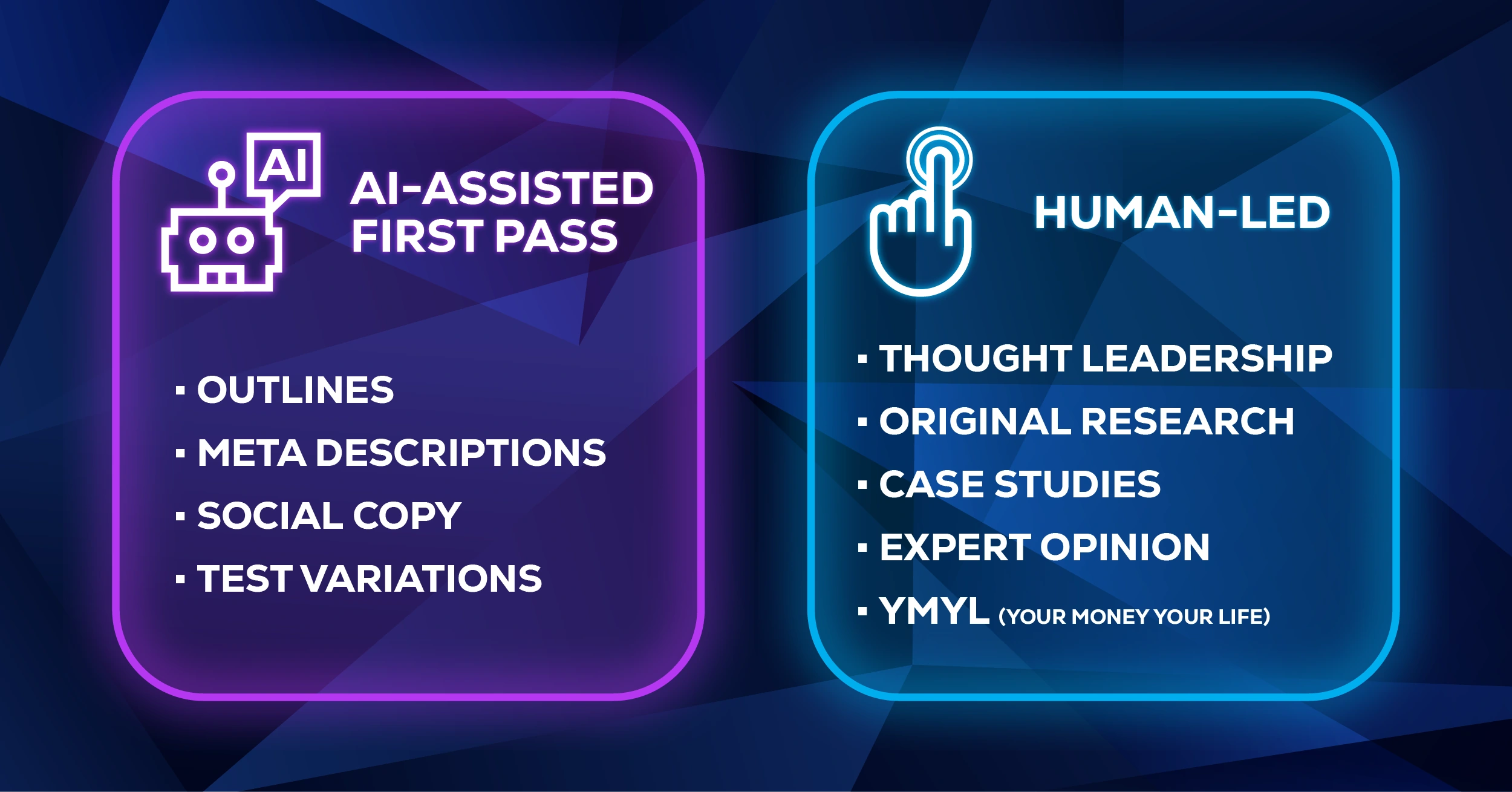
The fastest way to decide is to sort work by leverage versus judgment. AI is strong where the work is structured, repetitive, or derivative. Humans should lead where the work depends on experience or carries risk.
| AI-assisted first pass | Human-led |
|---|---|
| Blog outlines and first drafts | Thought leadership and original point of view |
| Meta descriptions and title variations | Original research, case studies, client results |
| Social copy and repurposing long-form | Sensitive or high-stakes (YMYL) topics |
| Multiple variations for testing | Anything representing a real expert opinion |
A simple AI-fit question
Ask one thing about any task: does it need lived experience or proprietary data? If yes, a human leads and AI assists. If it is structured, repetitive, or derivative, AI can take the first pass and a human refines. That single question routes most of your content correctly.
Inside the Process: Growth Conductor’s 5-Phase AI Content Workflow
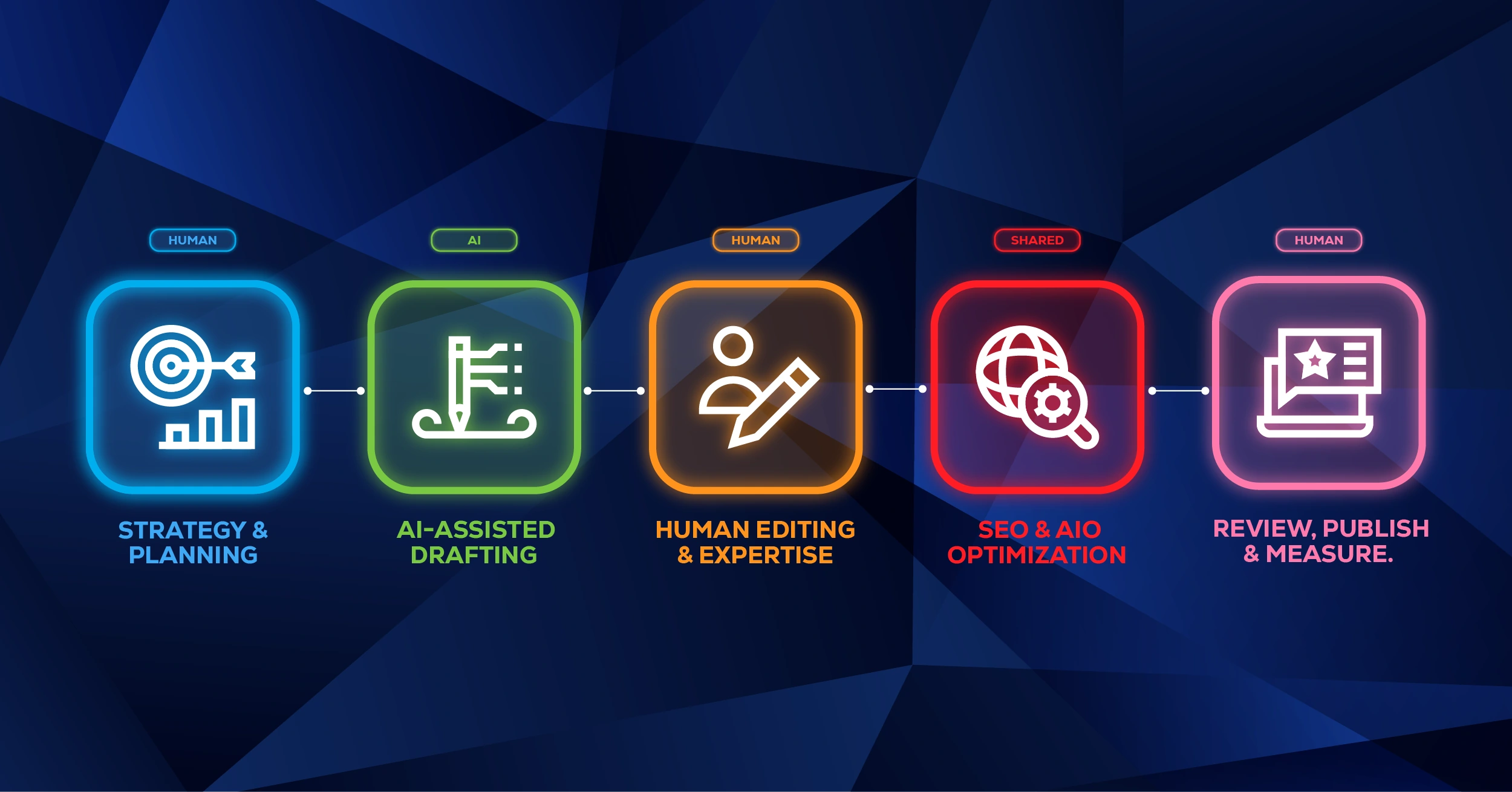
Here is the process we run. Notice that AI leads only one of the five phases. The rest is strategy and human expertise, which is why the output does not read like commodity content.
Phase 1: Strategy and Planning (human-led). We map keywords and topic clusters, define search intent and audience, and build the brief. Humans own the direction, because a great draft of the wrong thing is still the wrong thing.
Phase 2: AI-Assisted Drafting. We feed the brief, brand voice, and structure into the model to generate an outline and first draft. This is where the speed comes from, and the only phase where AI leads.
Phase 3: Human Editing and Expertise Injection. An editor adds real experience, examples, proprietary data, and point of view, then fact-checks every claim and removes anything the model may have invented. This is where a good draft becomes a credible one.
Phase 4: SEO and AIO Optimization. We score the piece against ranking signals, structure it so AI Overviews and answer engines can extract and cite it, add schema, and wire in semantic SEO and internal links. At Growth Conductor this is a 110-point scoring gate, and nothing publishes until it passes.
Phase 5: Review, Publish, and Measure. Final QA, disclosure where relevant, publish, then measure performance and feed what we learn back into the next brief.
Balancing Speed and Quality: When to Lean on AI vs. Humans
Speed and quality are not opposites if you put guardrails in the right places. Lean on AI for the first pass on structured work. Lean on humans for judgment, experience, and anything customer-facing. The case for AI on early drafts is real, and so are its limits, which is why generative AI for marketing copy works best with a strong brief, brand-voice inputs the model can follow, and a mandatory human edit before anything goes live.
Red-flag moments to slow down
Some pieces demand more human time no matter how busy you are: anything with data or claims, YMYL topics, and high-stakes customer-facing content. When you see those signals, slow the piece down. The cost of a fast mistake is always higher than the cost of a careful edit.
Before and After: An AI-Assisted Workflow in Action
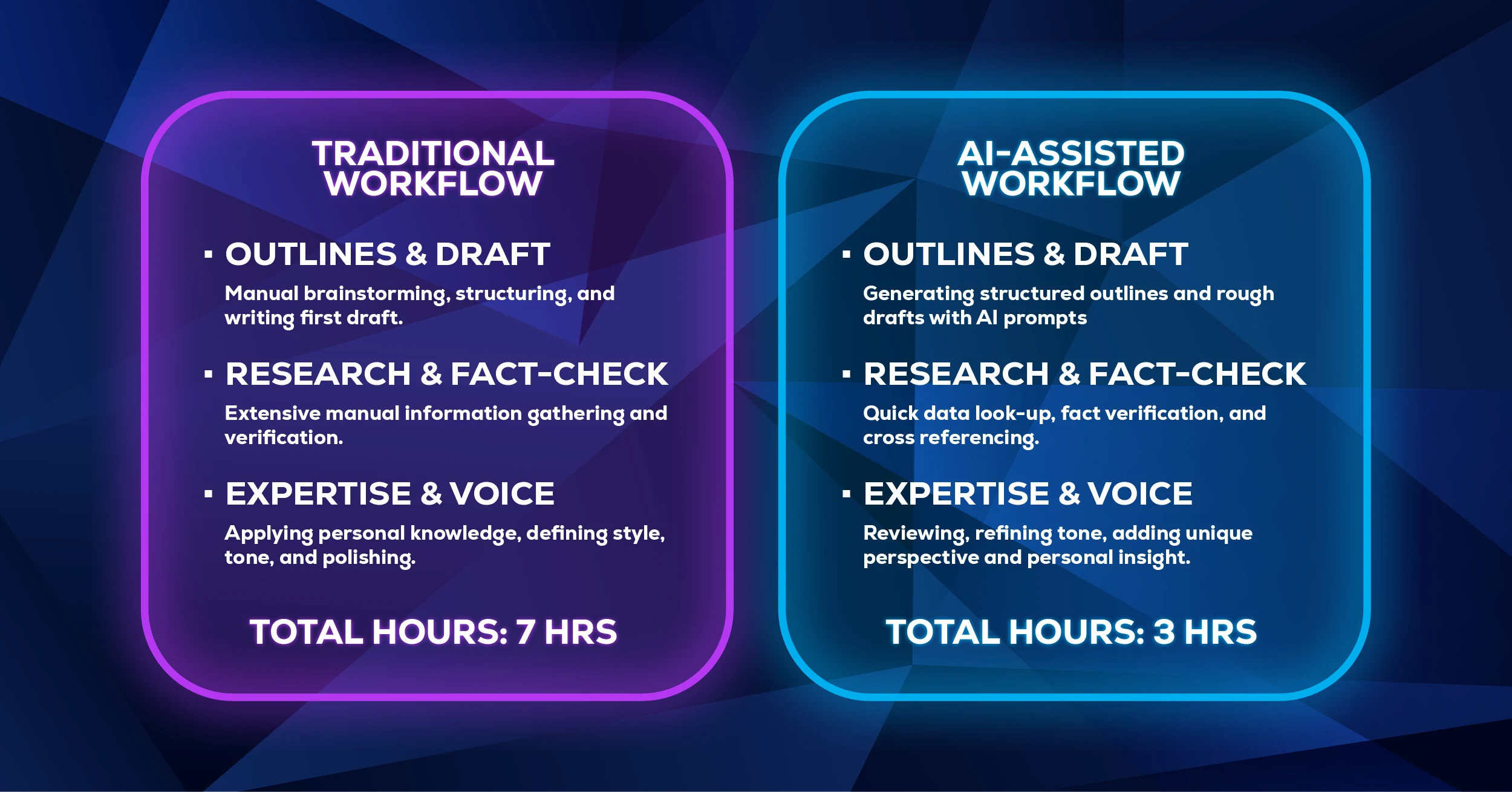
Consider one cluster blog post. In the traditional model a single writer researches, outlines, and drafts from scratch, roughly eight to twelve hours, and throughput is limited by that one person’s calendar. In the AI-assisted model the outline and first draft take minutes, and the writer’s time shifts to what matters: adding expertise, verifying facts, and sharpening the point of view.
| Step | Traditional | AI-assisted |
|---|---|---|
| Outline + first draft | 4-6 hours, writer | Minutes, AI |
| Research + fact-check | 2-3 hours, writer | 1-2 hours, editor |
| Expertise + voice | Bundled into drafting | Focused human pass |
| Total per post | 8-12 hours | A fraction, quality held or improved |
The corners are not cut. The quality bar is the same. What changed is that expensive human hours moved from the blank page to the work only a human can do.
Protecting Brand Voice at Scale
Voice is where scaled AI content usually falls apart. The fix is to treat your style guide as a reusable AI input: give the model real examples of how you write, prompt it with your voice, and keep an editorial gate so nothing publishes off-brand. Done consistently, your team’s judgment and methodology become the moat, the non-commodity layer a competitor cannot copy by buying the same tools.
How to Measure the ROI of AI-Assisted Content
Track the metrics that show whether faster is also better: production velocity, cost per piece, organic performance, AI Overview citations, and conversions. The content marketing statistics are clear that consistency and quality drive results, so watch one trap in particular. Velocity without quality control backfires; publishing more weak content erodes E-E-A-T and costs more than it earns. The teams that win measure output and quality together, never one without the other.
Why This Is Hard to Run In-House
Reading the process is easy. Running it every week is not. Doing this well requires strategy skill, prompt and brand-voice engineering, editorial expertise, an SEO and AIO scoring system, and the discipline to apply all of it to every piece. Lean teams tend to hit the same walls: no time for the human-editing phase, no scoring rubric, drifting brand voice, and a publishing pace that quietly trades quality for volume. The process is learnable. Running it consistently at scale is a staffing and systems problem, not a tool problem.
Build in-house vs. partner
You have two honest options. Hire and train a content operations function, buy the tools, build the scoring system, and manage it. Or bring in a team that already runs the process end to end. For most SMB and mid-market teams, the second path reaches consistent, high-quality output faster and without the overhead.
How Growth Conductor’s Content Engine Does This For You
Content Engine is the done-for-you version of the exact process above. It runs on proprietary AI infrastructure combined with human strategy, which is what makes Growth Conductor different from a traditional agency and different from a team just prompting a chatbot.
Every piece moves through AI-assisted drafting, expert human editing, internal and external link support, and our 110-point SEO and AIO scoring gate before it publishes. You get consistent, non-commodity content at scale, without hiring a content team and without sacrificing quality or brand voice. You get the outcome. We run the five phases.
If your team is under pressure to produce more without lowering the bar, that is exactly what Content Engine is built for. See Content Engine
Frequently Asked Questions
No. Google allows AI-assisted content and rewards helpful, people-first content regardless of how it is produced. It targets low-value content created only to game rankings.
Not for being AI-made. It penalizes unhelpful, spammy, or low-quality content. Human oversight and real expertise keep AI-assisted content on the right side of that line.
Let AI take the first pass on structured work like outlines, meta descriptions, and social copy. Keep humans in charge of experience-based work like thought leadership, case studies, and expert opinion.
Google does not require a label, but transparency protects trust. Disclosure is a brand-credibility decision as much as a compliance one.
Yes, and they may benefit the most, as long as they use a defined process with human oversight instead of publishing unedited AI output.
The Bottom Line
AI content done right is a disciplined process, and human judgment is the differentiator AI cannot replicate. The real question is not whether to use AI. It is whether to run this rigor yourself or hand it to a team built for it. If you would rather have the output than the operation, that is what Content Engine delivers.