


The Competitive Gap Between Small and Large Agencies
The structure of marketing agencies is changing.
As outlined in our perspective on the future of marketing agencies, AI and automation are reshaping how agencies create leverage, deliver performance, and design operating models.
For years, large agencies held a structural advantage. More headcount. More departments. More enterprise tools. More internal infrastructure. If you needed paid media, analytics, CRO, content, SEO, and data modeling, a large agency appeared safer.
That assumption is now outdated.
AI is compressing the advantage curve.
Technological adoption has historically increased productivity across firms of all sizes. Research published by the National Bureau of Economic Research on technology and productivity shows that access to digital tools can reduce performance gaps in organizations by increasing operational efficiency.
Scale is no longer reserved for the biggest payroll.
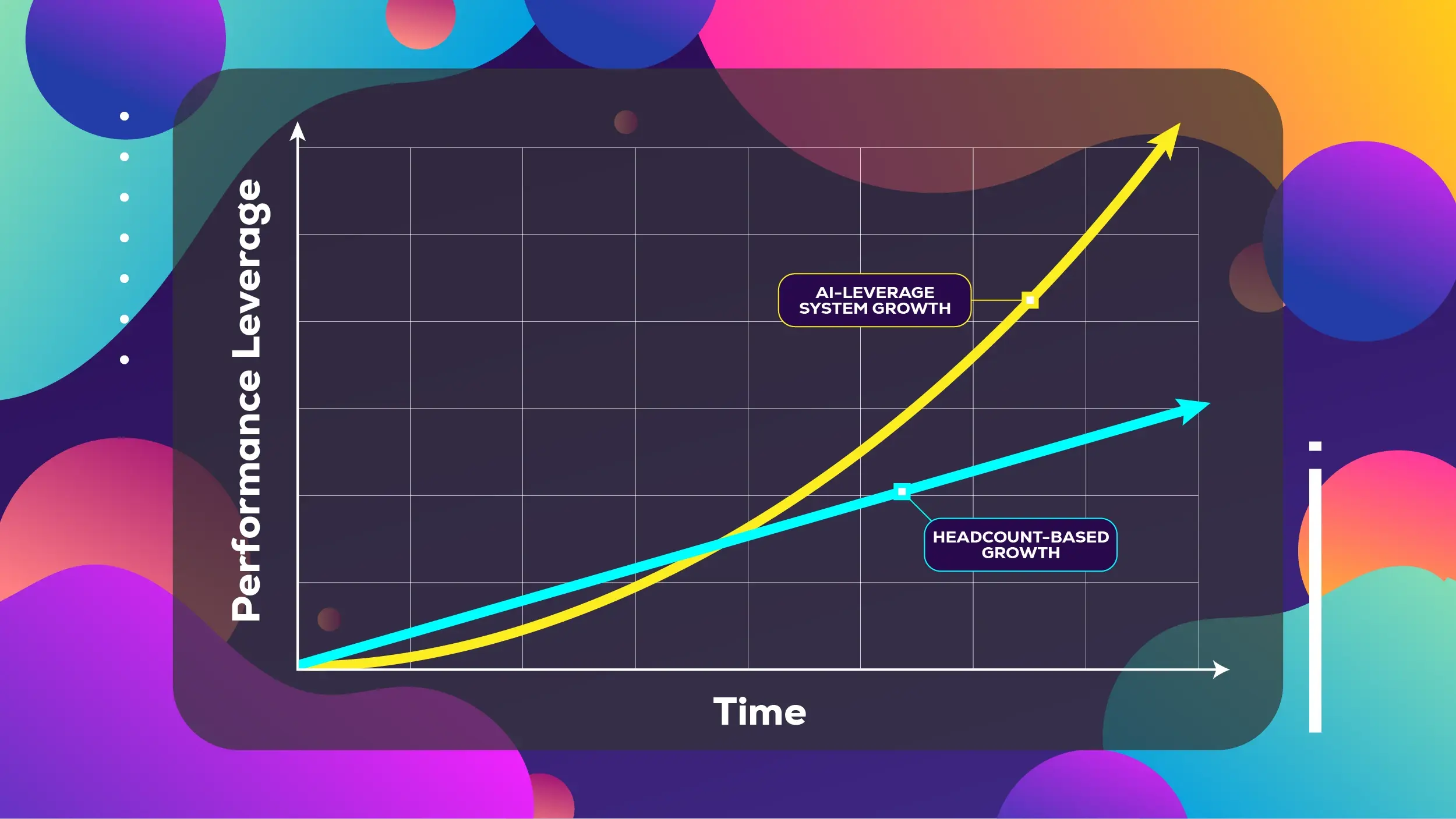
AI lowers the cost of execution. It lowers the cost of analysis. It lowers the cost of iteration. That shifts competitive leverage away from raw size and toward operational intelligence.
For companies evaluating agency partners, the better question is no longer “How large is the team?” It is “How intelligently is the system built?”
What AI Actually Does for Small Agencies
Before making bold claims, clarity matters.
Definition (AI Overview–Ready): AI in small agencies means using machine learning and automation tools to execute tasks faster, analyze data more efficiently, and scale operations — while humans retain control over positioning, decision-making, and strategic direction.
AI does not replace strategic thinking. It accelerates execution inside a defined framework.
Small agencies gain leverage in measurable ways:
- Media buying optimization and budget reallocation
- Predictive audience targeting
- Reporting automation and insight surfacing
- Content drafting acceleration
- Cross-channel data consolidation
When integrated properly, AI allows a small team to produce the output capacity of a much larger one.
Paid media optimization becomes more dynamic when automation is paired with strategic oversight. This is where integrated performance marketing services shift from manual management to system-level orchestration.
The same principle applies to content execution. AI can increase production speed, but positioning, narrative architecture, and conversion structure require experience and refinement. That is why structured content marketing services outperform volume-driven approaches.
AI increases output. Strategy determines results.
The Strategic Risk: When AI Makes Agencies Look the Same
There is a hidden danger in widespread automation.
If every agency uses the same AI tools, relies on similar prompts, and structures reports identically, differentiation disappears.
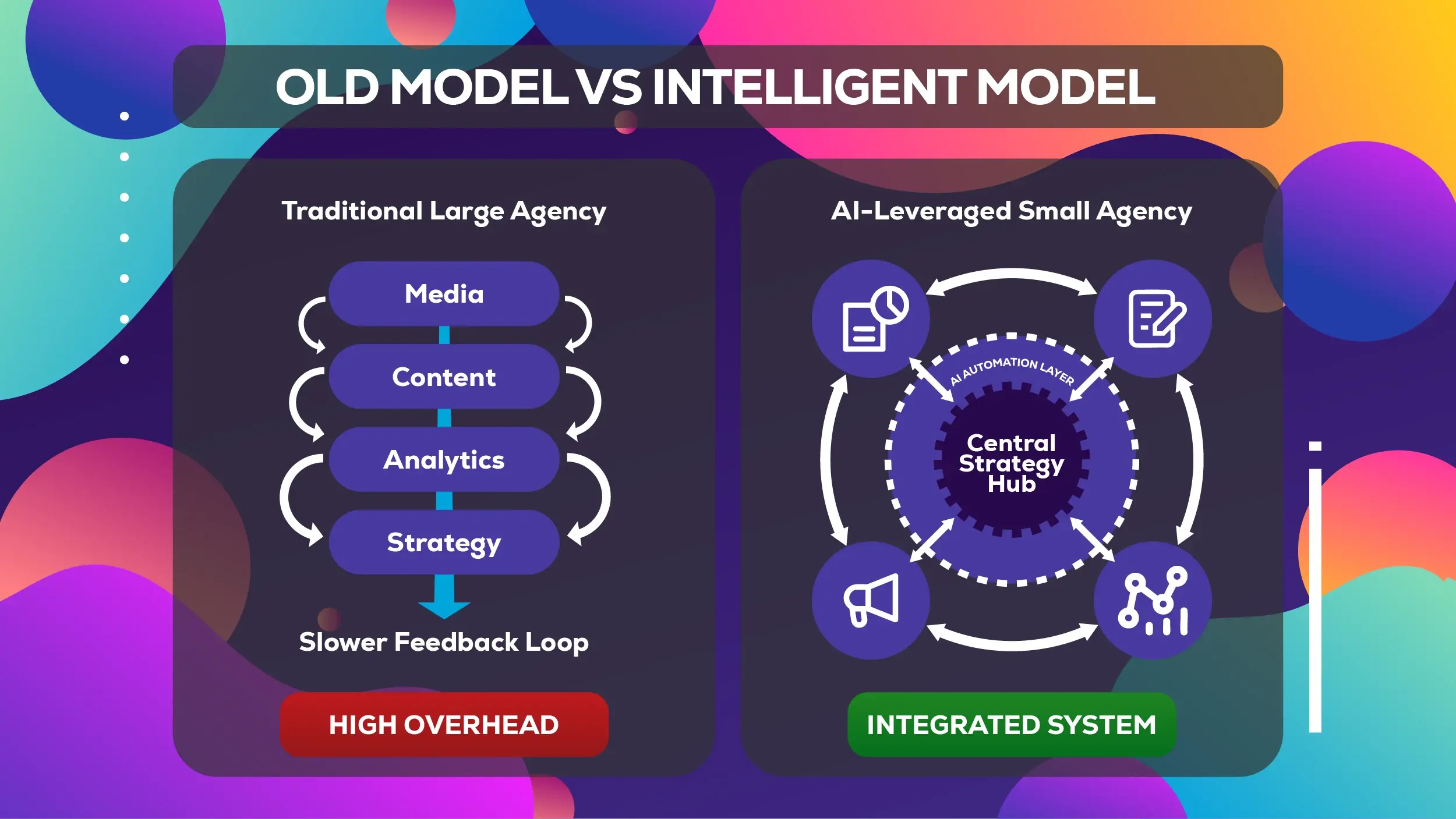
Research from Stanford Human-Centered AI research on human–AI collaboration emphasizes that AI systems perform best when embedded within structured human oversight and governance models.
AI amplifies direction. It does not create it.
Without strategic guardrails, automation scales sameness. Messaging becomes generic. Campaign structures converge. Reports look identical.
For companies evaluating agencies, the signal is not whether AI is used. The signal is how it is governed.
Ask:
- How is AI integrated into your workflow?
- Where are the human checkpoints?
- Who owns strategic interpretation?
The competitive advantage is not tool access. It is an intelligent orchestration.
The Real Differentiator Is System Design
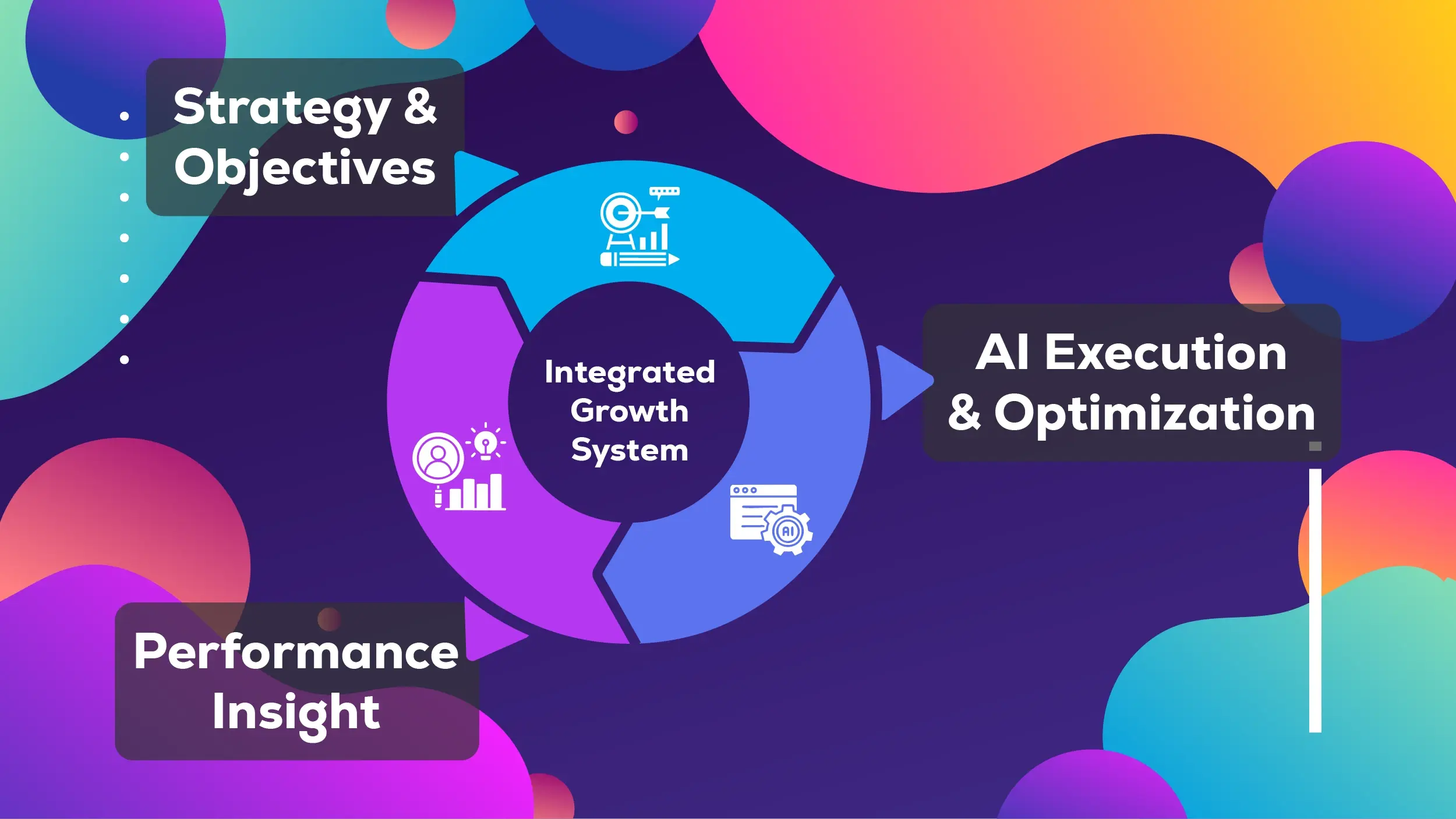
Small agencies often possess a structural advantage that larger firms struggle to maintain: integration.
Large agencies commonly operate in departmental silos. Media teams optimize performance. Content teams create assets. Analytics teams report data. Strategy lives somewhere in between.
Smaller, AI-enabled agencies can operate as unified systems.
Research from the MIT Center for Information Systems Research findings on digital operating models shows that competitive advantage increasingly stems from integrated digital operating models rather than isolated technology adoption.
In practice, this means:
Media insights inform messaging adjustments.
Content performance informs targeting refinement.
CRM data informs retargeting architecture.
Analytics informs narrative direction.
AI connects the signals. Humans interpret and act.
This closed-loop system becomes a multiplier.
The agencies that win are not the largest. They are the most aligned.
The Small Agency Advantage in an AI World
When supported by AI infrastructure, small agencies gain three decisive advantages: speed, cohesion, and accountability.
Speed matters. Decision cycles are shorter. Testing loops are tighter. Adjustments happen quickly because fewer layers slow implementation.
Cohesion matters. Messaging, media, analytics, and strategy remain connected from the start. AI enhances that connection by consolidating signals across channels.
Accountability matters. In smaller agencies, senior strategists are closer to execution. The same people interpreting performance data are responsible for refining campaigns. That proximity reduces distortion and increases ownership.
For companies selecting agency partners, this distinction is critical.
You are not hiring task executors. You are selecting a strategic operating partner.
A Practical Framework for Competing With AI
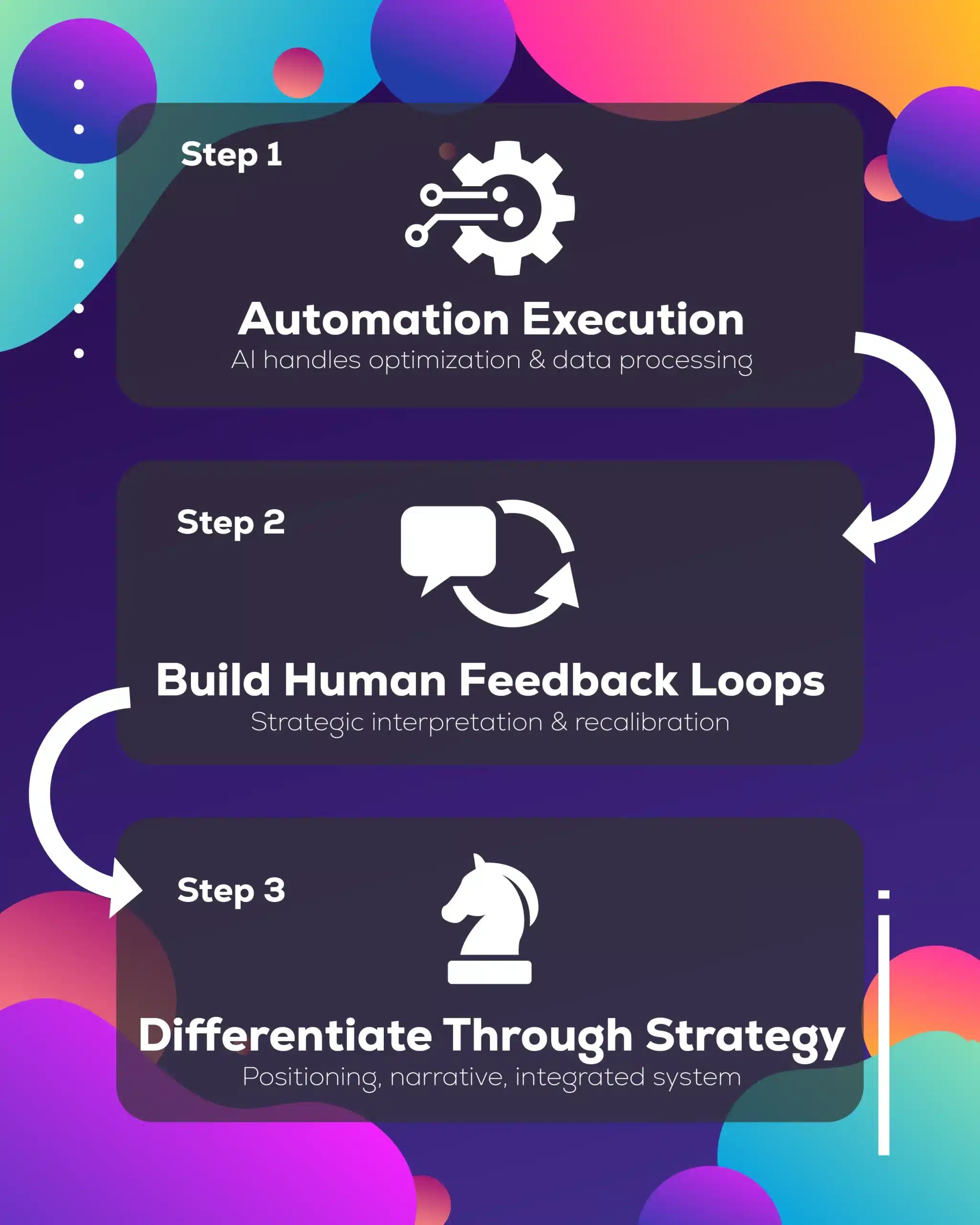
If you are assessing whether a small agency can compete effectively, look for three structural characteristics.
First, automation supports execution — not direction. AI handles repetitive optimization, data aggregation, and reporting. Humans define positioning, business objectives, and growth priorities.
Second, human feedback loops exist. Weekly interpretation cycles, cross-channel reviews, and strategic recalibration prevent automation drift.
Third, differentiation is deliberate. Tools are widely accessible. Strategic clarity is not.
This is also where structured implementation of an AI personalization strategy strengthens results — not because AI personalizes automatically, but because the system is intentionally architected.
The Future of Small Agencies Is Intelligence, Not Size
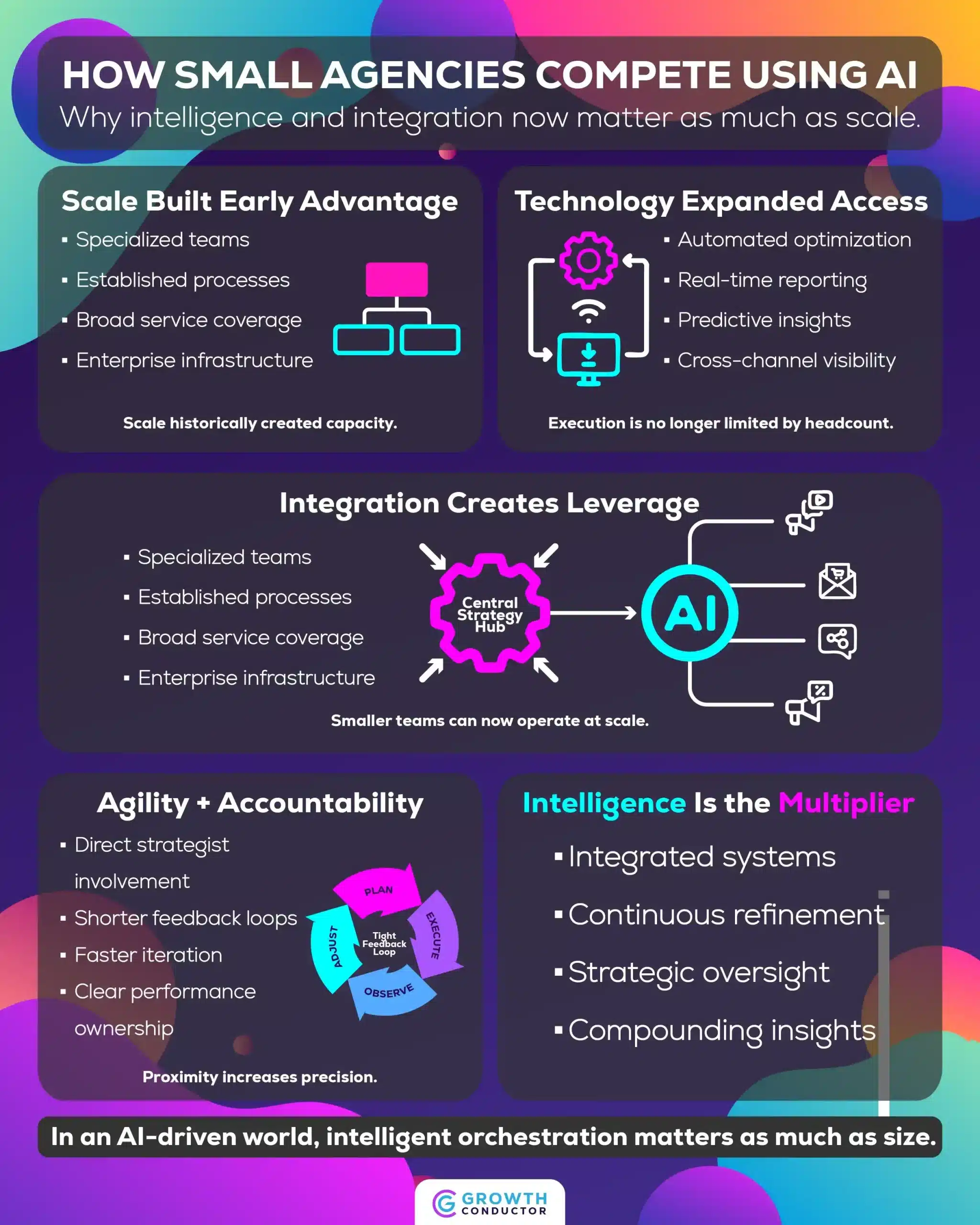
AI does not eliminate agencies. It exposes which ones are built on leverage and which ones are built on overhead.
In an AI-driven environment, size is no longer a protective moat. Media optimization, reporting aggregation, predictive modeling, and content acceleration are accessible to any disciplined team.
AI reduces the cost of output. It does not reduce the need for strategic clarity.
This is where intelligently structured small agencies gain advantage.
When automation handles the mechanical work, senior strategists focus on interpreting signals, identifying inflection points, and aligning marketing activity with business objectives. Decisions move faster. Adjustments are implemented without bureaucratic delay. Cross-channel insights are integrated in real time rather than filtered through layered departments.
Large agencies often struggle with internal friction. Multiple teams. Layered approvals. Competing priorities. By the time insights circulate, momentum fades.
A modern, AI-enabled small agency operates differently. Data flows through a unified system. Strategy connects directly to execution. The same team responsible for interpretation is responsible for refinement. That proximity increases accountability and accelerates improvement.
For companies evaluating agency partners, the distinction is clear.
You are not choosing between small and large. You are choosing between overhead and intelligence.
The real question is not how many employees an agency has. The real question is how effectively it converts insight into action.
AI rewards agencies that build tight feedback loops, maintain strategic ownership, and design systems that compound learning over time.
In this environment, a well-architected small agency is not a compromise. It is often the more agile, more aligned, and more performance-focused option.
Intelligence beats size.
FAQs
Yes. AI reduces structural size advantages by automating execution and accelerating analysis, allowing smaller teams to deliver enterprise-level output when supported by strong strategic oversight.
No. AI automates tasks and processes data, but it does not define positioning, interpret nuance, or design strategy.
Look for integrated systems, human oversight checkpoints, cross-channel data alignment, and strategic accountability — not just tool usage.
AI improves speed, predictive targeting, reporting automation, and cross-channel visibility. When paired with strategic direction, this leads to faster optimization and stronger ROI.