


Human Creativity in AI Marketing — What It Actually Means
Human creativity in AI marketing refers to the strategic interpretation, contextual judgment, emotional intelligence, and narrative direction that guide how AI tools are used. While AI generates outputs based on patterns, humans define intent, positioning, and meaning.

There is growing confusion in the market. Many equate creativity with production. But production is not creativity. It is execution.
AI can generate headlines, ad variations, landing page drafts, image concepts, and design mockups in seconds. What it cannot do is decide what your brand should stand for, how you should differentiate in a saturated market, or which risks are strategically worth taking.
Creativity defines direction.
AI accelerates delivery.
This principle sits at the center of the future of marketing agencies, where automation becomes infrastructure and human intelligence remains the control system.
AI Makes Content and Creative Assets Faster — But Not Smarter
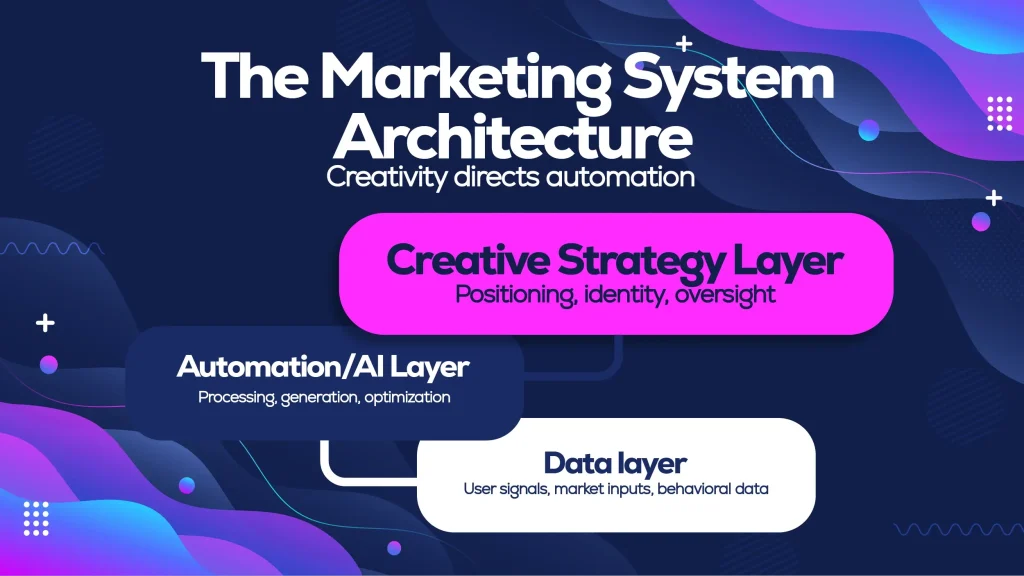
AI is exceptionally good at pattern recognition, data processing at scale, and iterative production. It can generate copy variations, visual concepts, layout structures, and campaign drafts almost instantly.
Research from Stanford Human-Centered AI Institute emphasizes that AI systems perform best when paired with human oversight, particularly in high-impact decision environments. These systems replicate patterns. They do not originate strategic direction.
Speed is not strategy.
AI does not define brand positioning.
It does not evaluate long-term reputational consequences.
It does not independently validate flawed inputs.
It does not introduce calculated strategic risk.
AI predicts what is likely.
Creative professionals decide what is right.
That distinction becomes more important as automation becomes widespread.
In an AI-Saturated Market, Creativity Becomes the Only Differentiator

As AI adoption increases, outputs begin to converge. Messaging frameworks look similar. Ad hooks follow predictable structures. Design layouts mimic familiar patterns. Brand voices begin to blur.
This convergence happens because AI systems are trained on existing material. They identify statistical norms. They remix what already exists.
Insights from Adobe Digital Insights on AI and creative workflows show that AI significantly improves production efficiency. But efficiency does not equal distinction. It increases volume.
Creativity prevents volume from becoming noise.
Human creative thinkers introduce unexpected positioning, emotional nuance, cultural awareness, and strategic reframing. They challenge assumptions. They interpret trends instead of merely repeating them.
This is why structured content marketing services are not about generating more content. They are about shaping meaning before scaling distribution.
When everyone uses AI, differentiation becomes a strategic decision, not a technical advantage.
Creativity Extends Beyond Copy — It Shapes Visual Identity and Experience
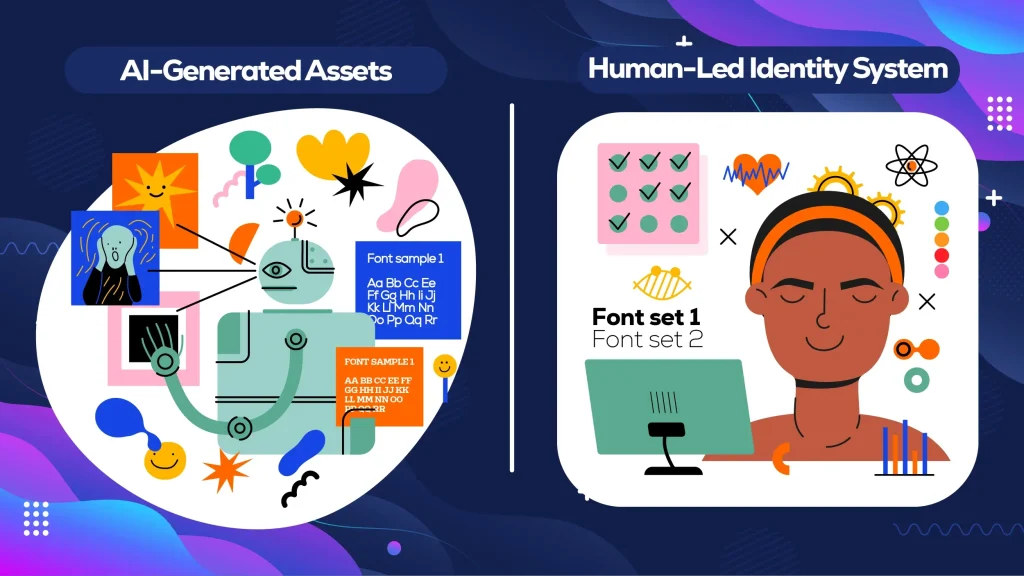
Human creativity in AI marketing does not stop at messaging. It extends into design systems, visual architecture, and experiential direction.
AI can generate images, design layouts, and brand mockups. It can suggest color palettes and logo concepts. But it replicates aesthetic patterns based on existing data. It does not build identity systems with long-term coherence and psychological intent.
Creative teams determine how a brand should look, feel, and evolve across channels. They understand that design is not decoration. It is communication architecture.
They decide when minimalism signals authority and when bold contrast signals innovation. They evaluate how typography affects perception. They assess how layout hierarchy influences trust. They balance originality with consistency.
Design thinking includes emotional interpretation. It considers audience psychology, market maturity, and brand aspiration. AI can assist in generating assets. It cannot independently build a cohesive identity system that holds up across campaigns, platforms, and years.
In this sense, creatives are not asset producers. They are system designers.
Creativity Protects Brands From AI-Driven Risk
AI systems reflect patterns in historical data. That means they can reinforce bias, amplify blind spots, or over-optimize for short-term metrics.
The Oxford Internet Institute’s research on algorithmic systems and society highlights how automated systems operate within sociotechnical environments shaped by both data and human influence. Remove the human influence, and you remove contextual correction.
Without creative oversight, AI can reinforce outdated audience assumptions, flatten emotional tone, drift from brand voice, or prioritize efficiency over long-term trust.
Creativity provides strategic insurance.
In performance environments, automated bidding and dynamic optimization must align with broader business objectives. That alignment requires interpretation, not just monitoring. This is where performance marketing services become essential — not to replace automation, but to guide it with strategic intent.
Automation without direction scales mistakes.
Creativity scales meaning.
The Agencies That Will Lead the Next Era

The real conversation is not AI versus humans. It is AI infrastructure directed by human intelligence.
The agencies that lead the next era will embed AI into workflows while preserving creative authority. They will build oversight systems above automation layers. They will treat AI as an execution engine, not a strategic brain.
AI should operate at the production layer.
Creativity should operate at the control layer.
Organizations that reduce creative teams in pursuit of short-term efficiency may lower costs temporarily. But long-term differentiation depends on narrative clarity, visual coherence, emotional resonance, and disciplined interpretation.
Creativity is difficult to automate.
It is difficult to commoditize.
That is precisely why it becomes a competitive moat.
Final Takeaway: AI Amplifies Strategy — It Does Not Create It
AI marketing systems increase speed, scale, and data visibility. They improve iteration and execution efficiency.
But they do not define purpose.
They do not establish positioning.
They do not build identity systems.
They do not imagine new market narratives.
Human creativity defines intent.
AI amplifies that intent across channels.
In the age of AI marketing, creativity is not optional. It is the differentiator.
FAQs
No. AI can generate content and design assets, but it cannot independently define strategic positioning, long-term brand direction, or cohesive identity systems.
Human creativity provides contextual judgment, emotional intelligence, strategic oversight, and visual interpretation. These capabilities ensure AI outputs align with broader business and brand objectives.
AI can assist with visual asset generation, but cohesive brand systems require human creative direction to ensure consistency, differentiation, and psychological alignment.
Over-reliance on AI can lead to content convergence, brand dilution, bias reinforcement, and short-term optimization at the expense of long-term strategy.
Original positioning, emotional resonance, visual coherence, and disciplined creative oversight — all human-led capabilities.