


What AI-Optimized Advertising Actually Means
Human oversight in AI-optimized advertising refers to the strategic supervision of automated ad systems by experienced marketing professionals to ensure campaigns align with business goals, maintain data integrity, and protect profitability.
AI-optimized advertising uses machine learning algorithms inside platforms like Google Ads and Meta to automate bidding, audience targeting, creative rotation, and budget allocation. These systems analyze large volumes of behavioral data in real time and adjust campaign variables to maximize performance toward a defined goal.
How Advertising Platforms Use Machine Learning
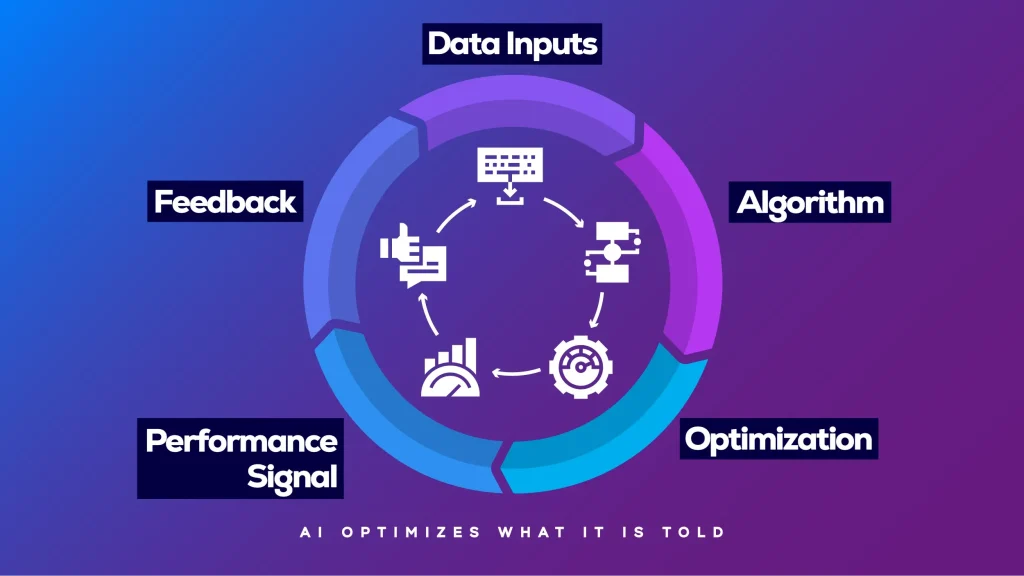
Modern ad platforms rely on automation features such as Smart Bidding, predictive modeling, and conversion-based optimization. Google’s own documentation on Smart Bidding explains how algorithms use historical data and real-time signals to adjust bids dynamically.
AI can:
- Adjust bids in milliseconds
- Identify patterns across thousands of data points
- Expand audiences beyond manual targeting
- Reallocate budgets automatically
- Optimize creative combinations
AI excels at execution speed and scale.
What it does not do is define business strategy.
That distinction is critical, and it is central to The Future of Marketing Agencies, where AI is positioned as a force multiplier, not a replacement for expertise.
Where AI Advertising Breaks Without Professional Oversight
Automation is powerful. But power without direction scales mistakes.
AI Optimizes What It Is Told — Even If the Goal Is Wrong
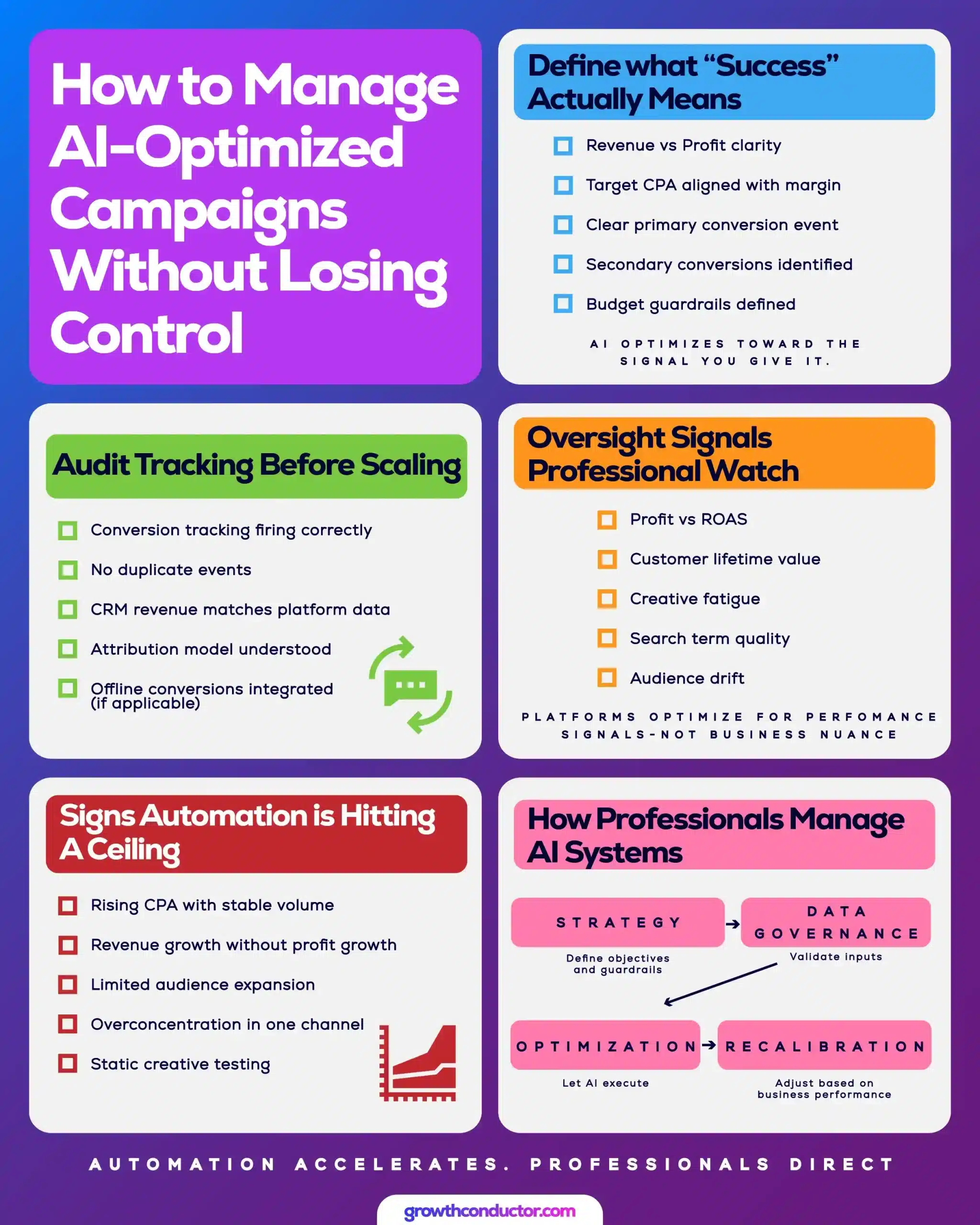
AI systems optimize toward the signal you provide.
If you optimize for revenue instead of profit, the system may scale unprofitable customers.
If conversion tracking is flawed, the system amplifies flawed signals.
If your attribution model is incomplete, the algorithm reinforces distorted data.
Automation does not question objectives. It accelerates them.
Without experienced professionals defining correct KPIs and validating performance metrics, AI can efficiently allocate large budgets toward the wrong outcome.
Data Errors Scale Faster Than Humans Can React
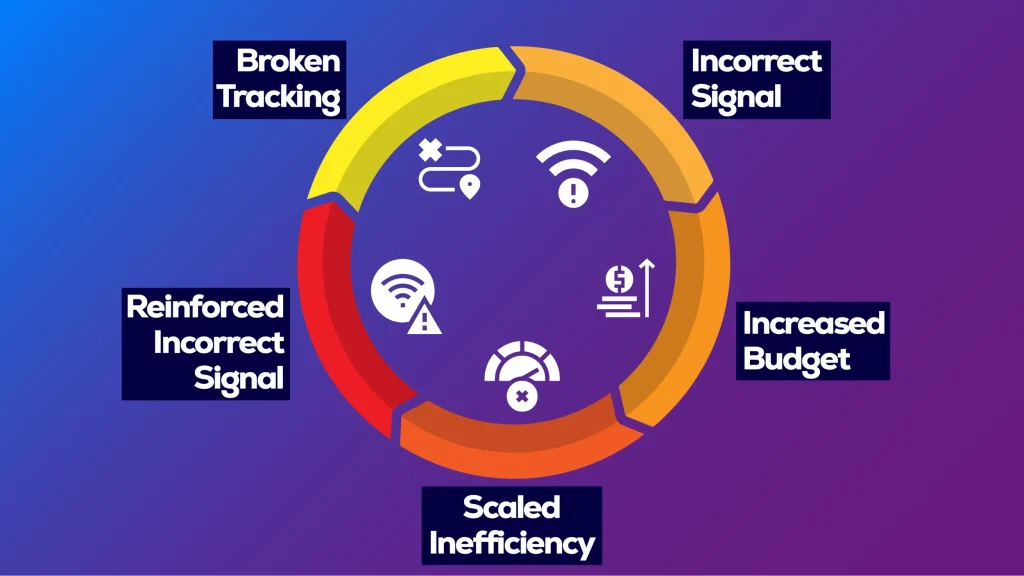
Automated systems create feedback loops.
If tracking breaks, the algorithm adjusts based on corrupted data.
If duplicate conversions fire, the system increases spend.
If attribution misfires, automation reinforces bias.
Research from the Brookings Institution highlights how automated decision systems can amplify systemic errors when not properly governed.
In advertising, this translates to scaled inefficiency.
Human oversight acts as the circuit breaker.
Professionals audit tracking integrity, reconcile CRM data, and compare platform-reported metrics to actual business outcomes. AI does not independently validate the accuracy of its own inputs.
Automation Prioritizes Platform Logic — Not Business Strategy
Advertising platforms are designed to optimize within their ecosystem.
They prioritize engagement, conversion likelihood, and auction competitiveness.
They do not account for margin structure, fulfillment capacity, or long-term brand positioning.
That is the role of marketing professionals.
Without strategic oversight, businesses can become dependent on black-box reporting and platform-defined performance metrics that do not always align with actual profitability.
The Strategic Role of Marketing Professionals in AI-Optimized Campaigns
AI accelerates execution. Professionals provide direction.
Research from McKinsey & Company’s State of AI Report emphasizes that organizations generating meaningful returns from AI are those combining automation with strong human governance.
Advertising is no different.
Professionals Define Strategy — AI Executes Within It
Experienced marketers:
- Align campaigns to revenue and margin goals
- Structure lifecycle-based budget allocation
- Define messaging hierarchies
- Set performance guardrails
- Determine expansion thresholds
AI operates inside that framework.
Without a strategic definition, automation becomes reactive instead of directional.
Professionals Audit Data Integrity and Signal Quality
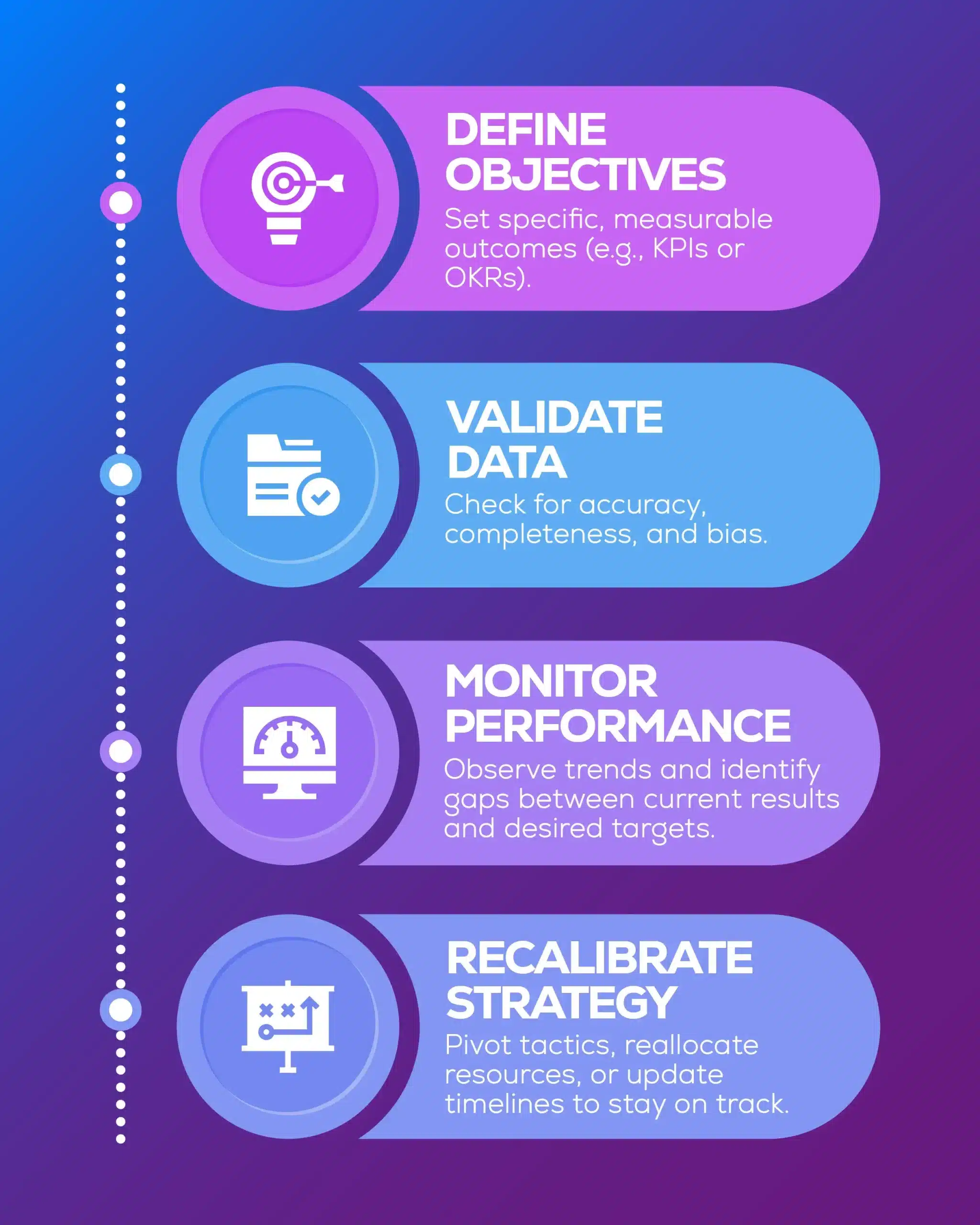
Human oversight ensures:
- Conversion tracking accuracy
- CRM alignment
- Cross-platform reconciliation
- Revenue verification beyond dashboard metrics
This oversight layer protects the system from amplifying technical errors.
AI does not check whether your attribution model matches your finance reports. Marketing professionals do.
Professionals Interpret Performance Beyond Dashboards
Dashboards show performance trends.
Professionals interpret meaning.
They identify:
- Competitive shifts
- Market seasonality
- Creative fatigue
- Brand positioning impact
- Customer lifetime value implications
Research from MIT Sloan supports the idea that human-AI collaboration produces stronger outcomes than automation alone.
In advertising, this collaboration is not optional. It is a strategic necessity.
Why Businesses That Rely Only on Automation Plateau
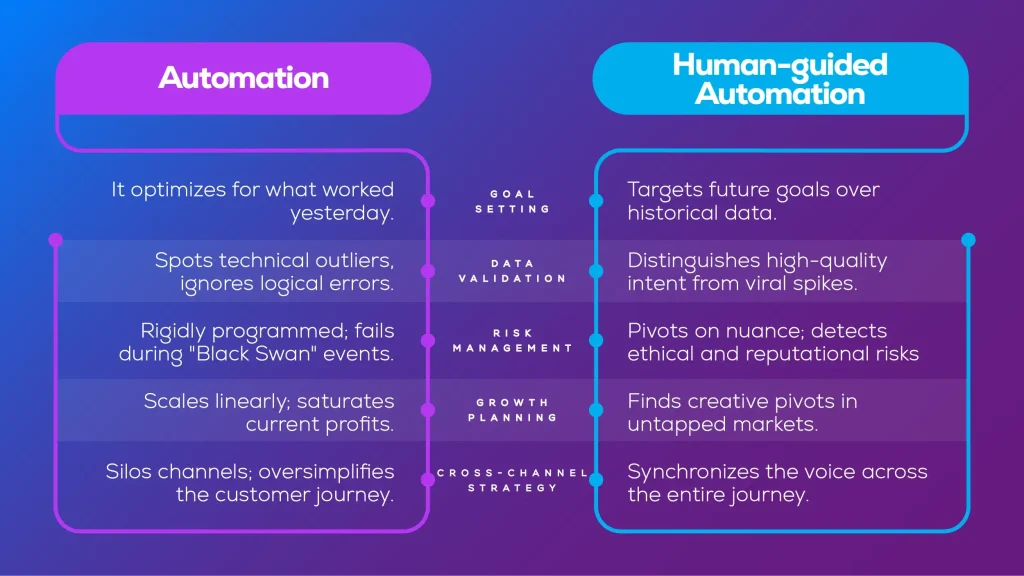
Automation is excellent at incremental optimization.
It improves efficiency inside an existing system.
It rarely redesigns the system itself.
Automation Without Strategy Creates Performance Ceilings
Businesses relying solely on automated bidding and audience expansion often encounter:
- Diminishing returns
- Rising acquisition costs
- Creative stagnation
- Limited channel diversification
AI optimizes the current structure.
Professionals redesign it when growth requires a new direction.
Growth Requires Strategic Oversight
Sustainable scaling requires:
- Cross-channel orchestration
- Testing frameworks
- Budget reallocation models
- Profit-based evaluation
- Long-term positioning decisions
This is the foundation of effective performance marketing services.
AI enhances performance execution.
Professionals ensure performance aligns with business reality.
The Future of Advertising Is Human-Guided Automation
AI is not the threat.
Unmanaged automation is.
AI accelerates:
- Execution speed
- Pattern recognition
- Budget efficiency
- Signal processing
Human oversight protects:
- Profitability
- Strategic alignment
- Data integrity
- Brand positioning
- Long-term growth
The future of marketing agencies is not automation alone. It is an intelligent orchestration. And orchestration requires professionals.
FAQs
AI can automate bidding, targeting, and budget allocation. However, it cannot define business strategy, validate data accuracy, or interpret long-term growth implications. Human oversight remains essential.
Risks include scaling flawed tracking data, optimizing toward incorrect KPIs, platform bias, and hidden inefficiencies. Without professional supervision, automation can amplify errors.
No. AI enhances execution. Paid media professionals provide strategic direction, governance, and interpretation that automation alone cannot replicate.
Automated bidding optimizes toward defined goals. If those goals or signals are incorrect, the system scales inefficiency. Human oversight ensures objectives and data integrity remain aligned.