


Marketing Skills in the AI Era — Definition
Marketing skills in the AI era refer to the ability to strategically direct, evaluate, and optimize AI-powered marketing systems while maintaining human oversight, accountability, and decision-making authority.
AI accelerates execution.
Human expertise determines direction.
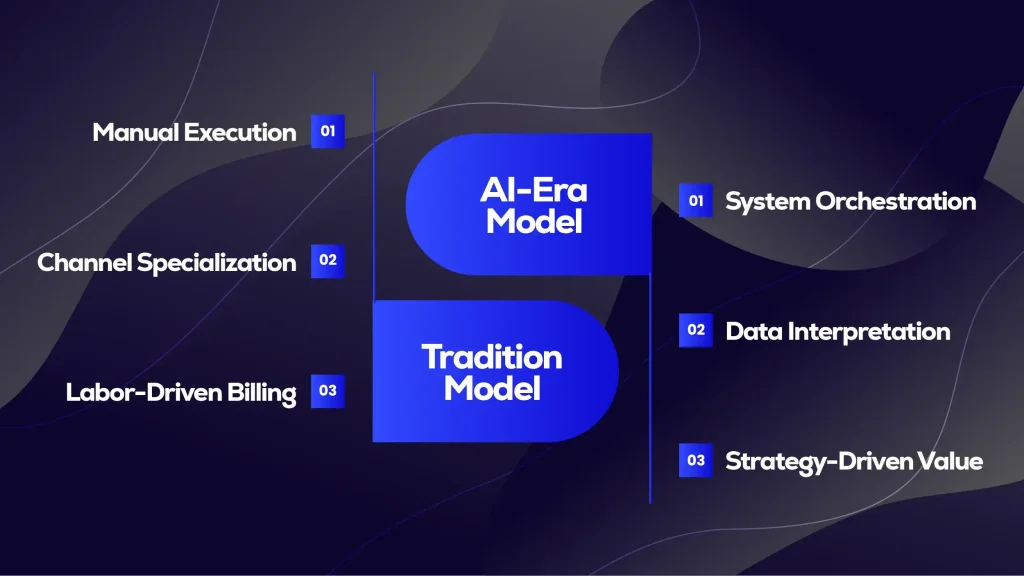
Artificial intelligence now assists with content creation, campaign optimization, segmentation, analytics, and automation workflows. Execution speed has increased dramatically. But responsibility has not decreased.
As outlined in the OECD report on AI and workforce skills transformation, artificial intelligence is reshaping which cognitive skills employers prioritize — placing greater emphasis on analytical thinking, systems awareness, and complex problem-solving. Marketing is no exception.
The scarcity has shifted. Manual execution is becoming automated. Strategic judgment is becoming premium.
This evolution is part of the broader transformation shaping the future of marketing agencies — from labor-based vendors to integrated growth systems.
Why This Shift Is Reshaping Agencies
AI is not just a new tool-set. It is an operating model shift.
Recent data from Statista’s research on AI adoption in marketing shows rapid acceleration in AI implementation across personalization, analytics, campaign optimization, and automation. Adoption is no longer experimental. It is structural.
For agencies, this changes value creation.
When AI increases production efficiency, agencies that compete solely on deliverables face compression. Agencies that compete on intelligence, integration, and oversight increase strategic leverage.
This is the transformation explored in The Future of Marketing Agencies: How AI, Automation & Human Creativity Shape What’s Next. The modern agency is not defined by how much it produces. It is defined by how intelligently it orchestrates technology and human creativity.
Technical Fluency Is Expected — But It Is Not the Differentiator
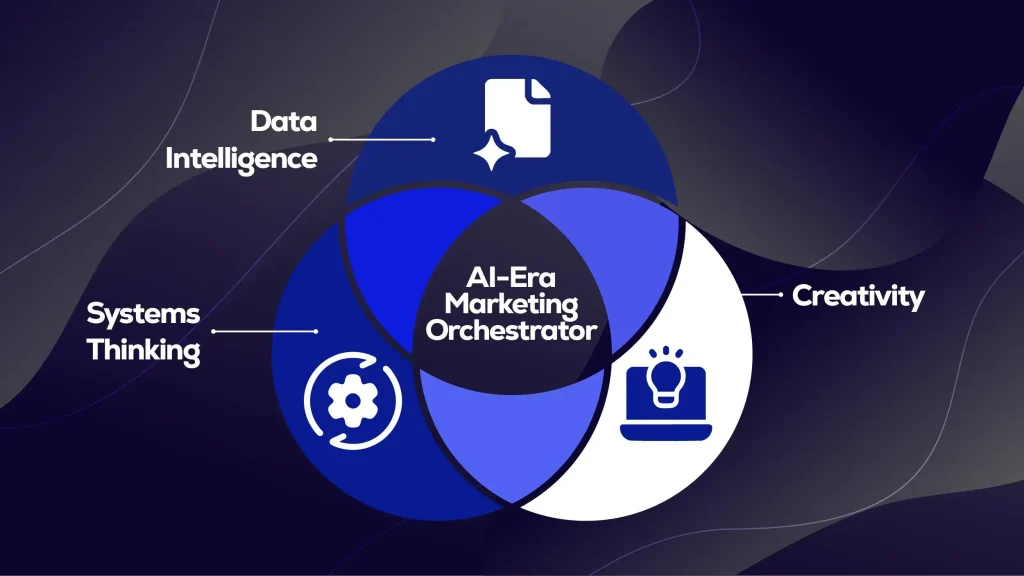
AI literacy has become baseline.
Marketers must understand how AI tools generate outputs, how automation workflows function, and how performance dashboards interpret signals. Without that fluency, teams risk misinterpreting data or scaling ineffective strategies.
However, technical knowledge alone does not create strategic advantage.
An AI system may optimize paid campaigns toward short-term conversions. But without context around customer lifetime value, brand positioning, and margin structure, those optimizations can quietly erode long-term growth.
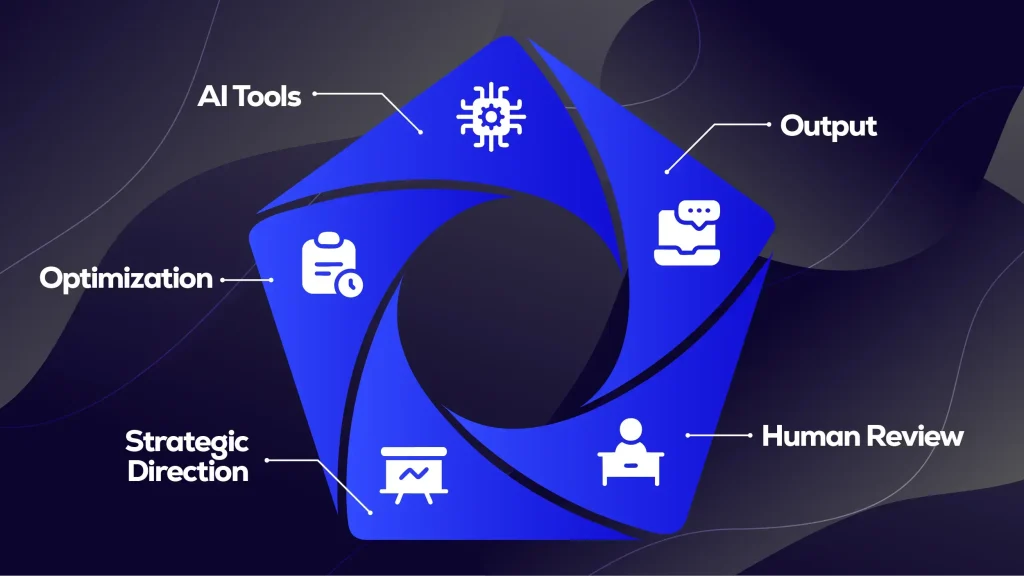
Inside strong performance marketing systems, automation supports execution — but human direction ensures optimization aligns with sustainable business outcomes.
Speed is useful. Alignment is essential.
Strategic Judgment Is Becoming the Most Valued Skill
As execution becomes easier, decision-making becomes harder.
AI can generate options.
It cannot determine which option aligns with competitive positioning.
AI can analyze patterns.
It cannot define strategic trade-offs.
Research from MIT Sloan Management Review on human–AI collaboration emphasizes that organizations outperform when humans guide AI systems with oversight and strategic clarity rather than automating blindly.
In marketing, this translates into several high-value capabilities:
Understanding which metrics truly indicate growth.
Knowing when to override algorithmic optimization.
Aligning automation with long-term brand equity.
Balancing performance with positioning.
These are not technical skills. They are leadership skills.
Customer Insight and Creative Direction Still Matter
AI can draft copy in seconds. It can test variations at scale. It can analyze engagement patterns across thousands of data points.
But it does not understand lived customer experience.
It does not hear tone shifts in sales calls.
It does not sense hesitation during checkout.
It does not feel the emotional resonance of a message.
Customer psychology remains a human responsibility.
This is why strong content strategy and execution still require experienced direction. AI can assist in production, but it cannot independently define narrative clarity or positioning nuance.
As automation increases content volume across the market, differentiation becomes harder. Insight-driven creativity becomes more valuable.
Systems Thinking: The Core AI-Era Competency
Marketing in the AI era is not channel-based. It is system-based.
Content influences paid acquisition.
Paid campaigns generate audience intelligence.
CRM automation drives retention and upsell.
Analytics informs reinvestment.
A modern marketer must understand how these components connect.
Systems thinking separates operators from orchestrator’s.
For small and mid-sized businesses, this distinction is especially important. Hiring siloed execution partners can create fragmentation. Working with a team that understands integration, oversight, and architecture creates compounding leverage.
The value is not in isolated tasks. It is in cohesion.
Accountability Intensifies With Automation
One of the most dangerous assumptions about AI is that it reduces responsibility.
In reality, it increases it.
When automation scales campaigns, errors scale with them.
When AI generates messaging, misalignment multiplies quickly.
When algorithms optimize aggressively, brand integrity can quietly erode.
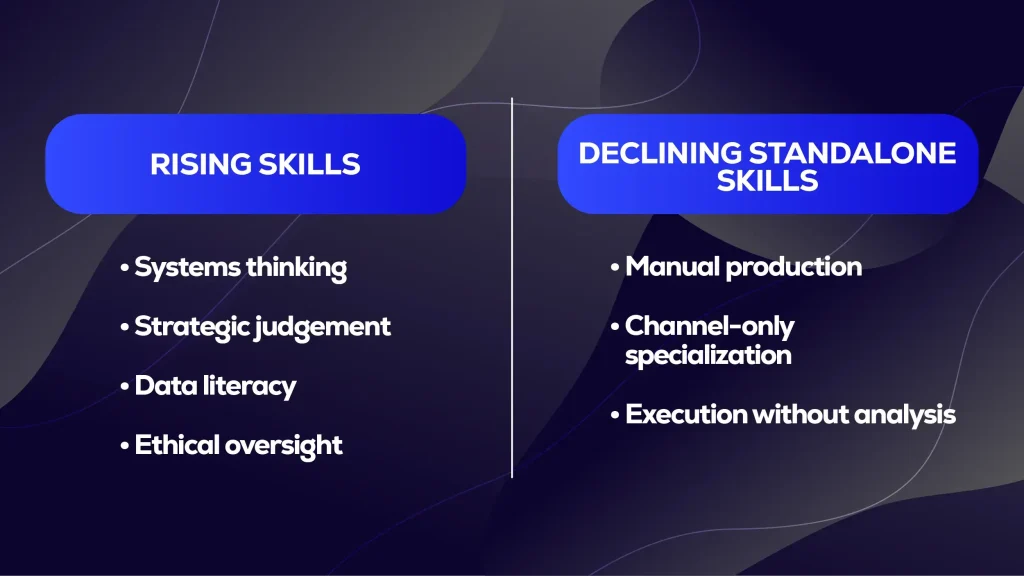
Ethical oversight, validation, and governance are not secondary considerations. They are foundational skills in AI-driven marketing environments.
Agencies that recognize this shift move upward — from task vendors to strategic partners.
What This Means for Agencies, Contractors, and Growing Businesses
For agencies, the future belongs to those who combine AI capability with strategic leadership. Tool adoption alone is insufficient. Systems design, oversight frameworks, and decision governance define competitive advantage.
For contractors, expanding beyond tactical execution increases long-term value. The more you understand how your work influences revenue, retention, and business objectives, the more indispensable you become.
For small businesses evaluating marketing partners, the key question is no longer, “How many deliverables will I receive?” It is, “Does this team understand how AI, automation, content, and performance integrate into a unified growth system?
”Execution is becoming automated.
Clarity is becoming premium.
Final Takeaway
The most valued marketing skills in the AI era are not about producing more output. They are about guiding intelligent systems responsibly and strategically.
Technical fluency is expected.
Data literacy is essential.
Systems thinking is foundational.
Strategic judgment is premium.
AI does not replace marketers.
It raises the standard.
The agencies and professionals who embrace this shift will compete on intelligence, integration, and leadership — not volume.
FAQs
The most important skills include strategic judgment, data interpretation, systems thinking, AI tool fluency, and ethical oversight. These skills guide automation effectively.
AI reduces manual execution but increases the need for strategic leadership and integration. Agencies that evolve toward system-based growth models are positioned to thrive.
Because AI can execute rapidly but cannot define business objectives, positioning, or long-term trade-offs. Strategic thinking ensures automation aligns with sustainable growth.
By working with partners who integrate AI, automation, and human expertise into cohesive systems rather than isolated tactics.