



Knowing how to budget for content marketing is the foundation of a scalable growth strategy. A content marketing budget defines how much your company invests in creating, optimizing, and promoting content that attracts, engages, and converts your audience. When structured properly, it helps you allocate spend across strategy, production, distribution, and analytics — turning creative output into measurable business performance.
Why this matters in the era of AI Overviews (AIO)
With Google’s AI Overviews (AIO) now summarizing web content directly in search results, clarity and topical depth matter more than ever. AI Overviews are enhanced SERP summaries that pull insights from high-authority pages and present them conversationally. To appear in these summaries, your article must define entities, use semantic terms, and demonstrate E-E-A-T (Experience, Expertise, Authoritativeness, Trustworthiness).By clearly defining what a content marketing budget is — and showing how it ties to ROI — you increase eligibility for AI Overview inclusion and long-tail voice queries.
What is a Content Marketing Budget?
A content marketing budget is a planned allocation of resources (time, talent, and money) toward producing and promoting digital content aligned with business goals.
It covers five core areas:
- Strategy & Planning
- Content Production
- Promotion & Distribution
- Tools & Technology
- Optimization & Reporting
Creating a documented budget helps brands scale sustainably, measure ROI, and stay competitive as search evolves toward AI-generated summaries and intent-based discovery.

Why Budgeting for Content Marketing Matters
Content is often labeled as free marketing because anyone can publish. But in reality, the difference between content that ranks and content that rusts is strategy, skill, and sustained investment. A budget turns creativity into a system — ensuring that every piece of content works toward measurable business goals.
Why “Free Content” Isn’t Free
Behind every blog post lies hours of research, writing, editing, SEO optimization, and design — not to mention the tools, hosting, and analytics needed to track results. Treating content as “free” leads to inconsistent publishing, rushed quality, and missed opportunities. When you plan a content budget, you move from reactive creation to proactive growth — choosing where to invest based on audience value, not guesswork.
A content budget also guards against the hidden cost of inconsistency. Without dedicated resources, momentum fades. SEO rankings slip. Teams lose focus. Budgeting keeps the engine fueled so the strategy never stalls.
Content as a Compounding Investment
Unlike paid ads that vanish when spend stops, content compounds in value. Each optimized article can generate organic traffic, backlinks, and conversions long after it’s published. Think of content as a digital asset — one that appreciates over time when maintained through updates, internal linking, and optimization.
Aligning Budget With Business Stage and Goals
Content maturity mirrors company maturity.
- Startups focus on building brand awareness and foundational SEO content.
- Growth-stage businesses invest in topical authority, conversion assets, and social amplification.
- Established brands shift budget toward optimization, repurposing, and performance analytics.
Map every dollar to outcomes — visibility, leads, authority, and conversions. That’s how you transform content from a marketing expense into a scalable growth channel.
Key Factors That Influence Your Content Marketing Budget
- Business size & competition: Competitive industries demand more frequent, higher-quality publishing.
- Content goals: Visibility → SEO investment; Leads → gated assets; Authority → original research; Conversions → case studies and CRO.
- Formats & frequency: Maintain a sustainable cadence (1–2 articles/month outperforms sporadic bursts).
- Internal vs outsourced support: Hybrid models combine internal strategy with external execution for efficiency.
Common Content Marketing Budget Benchmarks
- Allocation %: Typically 20–40% of total marketing budget goes to content (Search Engine Journal, HubSpot, Semrush).
- Spend ranges: Small biz $2.5–10K/mo | Mid $10–30K | Enterprise $30K +
- Use benchmarks: Reference annual CMI/HubSpot budget reports for credibility.
| Category | % of Budget | Focus |
| Strategy & Planning | 15–25% | Research, topical mapping, calendars |
| Content Production | 40–60% | Writing, editing, design, video |
| Promotion & Distribution | 10–20% | Email, social, paid boosts |
| Tools & Technology | 5–10% | SEO and analytics platforms |
| Optimization & Reporting | 5–10% | Refreshes and performance reviews |
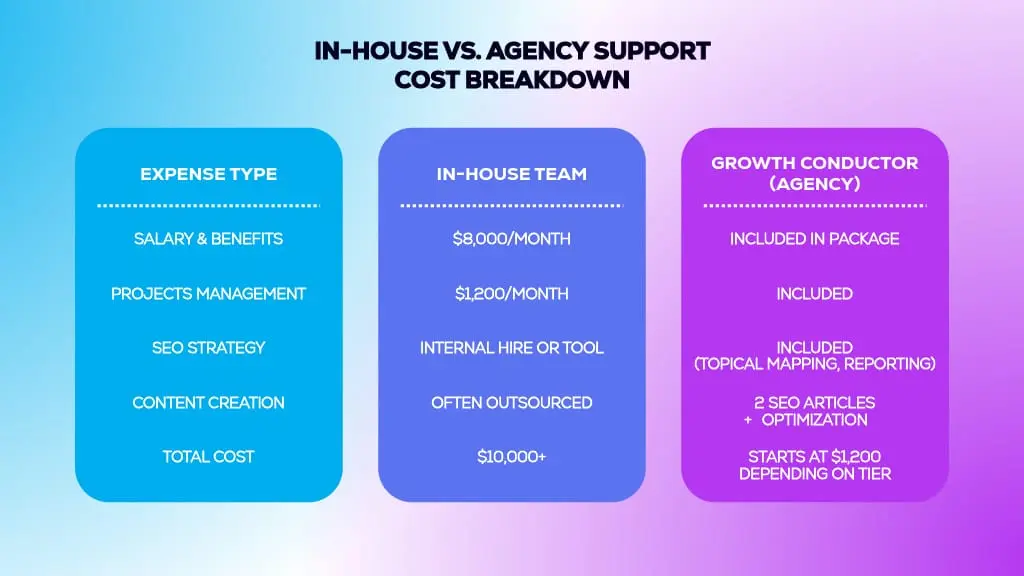
In-House vs Agency Support – Cost Breakdown
Choosing between in-house content production and agency partnership comes down to scalability, expertise, and total cost of ownership. Each model carries unique advantages and limitations that directly influence content quality and velocity.
In-House Content Teams
Building an in-house content function provides deep product knowledge, brand voice consistency, and faster stakeholder access. You gain embedded expertise — writers, strategists, and designers who understand your industry inside out.
However, this control comes with fixed costs: salaries, benefits, tools, training, and turnover management. A mid-sized internal content team can easily reach $250K–$500K annually once you factor in strategists, editors, and production software. Scaling output means adding headcount, which can strain budgets during slower quarters.
Agency Support
A content marketing agency offers a flexible cost structure and access to specialized talent — SEO strategists, editors, designers, and analysts — without permanent overhead. Agencies also bring refined SOPs, analytics reporting, and cross-industry insights that shorten ramp-up time. The trade-off is less embedded product knowledge and the need for tight onboarding and communication loops.
When to Outsource (or Blend Models)
Consider outsourcing when you:
- Need to increase publishing velocity quickly
- Require SEO strategy or technical optimization expertise
- Lack bandwidth to manage freelancers or full-time hires
- Want to test new content formats or markets without fixed expenses
Many brands adopt a hybrid approach — retaining strategic direction internally while outsourcing production and optimization to stay agile and cost-efficient.
Example: Growth Conductor’s Content Engine
Growth Conductor’s Content Engine functions as a plug-and-play content team. It includes topical mapping, topic research, competitive research, two optimized articles per month, internal linking, social media graphics, social media posting, and monthly reporting. Tier-based pricing scales with your goals — giving you agency-level execution with strategist-level oversight, without expanding payroll. You can even add on additional articles per month.
Learn how Content Engine helps brands scale strategy, publishing, and optimization with predictable ROI.
How to Calculate ROI on Content Spend
Measuring the ROI (return on investment) of content marketing connects creative activity to business results. A well-defined ROI model helps justify spend, forecast growth, and refine future budgets.
KPIs: Traffic, Leads, Engagement, and Sales
Start with clear metrics that ladder up to revenue:
- Traffic metrics: impressions, organic sessions, and average position show visibility growth.
- Engagement metrics: time on page, scroll depth, and social shares reveal resonance.
- Lead metrics: form fills, demo requests, and newsletter sign-ups quantify conversion activity.
- Revenue metrics: MQL → SQL → Closed-Won tracking confirms pipeline contribution.
Tie each content type to its role in the funnel. For example, blog articles drive awareness; guides and case studies drive consideration; landing pages convert.
Attribution: Understanding Content’s True Influence
Traditional “last-click” attribution undervalues content’s long-tail influence. Use multi-touch attribution to credit every meaningful interaction along the buyer journey:
- First-touch: identifies discovery content that started engagement.
- Assisted-touch: recognizes nurturing assets like blogs or newsletters.
- Last-touch: credits the final conversion driver.
Pair attribution data with content path analysis in Google Analytics 4 or your CRM to see how users interact with multiple assets before buying. This reveals which topics truly accelerate deals.
Example ROI Framework
Suppose your company invests $10,000/month in content marketing for six months ($60,000 total). After six months, your campaigns generate 50 qualified leads valued at $1,500 each, producing $75,000 in attributable revenue.
ROI=60,000(75,000−60,000)=0.25
That’s a 25% ROI in the first six months — not counting the compounding benefits of evergreen SEO content. Now extend the horizon: if the same content continues to generate leads for 12 more months without equivalent spend, total attributed revenue could easily double. By month 18, the same assets may deliver a 150–200% cumulative ROI, illustrating why content is a long-term growth investment rather than a short-term cost.
Timeline: Paid vs. Organic ROI
- Paid content & ads: deliver immediate data but vanish when budgets pause.
- SEO-driven content: compounds visibility over 3–6 months, with peak ROI often appearing between 9–12 months as rankings stabilize.
Evaluating ROI over a full year — not campaign-to-campaign — captures the true financial return of content marketing.
How Growth Conductor Supports Scalable Content Budgeting
- Content Engine: Managed publishing and optimization
- Search Precision: SEO foundations for visibility
- AdVelocity: Paid promotion for short-term ROI
- ConductorCare: Site maintenance for website performance
Each service ties strategy, execution, and analytics for compounding growth.
Final Thoughts
Budgeting for content isn’t about controlling costs — it’s about enabling strategy. A clear, intentional budget turns marketing from guesswork into a growth system that compounds value over time.
Budget by goals, not gut.
Every dollar should map to a measurable outcome: visibility, demand, authority, or conversion. Aligning budget with business objectives ensures your investment drives performance, not just production.
Prioritize consistency over volume.
Publishing predictably beats publishing frequently. Momentum builds trust with your audience and with search algorithms. A smaller, steady budget sustained over time outperforms big, erratic bursts of spend.
Blend internal insight with external execution.
our team holds the brand story. An agency brings process, scale, and perspective. Together, they turn strategy into sustainable output — precision without burnout.
Build a system, not a scramble.
Treat your content budget like an engine: fuel it, maintain it, and monitor performance. Over time, it drives predictable growth and lasting visibility.
Ready to build a content marketing budget that actually drives ROI? Growth Conductor helps you plan, produce, and optimize content that compounds — not just campaigns that burn out.
Let us help you design your custom content plan