


Tired ads don’t just get ignored — they cost you money.
If your once high-performing campaigns are suddenly under-delivering, chances are you’re facing ad fatigue — a common issue where your audience sees your ads so often that they stop engaging altogether.
Ad fatigue is one of the most overlooked performance problems in digital marketing. It slowly eats away at click-through rates, drives up your cost per click, and makes even your best creative start to fall flat. The worst part? It’s not always easy to spot until your results — and your ROI — take a hit.
In this guide, we’ll help you understand exactly what ad fatigue is, how to identify it early, and how to fix it before your budget bleeds dry. You’ll also learn how to create a rotation strategy that keeps your campaigns fresh and your audience engaged across every channel — whether you’re running Google, Meta, or LinkedIn Ads.
This article is brought to you by Growth Conductor, an AI-forward marketing agency focused on performance, transparency, and scalable results through data-driven advertising.
Why Your Ads Might Be Underperforming
Every marketer knows the feeling — your ad campaign launches strong, CTRs look great, conversions climb, and then… the performance drops.
It’s not always that your audience changed — it’s that they’ve seen it all before.
When users are exposed to the same visuals and messages repeatedly, their attention starts to fade. This loss of engagement is what we call ad fatigue — and it’s one of the main reasons campaigns under-perform after the initial surge.
But ad fatigue isn’t the only culprit. A drop in results can also come from:
- Overlapping audiences across ad sets
- Stale messaging or overused creative
- Algorithm shifts (especially after platform updates)
- Lack of segmentation or audience rotation
- Over-reliance on a single ad type or placement
Most campaigns don’t fail because of one big mistake — they degrade from small, repeated oversights that compound over time.
As a growth strategist, I’ve seen that the best-performing campaigns aren’t just creative — they’re adaptive. They’re monitored weekly, refreshed proactively, and tested continuously.
The moment your data begins to flatten, it’s your signal to pivot.

What Is Ad Fatigue?
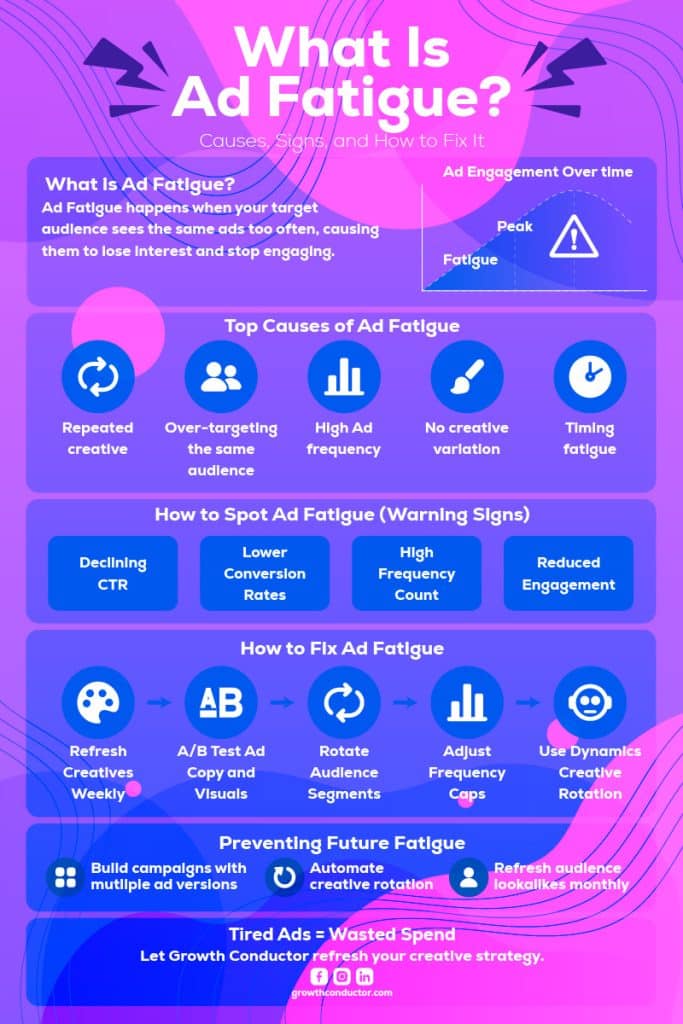
Ad fatigue happens when your audience sees your ads so many times that they stop paying attention. The same creative that once drove clicks and conversions starts blending into the background — resulting in declining engagement, higher costs per click, and fewer conversions.
It’s a natural byproduct of repetition. Just like banner blindness on websites, your audience begins to tune out what feels overly familiar. And when your ads compete for attention in crowded feeds, every impression that fails to capture interest becomes wasted spend.
Ad fatigue affects all major platforms — Meta, Google, LinkedIn, and even YouTube. Each has its own thresholds for how often an ad can appear before performance declines, but the underlying principle is the same:
When people see the same message too many times, effectiveness drops — no matter how good the ad is.
Why It Matters
Because digital ad budgets are constantly in motion, even small inefficiencies can compound quickly. A fatigued campaign doesn’t just stop performing; it can distort your data, making it harder to see what’s actually working.
Keeping your creative strategy fresh and adaptive ensures your ads work together — not against you. Understanding how content and ads work strategically in sync helps your campaigns perform smarter, not just louder.
👉 Related insight: SEO and SEA: What’s the Difference — and Why It Matters
Common Causes of Ad Fatigue
Ad fatigue doesn’t happen overnight — it builds quietly, campaign after campaign. By the time you notice performance dropping, your audience has likely seen the same message multiple times, across multiple placements.
Here are the most common causes of ad fatigue (and how to spot them early):
1. Repetitive Creatives
If your audience has seen the same image, video, or carousel design too often, they’ll scroll past it instinctively.
Even subtle changes — background colors, text overlays, or framing — can extend an ad’s lifespan. But when visuals stay static for too long, creative burnout sets in quickly.
Tip: Refresh your visuals every 7–14 days for smaller campaigns, or every 3–4 weeks for larger rotations.
2. High Frequency
When your ad frequency rises above 2.5–3.0, engagement almost always begins to fall. This means your audience has seen the same ad multiple times — and is tuning it out.
High frequency is one of the clearest early indicators of ad fatigue. It doesn’t just lower CTRs; it increases CPCs, wasting budget on unresponsive impressions.
3. Narrow Targeting or Audience Overlap
Running multiple ad sets with overlapping audience segments causes competition between your own campaigns.
Your ads begin to “fight” each other for impressions, driving up costs while showing the same message to the same people repeatedly.
💡 Pro Tip: Use audience exclusions and refresh your custom or lookalike audiences every 30–60 days.
4. Lack of Format Variety
When all your ads use a single format — for example, static images — they become predictable.
Adding videos, carousels, or dynamic creatives can dramatically increase engagement by reintroducing novelty into your feed placements.
5. Over-Reliance on One Platform
Focusing entirely on one ad network (like Meta or Google) limits your reach and accelerates fatigue.
Each platform has unique creative formats, audiences, and engagement behaviors — diversifying your mix helps extend the lifespan of your campaigns.
Poor ad performance often ties back to weak optimization and lack of variety, similar to how SEO depends on freshness and authority.
👉 Learn more about maintaining consistent visibility in search: What Are Important SEO Ranking Factors That Can Help You in 2025
How to Recognize Ad Fatigue (Early Warning Signs)
Ad fatigue rarely happens all at once — it creeps in slowly.
You might notice your metrics slipping week over week without any major change in strategy. That’s because your audience’s attention is fading, not your campaign’s potential.
Here’s how to spot the early warning signs before performance drops too far:
1. Click-Through Rate (CTR) Drops
A consistent decline in CTR is often the first and clearest sign. When people stop clicking, it’s a signal that your ad no longer captures attention — not that your offer stopped working.
2. Cost Per Click (CPC) Increases
When engagement drops, algorithms interpret your ad as less relevant and charge more to show it.
If your CPC is rising while impressions stay stable, you’re likely paying for uninterested viewers.
3. Cost Per Acquisition (CPA) Climbs
As users stop interacting, it takes more clicks to convert a single lead or sale.
A jump in CPA alongside a drop in CTR is a strong indicator that your audience has seen your message too many times.
4. Ad Frequency Rises Above 2.5
If your frequency exceeds 2.5–3.0, your ad has likely reached the same audience too often. This number can vary by industry and campaign type, but consistently high frequency is almost always correlated with declining engagement.
5. Engagement Declines
Lower likes, comments, shares, or video completions all suggest that your creative has lost its appeal. For video ads, also look for decreasing average watch time — another early fatigue signal.
6. Conversion Rate Slips Despite Traffic Stability
If traffic is steady but conversions dip, users may be experiencing message fatigue — they’ve seen the offer but aren’t inspired to act again.
These metrics are like your campaign’s health report.
Tracking them weekly — not just monthly — helps you stay ahead of fatigue and optimize proactively.
💡 Tip: Meta recommends updating creative and audience segments at least every 2–4 weeks to prevent performance decay. Google Ads also encourages rotating ad assets dynamically to maintain relevance and freshness.
How to Rebuild Campaigns That Stay Fresh with Your Audience
Most advertisers react to declining performance only after the damage is done. But the strongest campaigns aren’t reactive; they’re engineered for longevity.
At Growth Conductor, we call this the future-proofing phase — where data and creativity work together to keep performance consistent. It’s not about chasing quick wins; it’s about setting up a rhythm of continuous refresh, testing, and adaptation.
In this section, we’ll show you how to rebuild your campaigns so they evolve with your audience — using proven creative testing frameworks and refresh strategies designed to maintain engagement, not just recover it.
1. Refresh and Test Creatives Strategically
The easiest way to fix ad fatigue is also the most misunderstood. It’s not just about swapping images — it’s about strategically testing creative directions while balancing authenticity and production value.
Over time, audiences stop responding to familiar visuals or overly polished ads that “look like marketing.” In fact, research consistently shows that people trust authentic content over traditional advertising.
That doesn’t mean every campaign should feel unprofessional — it means learning to balance artistic polish with authentic relatability depending on your audience and objective.
A. When to Use Polished (Artistic) Creatives
Choose artistic, high-production visuals when:
- Targeting premium or professional audiences who associate quality with credibility.
- Building brand awareness or trust in industries where polish signals authority.
- Competing in crowded or luxury markets where production quality helps differentiate.
- Running LinkedIn campaigns or brand placements where refined visuals fit the platform.
Artistic ads typically sustain results longer — around 3–4 weeks before engagement begins to plateau — provided frequency is capped and variations are introduced regularly.
B. When to Use Authentic (Raw) Creatives
Choose authentic, “native-feeling” creatives when:
- Running direct-response campaigns or retargeting ads focused on conversions.
- Targeting younger or social-first audiences that value realness over perfection.
- Trying to reignite stale campaigns that have relied on polished visuals too long.
- Advertising on Instagram Reels, Stories, or TikTok, where organic, low-production content performs best.
Authentic ads tend to drive higher engagement early on but can fatigue faster — typically within 7–14 days.
C. Creative Testing Framework (70/30 Split)
To prevent burnout and maintain control over results, follow a 70/30 creative testing model:
- Allocate 70% of your budget to your control creative — the proven performer.
- Dedicate 30% to experimental creatives that test new tones, formats, or levels of polish.
- Run each test for at least 7–14 days to allow for audience saturation effects.
- Monitor CTR, CPA, and ROAS — don’t just rely on clicks.
This approach allows your campaigns to evolve continuously without losing performance stability.
D. 3–2–1 Refresh Framework
Your timing is everything:
- Check performance every 3 days during launch or refresh cycles.
- When two signals appear together — frequency above 2.5 and CTR drop of 20% — you have 1 week to refresh.
This system prevents reactive decision-making while keeping creatives fresh and performance consistent.
E. Graduated Refresh Strategy
Avoid replacing all ads at once — that’s a fast track to volatility.
Instead, use a gradual refresh method:
- Start with 20% of your budget allocated to new creative tests.
- If new creatives outperform by 15% or more after 72 hours, shift to a 50/50 split.
- Fully transition only after consistent performance for 7 days.
This structured process maintains campaign stability while constantly injecting creative novelty — the antidote to ad fatigue.
Tactical Fixes for Ad Fatigue
Once your structure is in place, it’s time to fine-tune your campaigns at the tactical level.
These hands-on optimizations address the immediate causes of ad fatigue — from stale creatives to audience overlap — while keeping your overall strategy intact.
Think of these tactics as the maintenance plan for your marketing engine. They’re the small but critical adjustments that ensure your creative system keeps performing.
1. Test Multiple Versions (A/B Testing)
Ad fatigue thrives in stagnant campaigns. Combat it by testing variations.
Try new hooks, formats, visuals, and even audience messaging. Split tests provide real performance data so you can pivot confidently rather than guessing.
Test variables like:
- Ad copy tone (direct vs emotional)
- Visual style (photo vs graphic vs video)
- CTA placement and phrasing
- Audience segmentation
2. Use Frequency Caps and Smart Bidding
If your frequency is creeping up, set a frequency cap to control how often a single user sees your ad.
Platforms like Meta and Google also offer Smart Bidding options that automatically optimize for conversions — helping avoid wasted impressions.
3. Rotate Audiences
Regularly rotate your targeting pools to avoid overexposing the same audience.
Exclude recent engagers or converters, and introduce lookalike or interest-based audiences every few weeks.
This keeps your ads reaching fresh eyes while maintaining your targeting precision.
4. Diversify Channels and Formats
If you’ve only been running one format — say, static Meta ads or Google Search — consider expanding into video, carousel, or display.
Each format triggers a different engagement behavior, which helps reset audience attention and lowers fatigue.
5. Re-Evaluate Offer and Message Alignment
Sometimes, ad fatigue masks a deeper issue: message mismatch.
If your offer hasn’t changed in months, your audience might simply be ready for something new — a different angle, incentive, or creative narrative.
Strong campaigns evolve as their audiences do.
Refreshing creative is just like maintaining topical relevance in SEO — both rely on consistency and adaptability to stay competitive.
👉 Related read: How to Make Your Content Topically Relevant
How to Prevent Ad Fatigue
Once your ads are back on track, the real goal is to keep them that way.
Preventing ad fatigue isn’t about making constant changes — it’s about staying consistent with small, smart adjustments that keep your campaigns feeling fresh to your audience.
At Growth Conductor, we approach prevention as an ongoing rhythm — not a one-time fix. By putting a structure in place for creative refreshes, testing, and audience rotation, you’ll spend less time troubleshooting and more time scaling what already works.
1. Build a Creative Refresh Calendar
Ad fatigue often creeps in when updates are sporadic or reactive.
Instead, build a simple refresh calendar so you know when to make changes before results decline.
Here’s a good starting rhythm:
- High-frequency social campaigns: refresh every 7–14 days
- Evergreen or search campaigns: refresh every 3–4 weeks
- Brand awareness or video campaigns: rotate every 4–6 weeks
Your schedule doesn’t have to be exact — the key is staying proactive, not reactive.
👉 Related read: How to Write a Content Plan
2. Maintain a Testing Library
Keep track of what you’ve tested — and what actually worked.
Save your top-performing creatives, headlines, and CTAs in a shared folder or dashboard.
Over time, you’ll build a creative library that helps your team move faster and test smarter, without reinventing the wheel each time.
3. Rotate Your Audiences
Even the best ad will fatigue if it keeps showing to the same people.
Set up rules that automatically exclude users who have already clicked, converted, or engaged recently.
Then reintroduce them later with something fresh — a new message, visual, or offer.
That way, you’re constantly reaching new eyes while keeping your warm audience engaged at a sustainable pace.
4. Mix Up Your Channels and Formats
Putting all your ad spend into one platform is like playing one note over and over — eventually, people tune it out.
Instead, diversify where and how you show up:
- Meta Ads: great for testing visuals and quick engagement
- Google Ads: perfect for intent-driven searches
- LinkedIn: strong for professional trust and brand awareness
- YouTube or Display: ideal for storytelling and visibility
Every platform has its own rhythm — mixing them keeps your presence dynamic and your audiences rotating naturally.
5. Keep an Eye on Creative Lifespan
You don’t need to monitor every metric daily — but do check in regularly to see how your ads age over time.
A steady drop in CTR, engagement, or conversions is usually your early warning sign to refresh.
Track trends like:
- How long your best creatives perform before engagement dips
- How often your audience starts to see the same ad
- Which visuals or tones last longest
The more you learn your own patterns, the easier it becomes to stay ahead of fatigue.
6. Think in Cycles, Not Campaigns
Prevention is about rhythm — not reaction.
Treat each campaign as part of a bigger system that’s constantly learning and improving.
When your creative refreshes, testing, and audience rotation become part of your monthly flow, ad fatigue becomes less of a problem — and more of an opportunity to evolve.
At Growth Conductor, we help brands build this continuous optimization mindset so performance doesn’t just last — it compounds.
Final Thoughts: Staying Ahead of Ad Fatigue
Ad fatigue isn’t a failure — it’s feedback.
It’s your audience’s way of telling you they’re ready for something new. The best-performing brands don’t avoid fatigue — they anticipate it, learn from it, and build systems that evolve faster than the market changes.
When you treat your campaigns like living systems — with refresh cycles, testing frameworks, and audience rotation — performance doesn’t just recover; it compounds.
At Growth Conductor, we help brands design those Ad systems through AdVelocity, our performance-driven paid media package that combines strategy, data, and automation to keep your campaigns optimized for long-term ROI.
If your ad performance has hit a plateau, it’s not the end — it’s a signal to start refining your process. Because in digital marketing, the brands that grow consistently aren’t the ones that shout the loudest.
They’re the ones that adapt the fastest.