


Something broke in February 2026.
Not a single site … dozens of them. Not gradually, within days.
Enterprise SaaS companies that had spent years building organic visibility watched their blog traffic collapse by 30%, 40%, even 49%. The pattern was unmistakable. The cause was not.
The SEO community quickly splintered into competing explanations.
One group pointed to self-promotional listicles—those “best of” articles where companies conveniently rank themselves first. Another argued the issue was structural, tied to changes in how AI-driven search systems interpret and resolve intent. A third theory, based on forensic HTML analysis, suggested that Table of Contents links could be contributing to duplicate content signals.
At first glance, the explanation seems straightforward: Google is cracking down on listicles.
But the data tells a more complicated story.
Some listicles have lost rankings.
Others continue to perform.
And in many cases, the affected pages share deeper structural and strategic similarities that go beyond format alone.
So what’s actually happening?
The truth is more nuanced than any single theory.
This article examines what actually happened in February 2026, synthesizes the three leading expert analyses, and extracts the strategic signal from the noise. In this analysis, we break down the leading theories—and what they reveal about how Google’s ranking systems are evolving.
What Actually Happened in February 2026
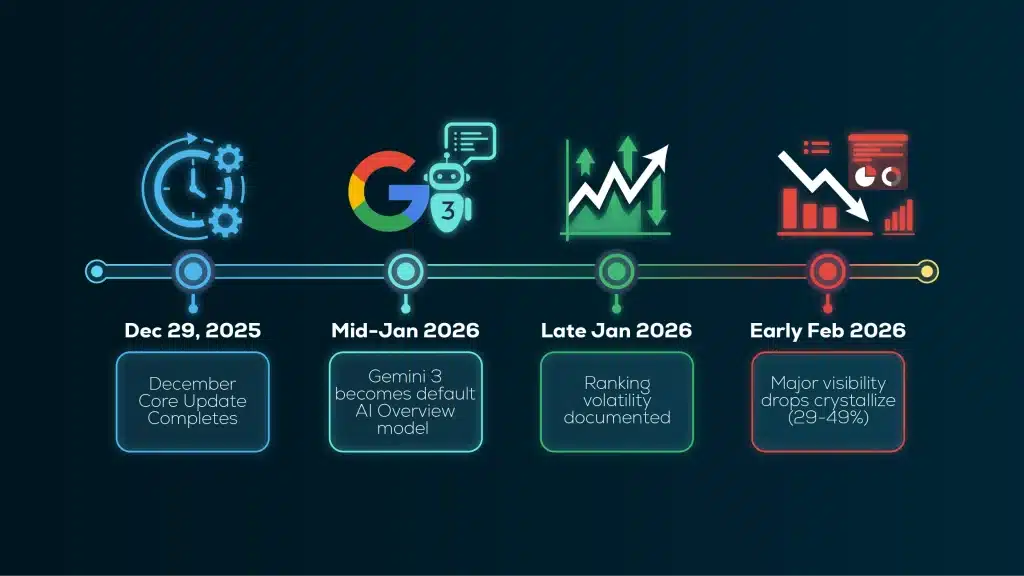
The February 2026 visibility drops affected primarily SaaS and B2B enterprise sites, with declines ranging from 29% to 49% concentrated in blog and resource center subfolders. The volatility followed the December 2025 Core Update completion and coincided with Google’s Gemini 3 becoming the default AI Overview model in mid-January 2026.
Before we analyze why, let’s establish what. The timeline matters because it shapes which theories hold water.
The Timeline — December 2025 Through February 2026
Google’s December 2025 Core Update completed on December 29. For most sites, the immediate impact was modest — the typical reshuffling that accompanies any core update. But something shifted in mid-January. Google rolled out Gemini 3 as the default model powering AI Overviews, a change that would prove more consequential than most initially recognized.
By late January, Barry Schwartz at Search Engine Roundtable began documenting significant ranking volatility. Visibility tools like Sistrix showed dramatic movement. And by early February, the pattern crystallized: major enterprise sites were experiencing precipitous drops, with the decline concentrated in their content hubs rather than their product or service pages.
Who Got Hit — And How Badly
The affected sites shared striking similarities. Analysis by Lily Ray, VP of SEO Strategy at Amsive, documented visibility drops across multiple well-known brands:
- One $8B B2B brand lost 49% visibility between January 21 and February 2
- A SaaS company dropped 43% starting January 19
- Another B2B/B2C SaaS fell 42% in the same window
- Multiple additional sites showed drops between 29% and 38%
The consistent pattern: blog or resource center subfolders represented 70-93% of these sites’ total organic visibility, and those subfolders bore the brunt of the decline. Product pages, service pages, and other sections often remained stable or even gained visibility during the same period.
Three Competing Theories — What Experts Are Saying
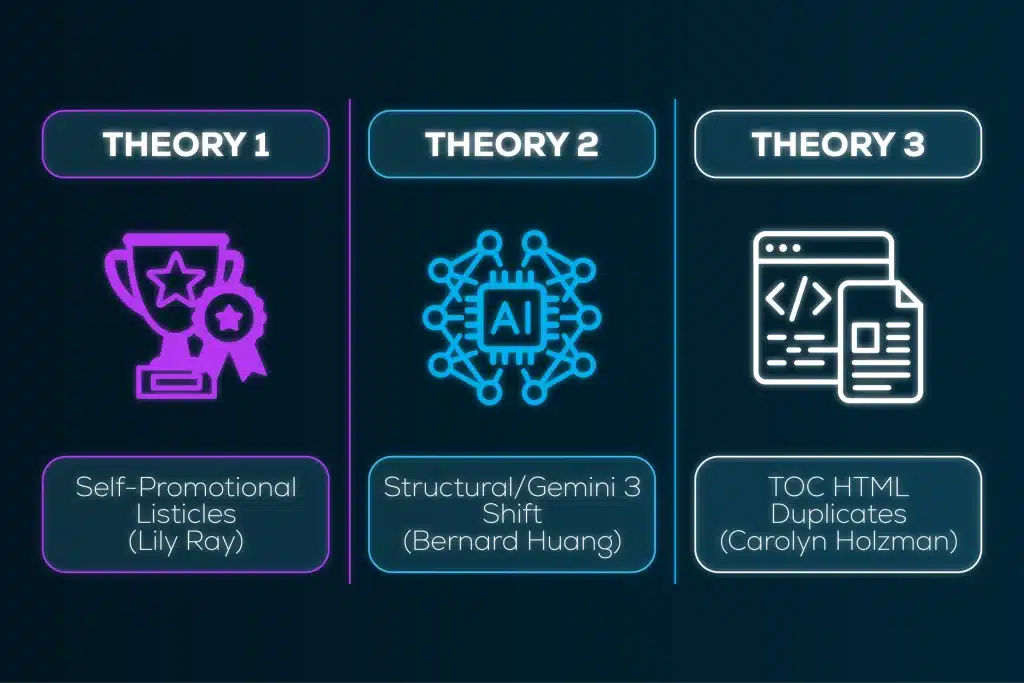
Three distinct analytical frameworks emerged to explain February 2026: self-promotional listicle targeting by Google’s Reviews System, structural shifts from Gemini 3 changing how AI Overviews resolve intent, and Table of Contents HTML creating unintentional duplicate content classifications. Each theory has evidence; none fully explains the data alone.
Rather than pick a side, let’s examine each theory on its merits. The strategic response that emerges works regardless of which theory proves most accurate.
Theory 1 — Self-Promotional Listicles Are Being Penalized
Lily Ray’s analysis on Is Google Finally Cracking Down on Self-Promotional Listicles? she identified a striking pattern: every major site experiencing significant drops had published dozens to hundreds of self-promotional listicles. These are “best of” articles where the publishing company ranks itself or its products in the top position — often #1 — without transparent methodology or evidence of real evaluation.
The numbers were substantial. One affected site had 191 such articles. Another had 228. A third had 340. While these represented small percentages of total indexed pages, the pattern was consistent across all significantly impacted sites.
Ray connected this to Google’s Reviews System, which has increasingly focused on detecting self-serving, biased, or low-evidence review content. The tactic had worked — self-promotional listicles had proven effective at driving visibility in both organic search and AI-generated answers. But as Ray noted, “it works, until it doesn’t.”
This theory aligns with Google’s documented guidance on avoiding content written primarily for search engines rather than humans. When a company consistently ranks itself first without demonstrating real evaluation of competitors, it fails multiple quality signals: original research, transparent methodology, and trustworthy information presentation. For organizations serious about technical SEO and content architecture, this represents a fundamental misalignment between content strategy and quality guidelines.
Theory 2 — It’s Structural, Not Format-Specific
In Huang’s analysis, Bad News: It’s Not Just Listicles, he takes a different approach. When his own site experienced similar declines, his team analyzed the data by content type — expecting to find self-promotional content as the primary driver. Instead, they found broad-based decline across multiple content categories.
Self-promotional content accounted for only about 55% of Clearscope’s overall decline. The rest came from educational content, guides, and other formats that had nothing to do with self-ranking listicles.
Huang’s theory: the real shift was structural. In mid-January, Google made Gemini 3 the default model for AI Overviews globally. This upgrade brought fresher information, longer multi-step reasoning chains, more complete intent resolution directly in the Overview, and a more seamless conversational follow-up experience.
When AI Overviews become more capable at resolving intent, fewer users need to scroll down or click through. Impression volume and click-through rates decline not because content is penalized, but because the search surface itself has changed. The visibility isn’t lost to competitors — it’s absorbed by the AI layer.
Theory 3 — Table of Contents HTML Is Creating Duplicate Content
Carolyn Holzman, a forensic SEO specialist, analyzed the same set of affected sites and arrived at a markedly different conclusion in her research, It’s Not Just Listicles. Its Not Use of Scaled AI Content – Its A Real Problem. Rather than focusing on self-promotional listicles, she identified a consistent technical pattern: every impacted page included Table of Contents (TOC) HTML—either embedded within the article body, implemented as a sidebar widget, or both.
Her theory centers on how anchor-based navigation may be interpreted during crawling and indexing. When a TOC includes jump links (e.g., domain.com/#section-one), those fragment URLs can, under certain conditions, be treated as distinct URL variations. While canonical tags are intended to consolidate these signals, they are not directives, and their effectiveness has diminished in some cases since Google deprecated the URL Parameter Tool in 2022.
If these anchor-based URLs are processed as separate entries containing largely identical content, the result could be a proliferation of duplicate signals across a domain. Over time, this may lead to content suppression at scale—offering a plausible explanation for the visibility pattern many analysts observed: an initial surge in impressions followed by a sharp and sustained decline.
Holzman’s findings suggest that this issue is not limited to listicle-style content, but may instead reflect a broader technical vulnerability tied to how structured navigation elements are implemented.
“The reason AI cites content is NOT because of the TOC html. The reason they are cited is the H2s which are part of the semantic HTML. AI would cite content with just the H2s alone.” — Carolyn Holzman
What’s Actually Happening
The data doesn’t point to a single cause—and that’s where many analyses fall short. Instead, what we’re seeing is a convergence of signals.
Across impacted sites, several patterns consistently appear:
- Self-promotional bias, where brands rank themselves without clear, objective evaluation
- Scaled content structures that rely on repeatable templates across dozens or hundreds of pages
- Limited first-hand experience or original insight
- Structural similarities (including TOCs, formatting, and layout) that reduce content differentiation
Listicles themselves aren’t the problem.
Predictable, self-serving content patterns are.
This explains why some listicles continue to perform well while others lose visibility. The differentiator isn’t format—it’s trust, originality, and intent alignment.
Technical factors—like how Table of Contents elements are implemented—may amplify these issues in certain cases. But they are more likely contributing signals, not root causes.
At a broader level, this aligns with the direction of Google’s ranking systems: rewarding content that demonstrates real expertise, clear value, and independent perspective—while systematically devaluing content that appears scaled, redundant, or overly self-serving.
What Actually Matters — The Signals Google Is Rewarding Now
Regardless of which theory proves most accurate, three content signals consistently separate affected sites from resilient ones: first-hand experience over aggregation, topical authority over keyword chasing, and structural depth over format optimization. Content that interprets information — rather than simply organizing it — shows greater resilience to algorithm volatility.
The strategic question isn’t which theory is correct. It’s what the convergence of all three theories tells us about where content quality is heading.
First-Hand Experience Over Aggregation
Google has long recommended that review content contain real evidence of having tested the reviewed products or services. The February 2026 drops suggest this standard is being applied more broadly and more strictly.
Self-promotional listicles fail this test almost by definition. A company claiming to have “extensively researched” competitors — while consistently ranking itself first — lacks credibility. There’s no evidence of real evaluation, no transparent methodology, no authentic comparison.
The question to ask of any content: “Could this have been written by someone who has actually done this, or is it compiled from what others have said?” Content demonstrating genuine experience — specific examples, nuanced observations, practical details — signals E-E-A-T in ways that aggregated content cannot.
Topical Authority Over Keyword Chasing
The Helpful Content System doesn’t evaluate individual pages in isolation. Google’s leaked API documentation revealed concepts like siteFocus and siteRadius — domain-level quality signals that assess how well a site demonstrates expertise across its content.
This explains why the affected sites’ product pages often remained stable while their blogs collapsed. A blog filled with formulaic listicles chasing every possible “best X for Y” keyword undermines domain authority even if individual pages rank well initially. The same principle applies to integrated organic and paid strategy — long-term success requires building authority rather than chasing volume.
Structural Depth Over Format Optimization
Holzman’s analysis offered an important insight: AI systems cite content based on semantic HTML structure — the H2 and H3 headers — not the Table of Contents links themselves. The headers enable extraction and citation; the TOC links may actually create problems.
More broadly, this points to a distinction between content that optimizes for format versus content that demonstrates depth. A listicle with ten items and a TOC has a particular structure. But if each item contains only surface-level information compiled from public sources, the format doesn’t save it.
The question to ask: “Does this content interpret information, or does it just organize it?” Content that adds analysis, perspective, methodology, or original insight provides value that AI systems cannot easily replicate by synthesizing other sources.
How to Audit Your Listicle Content — A Practical Framework
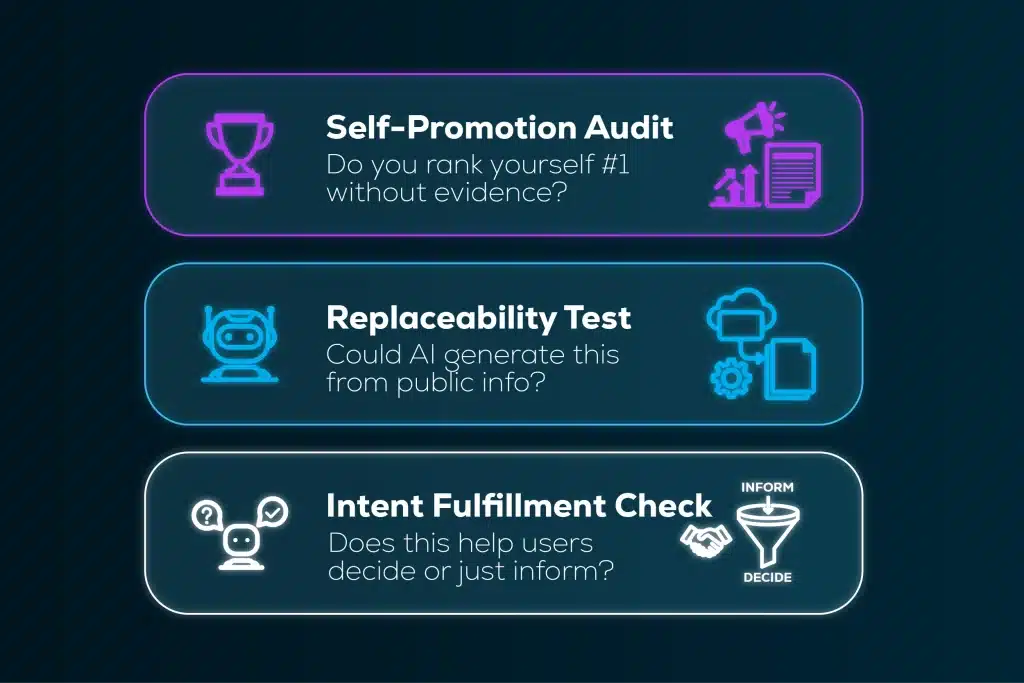
Audit your content with three tests: the Self-Promotion Audit identifies biased ranking patterns, the Replaceability Test evaluates whether AI could generate equivalent content, and the Intent Fulfillment Check assesses whether content helps users make decisions they couldn’t make from facts alone.
If you’re concerned about your own content — or want to prevent future vulnerability — here’s a practical framework for evaluating your listicle and comparison content.
The Self-Promotion Audit
Start with a simple search to identify your self-promotional content:
site:yourdomain.com intitle:best “1. [your company name]”
Count the results. If you have dozens or hundreds of pages where your company or product appears in the #1 position, you’ve identified a pattern worth examining. This doesn’t mean every such page is problematic, but concentration matters. Ray’s analysis showed affected sites had self-promotional listicles representing 1-10% of their indexed content.
For each page, ask: Is there transparent methodology for the ranking? Is there evidence of real evaluation of competitors? Would a neutral third party arrive at the same conclusion? If the answers are no, the content sits in what Ray calls the “gray area” of SEO — not explicitly violating guidelines, but not demonstrating genuine value either.
The Replaceability Test
Ask a harder question: Could an AI generate this content from publicly available information?
If the answer is yes, the content is vulnerable — not necessarily to algorithmic penalty, but to obsolescence. As AI Overviews become more capable at synthesizing comparisons and resolving intent, content that merely organizes public information loses its functional value.
Look for what makes content irreplaceable: proprietary data, original research, unique methodology, specific first-hand experience, or interpretive analysis that requires genuine expertise. This is where understanding semantic SEO principles becomes relevant — content built around meaning, context, and topical depth demonstrates the kind of expertise that AI cannot easily replicate.
The Intent Fulfillment Check
Finally, evaluate whether your content actually helps users make decisions — or just informs them.
There’s a difference between “here are ten options” and “here’s how to choose the right option for your situation.” The former organizes information. The latter interprets it.
After reading your content, can someone take action with confidence? Or do they need to search further to actually make a decision? Content that completes the user’s task — rather than just contributing to it — has structural advantages in both traditional search and AI citation.
What This Means for Your Content Strategy
Listicles aren’t dead — low-value listicles are. The February 2026 update revealed a broader truth: quality signals now propagate across Google organic, AI Overviews, and LLM citations simultaneously. Lose credibility with one system, lose visibility across all of them.
Listicles Aren’t Dead — But Low-Value Listicles Are
The format isn’t the problem. High-quality listicles that demonstrate real evaluation, transparent methodology, and genuine expertise continue to perform well. The format provides useful structure for both human readers and AI extraction.
What’s dying is the low-effort approach: templated “best of” articles scaled across hundreds of keywords, ranking the publisher first without real evidence, and treating the format as a ranking tactic rather than a communication choice.
The key question for any listicle: “Does this help someone make a decision they couldn’t make from the facts alone?” If your content adds interpretation, context, and expertise, the format serves the content. If the format is just a container for organized facts, it’s vulnerable.
The AI Visibility Connection
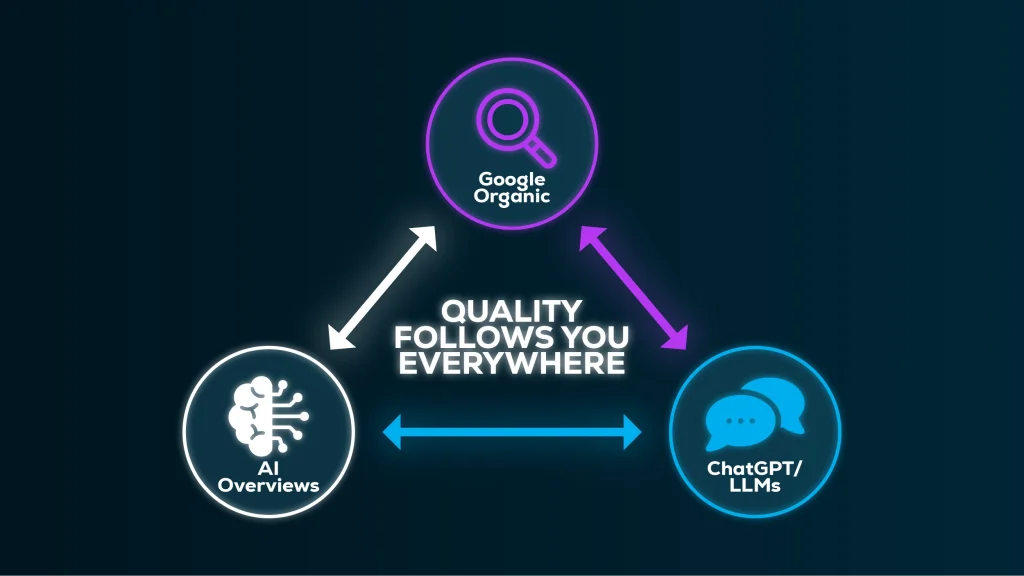
Perhaps the most significant finding from February 2026: quality signals now propagate across discovery platforms. Sites that dropped in Google organic search simultaneously dropped in AI Overviews and ChatGPT citations.
The Grokipedia case study illustrates this starkly. The AI-generated encyclopedia surged from 19 Google clicks in November 2025 to 3.2 million by January 2026. Then it collapsed — not just in Google, but across AI Overviews, AI Mode, and ChatGPT simultaneously. As SEO analyst Glenn Gabe documented, “Drop in Google and you can drop heavily in AI Search.”
This means content quality isn’t just an SEO concern. It’s a cross-platform visibility concern. The old playbook of gaming one channel while ignoring others no longer works. Quality — or the lack of it — follows you everywhere.
The Human+AI Advantage
The irony of February 2026 is that sites scaling AI-generated content got hit, while the winning approach turns out to be human intelligence augmented by AI efficiency.
AI excels at research, organization, and scaling. Humans provide what AI cannot: first-hand experience, interpretive analysis, strategic judgment, and authentic expertise. Content that combines AI efficiency with human insight produces work that’s both scalable and defensible.
At Growth Conductor, this is exactly how our Content Engine service operates: AI-powered research and structure, human-led strategy and creative. The result is content that builds lasting authority rather than temporary rankings — content that interprets information rather than just organizing it.
Frequently Asked Questions
Listicles remain effective when they provide genuine evaluation and expertise rather than simply organizing publicly available information. The February 2026 update targeted low-value, self-promotional listicles — not the format itself. High-quality listicles that demonstrate first-hand experience, transparent methodology, and authentic recommendations continue to perform well in both traditional search and AI citations.
Google did not issue a specific listicle penalty. The February 2026 visibility drops appear connected to multiple factors: ongoing Helpful Content System refinements, Gemini 3 deployment in AI Overviews, and potentially technical issues with how Table of Contents links are being classified. Self-promotional listicles were one pattern among several affected content types, suggesting the issue is content quality rather than content format.
Check your blog or resource center visibility in tools like Sistrix, Semrush, or Ahrefs for drops beginning mid-January 2026. Look specifically at the subfolder level — affected sites typically saw their content hubs decline while product pages remained stable. Audit for self-promotional listicles using the search: site:yourdomain.com intitle:best “1. [your company name]”. If you find dozens of such pages and experienced visibility drops, the patterns may be connected.
High-quality listicles demonstrate first-hand testing or experience with listed items, provide transparent evaluation methodology, include original insights beyond what AI could compile, and help readers make decisions. Low-quality listicles simply aggregate public information, consistently rank the publisher’s products first without evidence, use formulaic templates at scale, and provide no evidence of real evaluation. The key distinction: does the content interpret information or just organize it?
Not necessarily. The forensic analysis suggests TOC anchor links may be creating duplicate content classification issues, but this is one theory among several and not yet confirmed. More important: your H2/H3 header structure — which AI uses for citation extraction — provides the semantic value, not the TOC links themselves. Focus on content quality first. If you want to test, try removing TOC from a subset of pages and monitor the impact over 60-90 days.
Key Takeaways
- February 2026 brought significant visibility drops (29-49%) primarily affecting SaaS and B2B sites’ blog and resource sections, while product pages often remained stable.
- Three competing theories explain the drops: self-promotional listicle targeting, Gemini 3 structural shifts in AI Overviews, and TOC HTML creating duplicate content classifications.
- The common thread across all theories: content that organizes information without adding interpretation or expertise is increasingly vulnerable to algorithmic devaluation.
- Audit your content for self-promotion patterns, replaceability by AI, and genuine decision-support value. Concentration of low-value content appears to matter as much as individual page quality.
- Quality signals now propagate across platforms: decline in Google organic visibility correlates with decline in AI Overviews and LLM citations. You can’t game one channel independently.
- Listicles aren’t dead — low-value listicles are. The winning approach combines AI efficiency with human insight: scalable processes that still deliver genuine expertise and interpretation.
Ready to Audit Your Content Strategy?
The February 2026 update revealed what Google values: content that interprets, not just organizes. At Growth Conductor, our Content Engine team combines AI-powered research with human-led strategy to create content that builds lasting authority — not just temporary rankings.
Our technical SEO and content architecture approach ensures your content is structured for both traditional search and AI citation eligibility. Whether you need a content audit, a strategic refresh, or a complete rebuild of your content engine, we help you create work that demonstrates expertise rather than just claiming it.
Stop publishing content that blends in. Start building content that wins.
Let our team help you turn insight into execution.