



Quick Summary
E-E-A-T — Experience, Expertise, Authoritativeness, and Trustworthiness — has become the primary quality filter separating ranked content from invisible content in 2026. As AI-generated material floods the web, Google’s ability to detect genuine human experience and subject matter depth has sharpened significantly. Marketers who understand how to build E-E-A-T into AI-assisted workflows are outperforming those who treat it as an afterthought. This article breaks down what each signal means, why Experience is the hardest one for AI to replicate, and how to build a content workflow that earns both traditional rankings and AI Overview citations.
If you have spent any time in marketing conversations over the past two years, you have heard the same question repeated in different forms: does AI content actually rank? The short answer is yes — briefly, for some queries, on some domains. The more useful answer is that the question itself is the wrong frame.
Google does not penalize content for being AI-generated. What Google’s systems increasingly penalize is content that lacks the signals of genuine expertise, lived experience, and trustworthiness — signals that pure AI output structurally struggles to produce. The framework Google uses to evaluate these signals has a name: E-E-A-T.
Understanding E-E-A-T is not about gaming an algorithm. It is about building content that a real expert would actually write, a real reader would actually find useful, and a real AI system would consider worth citing. In 2026’s search environment — where AI Overviews appear in more than half of all queries and only 38% of those citations come from top-10 organic results — that distinction matters more than it ever has.
This article breaks down what E-E-A-T means, why the Experience signal has become the most consequential of the four, and how marketing teams can build it into AI-assisted content workflows from the start.
Why Experience Is the E-E-A-T Signal That Matters Most in the Age of AI

E-E-A-T — Experience, Expertise, Authoritativeness, and Trustworthiness — are the four quality dimensions Google uses to evaluate content. Of the four, Experience is the signal that AI tools cannot authentically replicate. It requires first-hand involvement: actually doing the thing being written about, observing real results, and translating lived practice into content. As AI-generated material becomes ubiquitous, the presence or absence of genuine experience signals is increasingly what separates content that holds its rankings from content that collapses within 90 days.
Breaking Down Each Element
Before we get into how Experience became the defining signal, it helps to understand what each letter actually means in practice — because they are often misunderstood as a checklist when they are really a framework for evaluating content quality from the reader’s perspective.
Experience is first-hand, personal involvement with the subject. Did the person who created this content actually do the thing they are describing? Experience shows up in specific details, nuanced observations, and the kind of practical caveats that only come from real-world application. It is the signal most likely to be missing from AI-generated content — and, as a result, the signal Google has placed increasing weight on since the December 2025 Core Update extended E-E-A-T requirements beyond traditional YMYL topics to general marketing, business, and education content.
Expertise is demonstrated depth and command of the subject. Note that this is different from credentials. A person can have a PhD and write shallow content. Expertise shows up in how a topic is framed, what context is provided, what nuance is acknowledged, and what practical implications are drawn. AI tools can approximate expertise patterns quite well — which is why Expertise alone is no longer sufficient to differentiate content.
Authoritativeness is whether other credible sources recognize and reference you. It is built over time through backlinks, brand mentions, consistent publishing on a topic, and being cited by other authoritative sources. This is largely a domain-level signal rather than a page-level one, though individual articles that earn citations and links contribute to it.
Trustworthiness is the foundation on which the other three signals rest. It includes accuracy, source attribution, transparent authorship, secure infrastructure (HTTPS), and the absence of manipulative or misleading language. An article can demonstrate experience, expertise, and authority — but if it cites fabricated statistics or hides its authorship, trustworthiness collapses.
Of the four E-E-A-T signals, Experience is the one AI cannot fake. The others can be approximated. Experience requires having actually done the thing — and that still requires a human.
How Google Uses E-E-A-T to Train Its Ranking Systems
A common misconception is that E-E-A-T is a direct ranking factor — a score that Google calculates and applies to each page. It is not. E-E-A-T is a framework used by Google’s Quality Raters: human evaluators who assess content quality according to Google’s Search Quality Rater Guidelines. Their assessments do not directly change rankings for individual pages, but they do train the machine learning models that power Google’s ranking systems over time.
The practical implication: E-E-A-T is built into the algorithm at a system level. Pages that consistently demonstrate strong E-E-A-T signals perform better across algorithm updates. Pages that lack them are increasingly vulnerable — a pattern that became starkly visible after the December 2025 Core Update. Research by BKND Development analyzing post-update traffic data found that sites with verifiable E-E-A-T signals saw an average 23% increase in organic traffic, while content farms producing high volumes of generic material experienced significant losses.
The update’s reach extended beyond the health, finance, and legal topics (YMYL — Your Money or Your Life) that had historically been the primary E-E-A-T battleground. Marketing, business strategy, and technology content were all affected — meaning agencies and marketing teams can no longer treat E-E-A-T as someone else’s problem.
Does E-E-A-T Apply Differently to AI-Generated Content?
Google’s systems evaluate content quality signals — not authorship method. AI-generated content is not penalized by default. What gets penalized is the structural absence of experience, expertise, and trust signals that characterizes most AI-only content. Research tracking 15,000+ URLs over 16 months found that pure AI content achieved meaningful rankings in the short term but dropped out of the top 100 within 90 days at a rate of 97% when no E-E-A-T signals were present. The content production method is irrelevant. The quality signals are everything.
Google’s Official Position — and What It Actually Means
In November 2025, Google’s John Mueller addressed the AI content question directly: Google’s systems do not evaluate whether content was written by a human or an AI — they evaluate whether it is helpful, accurate, and trustworthy for users. That statement is accurate, and it is also frequently misread as a green light for unrestricted AI content production.
What Mueller’s statement does not say is that AI content performs equally well. The data tells a more nuanced story. A 16-month tracking study published by Search Engine Land in March 2026 monitored AI-generated content across 847 domains. The findings: pages with strong E-E-A-T signals — regardless of whether they were AI-assisted or human-written — maintained and grew their rankings. Pages without those signals, whether AI-generated or not, declined. The content production method was not the determining variable. The quality signals were.
The practical conclusion: using AI in your content workflow is not a competitive disadvantage. Using AI as a replacement for the human judgment, experience, and oversight that produce E-E-A-T signals is.
The Experience Gap — What AI Cannot Produce

Of the four E-E-A-T elements, Experience is the one that AI tools genuinely cannot replicate. AI language models are trained on text — they can identify patterns in how experts write, synthesize information across sources, and produce content that matches the structure and vocabulary of experienced practitioners. What they cannot do is draw on first-hand involvement with the subject.
The difference shows up in concrete ways. Consider two descriptions of the same content marketing strategy:
Generic version (no experience signal): ‘A/B testing your CTA copy can significantly improve click-through rates. Testing different variations helps identify which language resonates best with your audience.’
Experience signal present: ‘When we changed a client’s primary CTA from ‘Learn More’ to ‘Get Your Free Audit’ in Q3 2025, click-through rate increased 41% within the first two weeks — and the leads that came through converted at a higher rate because the CTA itself set clearer expectations.’
Both statements convey the same general principle. Only the second one demonstrates that the author has actually done this. Only the second one gives the reader a specific, replicable data point. And only the second one is the kind of passage that Google’s systems — and AI Overview citation models — are increasingly designed to surface.
How to Build E-E-A-T Into AI-Assisted Content Workflows
Building E-E-A-T into AI-assisted content is not about using less AI — it is about being deliberate about where humans lead and where AI supports. AI tools are highly effective at research synthesis, structural drafting, semantic coverage, and FAQ generation. They are ineffective at supplying the first-hand experience, strategic framing, and brand-specific context that make content genuinely authoritative. The teams producing content that ranks and earns citations in 2026 are those who have drawn that line clearly and built their workflows around it.
The Human + AI Content Model — Dividing the Work

The most effective AI-assisted content workflows are not the ones that use the most AI — they are the ones with the clearest division of responsibilities between AI tools and human judgment. At Growth Conductor, every content brief is human-led from the start — the same principle that drives our SEO services. The AI handles the tasks it genuinely excels at. Humans handle the tasks where their involvement is irreplaceable.
AI’s role in a well-structured content workflow: keyword and entity research synthesis, draft structure generation, supporting keyword integration, FAQ draft production, semantic coverage verification, and metadata drafts. These are tasks where AI accelerates production without compromising quality — and where the output is easily validated by a human reviewer.
The human role: strategic framing and angle (what is the unique point of view this article takes?), first-hand examples and results, brand voice application, source verification and accuracy checking, and creative direction for visual assets. These are the tasks where human involvement is not just valuable — it is the difference between content that builds authority and content that blends into the background.
The key insight for marketing teams: the quality ceiling for AI-assisted content is set by the human layer, not the AI layer. More AI output without more human oversight produces diminishing returns. The workflow that scales is the one where AI handles volume and humans handle value.
Five Ways to Add Experience Signals to AI-Assisted Content
These tactics are not theoretical — they are the specific techniques that separate AI-assisted content with genuine E-E-A-T signals from the commodity content filling the web right now.
- Add a practitioner perspective to every article. This does not require a lengthy section — a single paragraph describing what you or your team actually observed, tested, or applied is enough. The key is specificity: ‘In our experience’ is weak; ‘When we restructured a client’s blog architecture in January 2026, organic sessions increased 34% within 60 days’ is strong. The specificity is the signal.
- Use real data from your own work. Industry statistics are widely available and used by every article on a given topic. Your own performance data — from campaigns, audits, client accounts, or internal tests — is unique. Even approximate figures with context (‘across the 40+ SEO audits we ran in 2025, the most common structural issue was…’) carry significantly more E-E-A-T weight than citing a Gartner report that ten other articles on the same topic also cite.
- Replace generic scenarios with real client contexts. ‘Imagine a mid-size e-commerce business…’ is a construction AI produces naturally and that signals nothing. Even anonymized client scenarios (‘a regional healthcare provider we worked with in Q4 2025…’) carry experience signals that generic constructions do not. The reader recognizes the difference immediately — and so do Google’s systems.
- Add temporal markers from real practice. Phrases like ‘tested in Q3 2025,’ ‘observed across 12 client accounts over 6 months,’ and ‘as of March 2026, our approach has been…’ signal both recency and lived practice. They tell the reader — and the algorithm — that the content reflects ongoing, current engagement with the subject rather than a synthesis of what others have written.
- Invest in real author attribution. Named authors with verifiable credentials — specific role, years of experience, named clients or publications, a link to a LinkedIn profile with actual activity — consistently outperform anonymous or generic bylines. This is not a minor SEO tweak. Author schema with ‘sameAs’ linking to a real professional profile is a direct trust signal that influences both organic ranking and AIO citation eligibility.
Trust Signals That AI Content Frequently Misses
Beyond the Experience gap, AI-assisted content commonly falls short on several trustworthiness signals that are easy to miss in a high-volume production workflow.
Source attribution is non-negotiable. Every statistic needs a named, linkable source and a publication year. ‘Studies show…’ and ‘research indicates…’ are automatic trust failures — and automatic fail conditions under GC’s content scoring matrix. If a claim cannot be attributed to a specific source, it should not be in the article.
Accuracy maintenance matters as much as accuracy at publish. A statistic that was accurate in 2024 and is now outdated is a trust signal problem. Content refresh cycles — not just publish cycles — need to be built into your workflow. Articles referencing stale data get caught in algorithm updates that prioritize freshness, and they erode brand credibility with readers who know better.
Transparency about AI involvement builds trust, not just credibility. Proactive disclosure of AI use in content production, where relevant and appropriate, signals editorial responsibility. Readers and search systems alike are increasingly sophisticated about AI content. Brands that acknowledge their workflow build more durable trust than those that obscure it.
E-E-A-T and AI Overviews — What Gets Cited and Why
Google AI Overviews now appear in more than 50% of all searches. Research across 15,847 AIO results found that 96% of citations come from sources with verified E-E-A-T signals — and 47% come from pages ranking below position five in traditional organic search. This means E-E-A-T quality can win AI Overview citations even without top organic rankings. The structural requirement for citation eligibility: self-contained answer passages that can be extracted and used without surrounding context, paired with FAQPage schema and comprehensive topic coverage.
How Google AI Overviews Select Content Sources

The emergence of AI Overviews as a dominant search feature has fundamentally changed the value equation for content quality. In traditional SEO, the primary objective was a top-10 organic ranking. In 2026’s search environment, a page ranking at position eight with strong E-E-A-T signals and well-structured answer passages can generate more visibility than a page ranking at position two with weak signals and dense, poorly structured content.
The citation selection mechanism works roughly as follows: AI systems scan content for self-contained passages that directly answer an implied question, can be extracted without surrounding context, and come from sources with verifiable authority signals. Pages that consistently structure content this way — opening every major section with a direct, self-contained answer — are significantly more likely to be cited than pages that bury the answer in surrounding context.
The data reinforces this: research tracking AIO citations across 15,847 results found that 96% came from sources demonstrating strong E-E-A-T signals, and 47% came from pages that were not in the top five organic positions. High E-E-A-T quality is a more reliable predictor of AIO citation than organic ranking position.
Structuring Content for AIO Citation Eligibility
The structural habits that improve AIO citation eligibility are not separate from good content writing — they are good content writing, applied deliberately. The core principle: lead with the answer, follow with the context. Most content does the opposite, spending the opening of each section establishing context before getting to the point. AI extraction systems reward the reverse structure.
Open every H2 section with a citation block. A 50–70 word paragraph that directly answers the implied question of the section heading — without preamble, without ‘In this section we will discuss…’ — is the primary extraction target for AI systems. Write this block as if it will be read in complete isolation, because it may be.
Use question-based headings where natural. Headings phrased as ‘How does / What is / Why does’ questions signal to AI systems that the following content is an answer to a specific query. At least two to three headings per article should be question-based — not forced, but wherever the topic genuinely lends itself to a question framing.
FAQ sections are not optional. A dedicated FAQ section with a minimum of four self-contained Q&A pairs, each 40–70 words, paired with FAQPage schema implementation at publish, is one of the highest-leverage structural elements for both AIO citation eligibility and traditional organic ranking. Every GC article includes this by default.
Cover the topic completely. Semantic completeness — addressing the PAA questions and related concepts a reader would expect on this topic — is the top AIO ranking factor. AI systems reward content that covers a subject comprehensively over content that focuses narrowly on a single keyword. The entities and related concepts in your SEO mapping block are your coverage checklist.
Frequently Asked Questions About E-E-A-T and AI Content
Yes — E-E-A-T applies to all content regardless of how it was produced. Google’s ranking systems evaluate quality signals, not authorship method. AI-generated content faces a structural challenge: it can match expertise patterns but cannot demonstrate first-hand experience, the signal Google has weighted most heavily since the December 2025 Core Update. Human oversight and experience-infused editing are essential for sustained performance in competitive organic search.
The most effective approach layers human experience signals onto AI-generated structures. Add practitioner examples with specific results and timeframes, cite all statistics with named sources and years, use real author attribution with verifiable credentials, and include first-person observations from actual work. The AI handles structure and production scale; humans provide the experience signals that algorithms cannot synthesize from training data alone.
Expertise is demonstrated depth of subject knowledge — shown through how content is explained, structured, and contextualized. Experience is first-hand involvement — actually doing the thing being written about. Both matter, but experience is harder to replicate. A content piece can sound expert while lacking any genuine experience signal, which is the core vulnerability of purely AI-generated content in Google’s 2026 ranking environment.
Yes, but only when it demonstrates strong E-E-A-T signals. Research shows 96% of AI Overview citations come from sources with verified expertise and trust signals. AI-assisted content that combines human experience signals, self-contained answer blocks, FAQPage schema, and comprehensive topic coverage is eligible for citation. Pure AI content without human value-add rarely sustains AIO presence past the initial indexing window.
Google does not penalize content for being AI-written. What Google’s systems increasingly surface is content that demonstrates genuine E-E-A-T signals — and what they deprioritize is content that lacks them, regardless of production method. A 16-month tracking study found that AI-generated content without E-E-A-T signals dropped out of top-100 rankings at a 97% rate within 90 days. The penalty is not for using AI — it is for producing low-quality content with it.
E-E-A-T signals are the primary predictor of AIO citation eligibility. Research across 15,847 AI Overview results found that 96% of citations came from sources with strong E-E-A-T signals — outranking organic position as a predictor. Content structured with self-contained answer blocks, question-based headings, FAQPage schema, and comprehensive topic coverage consistently earns more AIO citations than content optimized exclusively for traditional keyword rankings.
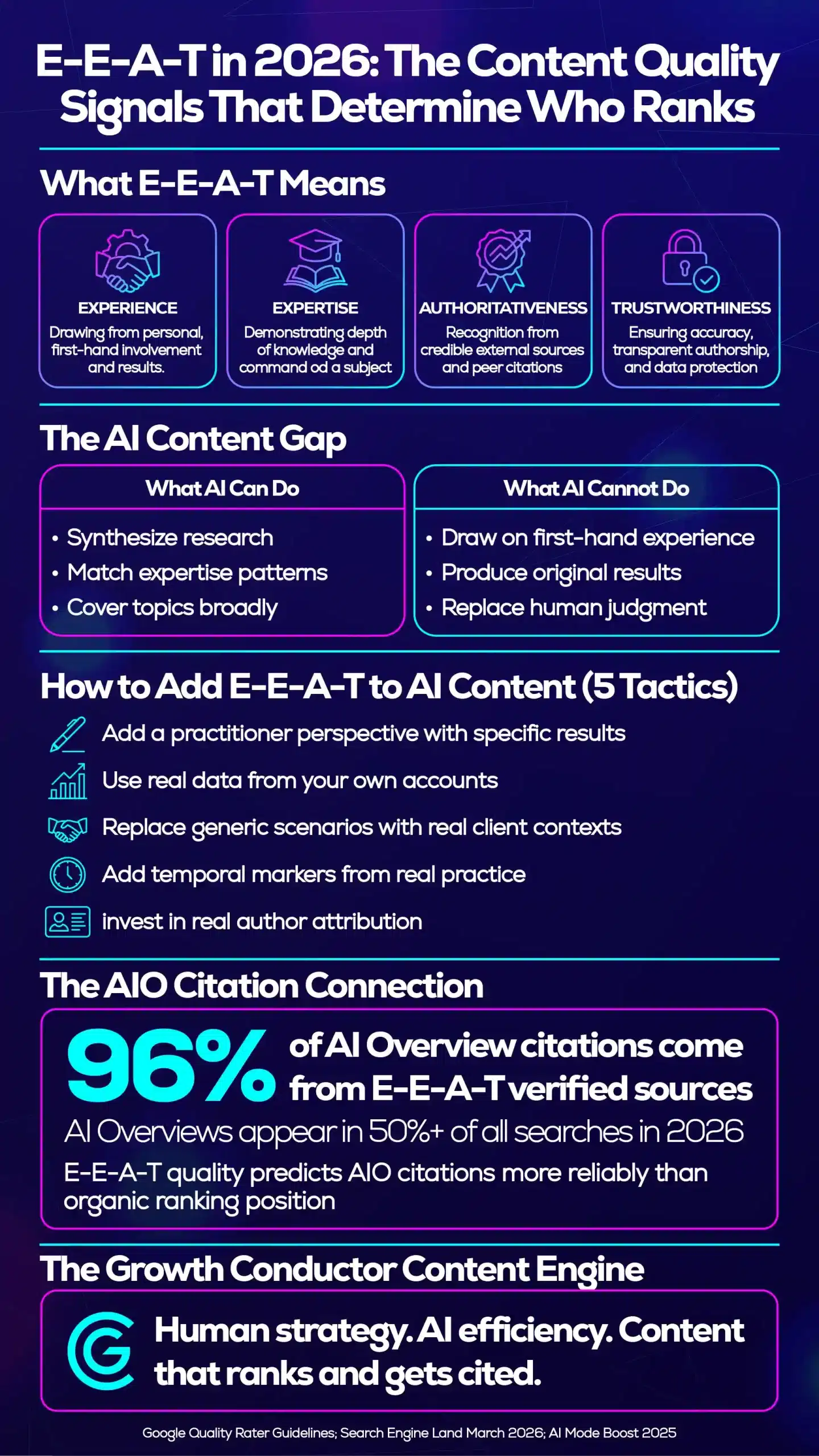
Key Takeaways — Building Content That Earns Rankings and Citations in 2026
The core shift in AI-driven content marketing over the past 18 months is not about AI replacing human writers. It is about the bar for what constitutes genuinely useful, authoritative content rising faster than most production workflows can keep up with. E-E-A-T is the framework that defines that bar — and Experience is the element that AI tools cannot clear on their own.
The teams winning in 2026’s search environment are those that have built their workflows around this reality: AI accelerates production, humans supply the signals that make content worth ranking. Here is what that means in practice:
- E-E-A-T is now a quality gatekeeper for all content — not just YMYL topics. The December 2025 Core Update extended these requirements across marketing, business, and education content.
- Google does not penalize AI content by default — it penalizes content lacking genuine expertise, experience, and trust signals. AI-only workflows structurally struggle to produce those signals at scale.
- Experience is the most defensible differentiator available to content teams. First-hand results, specific data, and named practitioner observations cannot be synthesized from training data — only humans can supply this layer.
- Structuring content for AIO citations — self-contained answer blocks, question-based headings, FAQPage schema — compounds the value of every E-E-A-T investment and expands visibility beyond traditional organic and paid search.
- The sustainable content production model for 2026: AI handles research synthesis and structural drafting; humans supply strategy, experience signals, and quality oversight. The bottleneck is always the human layer.
Ready to build a content operation that earns rankings and AI Overview citations?
Most marketing teams know they need better content. The harder problem is building a workflow where AI accelerates production without eroding the experience and trust signals that drive results. That is exactly what Growth Conductor’s Content Engine is designed to solve.
Every Content Engine engagement is human-strategy-led: we map your keyword territory, brief every article against your audience and service positioning, and apply AI where it creates efficiency — not where it cuts corners. The result is content built to rank in traditional search and earn citations in AI Overviews.