


Most SEO teams reporting Q1 2026 numbers are flying blind on the fastest-growing part of search. AI Overviews now appear on about half of all queries, click-through rates on those queries have dropped sharply, and Google Search Console gives site owners one combined “Web” number that mixes AI traffic in with traditional organic. There is no filter. There is no separate report. There is no way to show a client or stakeholder whether a traffic drop came from AI Overviews or a ranking change — not from the data Google gives by default.
At Google Search Central Live Toronto on April 21, 2026, the team confirmed that AI Overview tracking is in the works. They did not share a date. Until it’s available, there is a regex filter inside Search Console that gets SEO teams close — and used the right way, it does more than fill in the missing data. It shows content teams what to build next.
TL;DR: Google Search Console bundles AI Overview and AI Mode data inside the Web search type. There is no filter, no separate report, and no published timeline for one. A regex query filter isolates conversational long-tail queries — the queries most likely to trigger AI Overviews — and the results double as a content gap map. Archive pre-AI baseline data before the 16-month window closes.
Why Can’t You See AI Overview Data in Search Console?
Google Search Console bundles AI Overview and AI Mode clicks and impressions inside the standard Web search type. There is no dedicated filter, no separate report, and no way to pull AI traffic out from traditional blue-link organic. The data is in every site owner’s account — it just cannot be viewed on its own. For most teams, this means flying blind on the fastest-growing part of search.
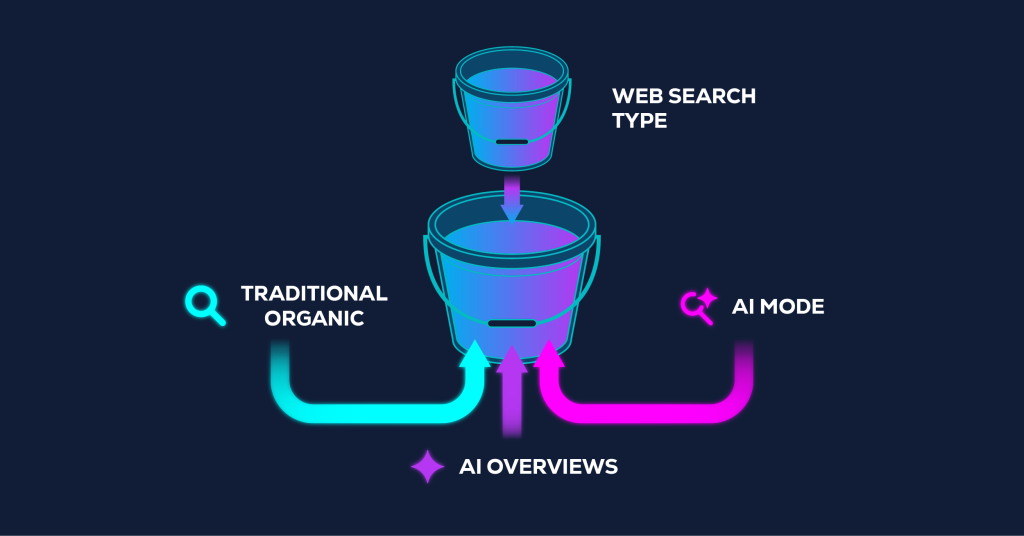
Search Console’s Web search type combines three data streams into one bucket: traditional organic blue-link results, AI Overviews, and AI Mode. Site owners see one combined number. AI Overview impressions show up in the same column as a standard organic listing. AI Mode interactions get folded into the same totals. The interface gives no way to separate them.
This is by design. Google has confirmed it. As Search Engine Roundtable documented in September 2025, John Mueller publicly debunked a fake screenshot that claimed to show an AI Overview filter, stating directly that no such filter exists in Search Console and that the help center page confirms these features are tracked within the general Web bucket.
What Search Console Actually Shows
- The Web search type combines traditional organic, AI Overviews, and AI Mode into one aggregate
- Impressions count once when a URL appears in both an AI Overview and a blue-link listing for the same query
- Position data is misleading: every link inside an AI Overview shares position 1 together, so a URL cited alongside three competitors and a URL cited alone both register the same way
Why This Breaks SEO Reporting
The reporting impact is real. When CTR drops on a query that triggers an AI Overview, there is no way to tell whether the loss came from the AI Overview absorbing the click, a competitor outranking the page, or a seasonal change in demand. Research from Seer Interactive in late 2025 measured a 61% organic CTR decline on AI Overview queries — falling from 1.76% to 0.61% — but that data was put together by manually cross-referencing GSC exports against third-party AI Overview tracking tools. The native interface gives no such read.
“The data exists in every site owner’s account. The interface just won’t let them see it”
What Did Google Announce at Search Central Live Toronto?
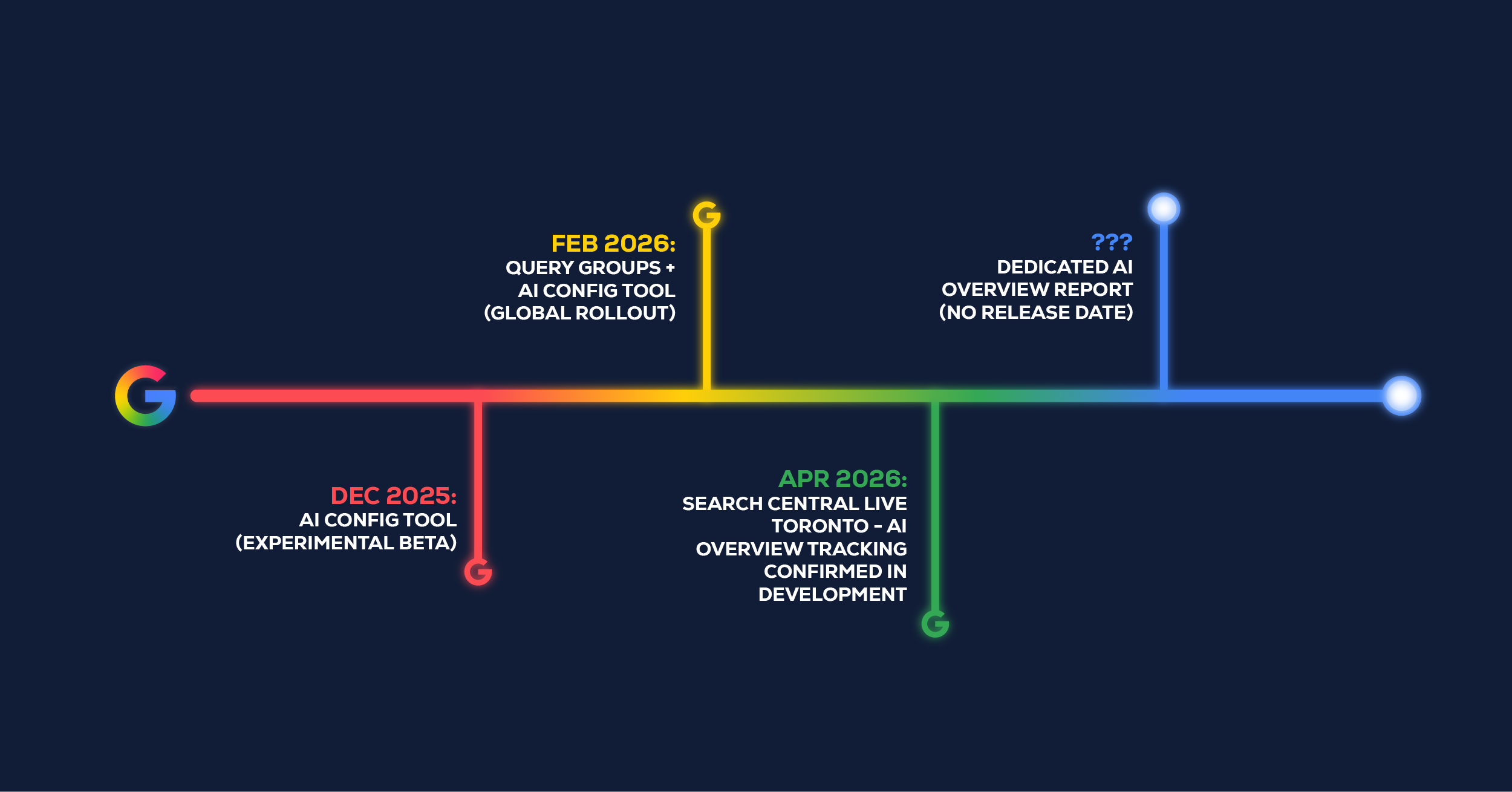
At Google Search Central Live Toronto on April 21, 2026, Google Search Advocate Daniel Waisberg presented Search Console updates and the team confirmed that AI Overview and AI Mode tracking is in development. No release date was given. Google has rolled out other Search Console AI features in 2026 — Query Groups and a natural-language configuration tool — but the dedicated AI Overview report has not been released.
The April 2026 Toronto event was the first Google Search Central Live held in Canada. SEO consultant Jean-Christophe Chouinard’s session notes captured the team’s position on AI Overview tracking directly: there was little new shared on AI Overview and AI Mode tracking, and while the team confirmed they are working on something, they gave no timeline.
Source: JC Chouinard — Search Central Live Toronto slide notes, April 2026.
That phrasing matters. Google has neither denied the gap nor committed to closing it. The acknowledgment without a date functions as a holding pattern — and SEO teams have to work inside it.
What Has Been Released (and Why None of It Solves the Gap)
Google rolled out several Search Console AI features in 2025 and 2026. None of them surface AI Overview data on its own.
- Query Groups (February 2026): Clusters similar queries into themes. Useful for cleaning up fragmented keyword reporting. Does not separate AI traffic from traditional organic.
- AI Configuration Tool (global rollout February 2026): Lets users configure Performance reports with natural-language prompts. Helpful for filter shortcuts. Does not surface AI Overview data on its own.
- Branded vs. non-branded filter: Helps spot where AI search is eating into informational queries while branded queries hold steady. Useful directional signal, but not AI-specific.
What Is Still Missing
- No dedicated AI Overview filter
- No dedicated AI Mode filter
- No published timeline from Google
- No commitment to backfilling historical data if and when the feature launches
How Are SEO Teams Tracking AI Overviews Inside Search Console Today?
Until Google releases a dedicated report, the most reliable workaround inside Search Console is a regex query filter that isolates conversational long-tail queries — the type most likely to trigger AI Overviews. The results don’t just reveal where AI Overviews are absorbing clicks; they surface content gaps and topic patterns SEO teams can use as a content strategy roadmap, turning a reporting limitation into a planning advantage.
The workaround uses a pattern in how people search: AI Overviews trigger most often on conversational, long-tail queries. Short transactional queries usually return a standard results page; long, question-shaped queries tend to surface an AI Overview block. By filtering Search Console queries to show only the long-tail set, SEO teams can zero in on the segment where AI Overview activity concentrates. The technique is established peer practice — Practical Ecommerce documented a near-identical regex pattern in their coverage of AI-style query detection in GSC.
The Regex Filter, Step by Step
- Open Search Console and navigate to Performance → Search Results
- Set the date range to Last 12 months (enough data to spot patterns, short enough to stay within the API window)
- Click Add Filter → Query
- Change the dropdown to Custom (regex)
- Paste the following expression:
^(?:\S+\s+){9,}\S+$ - Click Apply
The filter matches any query with ten or more words. To widen the threshold and surface even longer prompts, change the 9 to a 19 to capture queries of 20+ words. Those are the highest-signal AI Overview triggers.
What the Filtered Results Show
Most SEO teams stop the workaround at “now I can see AI-style queries.” That is half the value. The other half is what those queries tell content strategists about the site they are reporting on.
- High-impression, low-CTR queries: AI Overview is absorbing clicks. The page exists, it shows up in results, but visitors are getting their answer from the AI summary instead of clicking through.
- Recurring question patterns: Content gaps. Topics the target audience is asking about that the site has not covered yet. Each cluster of related long-tail queries points to an article that has not been written yet.
- Topic clusters in the results: Future pillar pages. When the regex surfaces a coherent group of related long-tail queries pointing at the same underlying intent, that is often a pillar page or content cluster the site should own.
“The regex doesn’t just show what’s being lost. It shows what to build next”
Why the 16-Month API Window Is a Hidden Problem
Google Search Console keeps only 16 months of performance data. As 2026 moves forward, pre-AI Overview baseline data from late 2024 is rolling out of the window. Once it’s gone, SEO teams lose the ability to show that traffic declines were caused by AI Overview rollout rather than ranking changes. Setting up the baseline now — by exporting data to Looker Studio or BigQuery — is the only defense.
The 16-month retention limit is one of the most overlooked problems in AI Overview reporting. AI Overviews began rolling out at scale in mid-2024. Twelve months later, that pre-AI baseline data started leaving Search Console’s accessible window. By late 2026, most teams will no longer be able to compare current performance against a pre-AI period inside the native interface.
The smart move is to archive the baseline before it’s gone. Two options work:
- Looker Studio: Connect Search Console as a data source and build dashboards that pull historical data into a persistent store. Free and quick to set up.
- BigQuery export: Set up the official Search Console bulk export. Higher technical lift, but produces a complete, queryable historical archive that does not age out.
Either approach turns the rolling window from a constraint into a managed dataset. Without one of them, the moment Google releases its AI Overview filter, the historical context needed to interpret it will already be gone.
What the Tracking Gap Means for SEO Reporting in 2026
The Search Console AI Overview gap isn’t just an inconvenience — it’s a real reporting problem. SEO teams can’t easily isolate the cause of CTR declines, can’t quantify how much AI is absorbing clicks, and can’t directly prove the value of content optimized for AI citation. Until Google releases dedicated tracking, the regex workaround plus a pre-AI baseline archive is the most defensible way to report AI impact to stakeholders.
Until Google releases dedicated AI Overview tracking, these are the most reliable ways to access AI Overview data inside Search Console: the regex query filter to isolate AI-style queries, the CTR comparison to measure the AI Tax, and the Looker Studio or BigQuery archive to protect the historical baseline. Used together, they give SEO teams a defensible read on AI search performance and a roadmap for what content to build next.
That’s why the most important work right now isn’t measurement — it’s building content that earns AI citations in the first place. Answer-first structure, semantic depth, structured data, and topical authority that builds over time. These are the same signals Google’s ranking systems reward, and they’re what separates content built for AI citation from generic SEO output. The non-commodity content framework Google itself has been pointing toward in 2026 is the strategic foundation.
For more on building scalable content infrastructure for AI search, see our complete guide to AI content marketing strategy.
Key Takeaways
- Google Search Console bundles AI Overview and AI Mode data inside the Web search type. No dedicated filter exists, and Google has not published a timeline for one.
- At Search Central Live Toronto in April 2026, Google confirmed AI Overview tracking is in development but offered no release date.
- The regex filter
^(?:\S+\s+){9,}\S+$isolates conversational long-tail queries inside Search Console — the closest native approximation of AI Overview traffic available today. - The filtered results double as a content strategy roadmap: high-impression / low-CTR queries flag where AI is absorbing clicks, recurring question patterns flag content gaps, and topic clusters flag future pillar opportunities.
- Archive pre-AI baseline data to Looker Studio or BigQuery before the 16-month window closes. Without it, future AI impact analysis loses its reference point.
Frequently Asked Questions
Not separately. AI Overview clicks and impressions are included inside the Web search type aggregate, blended with traditional organic. There is no filter to isolate them and no dedicated report. The data is in every site owner’s account; it just isn’t visible on its own. Google has confirmed a dedicated report is in development but has not released a timeline.
No date has been published. At Google Search Central Live Toronto on April 21, 2026, the Search Console team confirmed AI Overview performance reporting is on the roadmap. Google has rolled out other AI features in 2026 — Query Groups and a natural-language configuration tool — but the AI Overview report has not been released.
The most reliable workaround is a regex query filter. Inside the Performance report, add a Query filter with the Custom (regex) option and paste ^(?:\S+\s+){9,}\S+$. This isolates queries with ten or more words — the conversational long-tail pattern that correlates with AI Overview triggers. Changing the 9 to 19 narrows the filter to queries of 20+ words for the highest-signal results.
AI Overviews appear at the top of standard search results. AI Mode is a separate search tab with its own interface. In Search Console, both are routed into the Web search type aggregate with no separation. Neither has dedicated filtering, and neither can be isolated from traditional blue-link organic in the current reporting view.
Bridging the Gap Until Proper AI Tracking Arrives
None of these workarounds are perfect. The regex filter is an estimate. The CTR comparison is a directional read. The Looker Studio or BigQuery archive is a safeguard against a data limit that shouldn’t exist in the first place. Every one of them is a bridge — meant to carry SEO teams across the gap between where Search Console reporting is today and where it needs to be once Google releases dedicated AI Overview tracking.
That gap is real, and it’s frustrating. AI Overviews are reshaping how people find information faster than the tooling can keep up. Stakeholders want answers about traffic drops. Clients want to know what to do about declining clicks. Reports are due whether the data is complete or not. SEO teams across the industry are doing serious analytical work to fill in what Google hasn’t built yet, and that work is genuinely valuable. It’s not a stopgap — it’s a current capability that shows analytical depth most competitors aren’t bringing to the table.
The workarounds in this guide give SEO teams three immediate moves: see what can’t be seen by default, defend against losing the historical baseline, and turn the limitation into a content planning advantage. Used together, they produce reporting that holds up to leadership and translates directly into content strategy — both right now and for the months ahead while Google finishes building what it confirmed in Toronto.
When the dedicated AI Overview report is released, the teams that set up baseline archives, mapped their content gaps with regex, and built content for AI citation will be in a stronger position than teams who waited. The data Google eventually surfaces will validate work already done — not catch teams flat-footed.
Growth Conductor’s Content Engine was built for this transition. Strategy is led by humans who understand both traditional SEO and how AI search systems extract and cite content. Production is AI-assisted, scored against a 110-point matrix that includes specific AI Overview and Generative Engine Optimization signals, and structured so every article is built to be cited — not just ranked. For SEO leads, agency owners, and in-house marketing teams operating inside the current reporting gap, that’s the partnership: helping clients adapt now, so they’re ready when the tooling catches up.
Reporting on AI search without the data you need?
The regex workaround closes part of the gap. Content built to earn AI citations closes the rest.
See how Growth Conductor’s Content Engine puts both together