


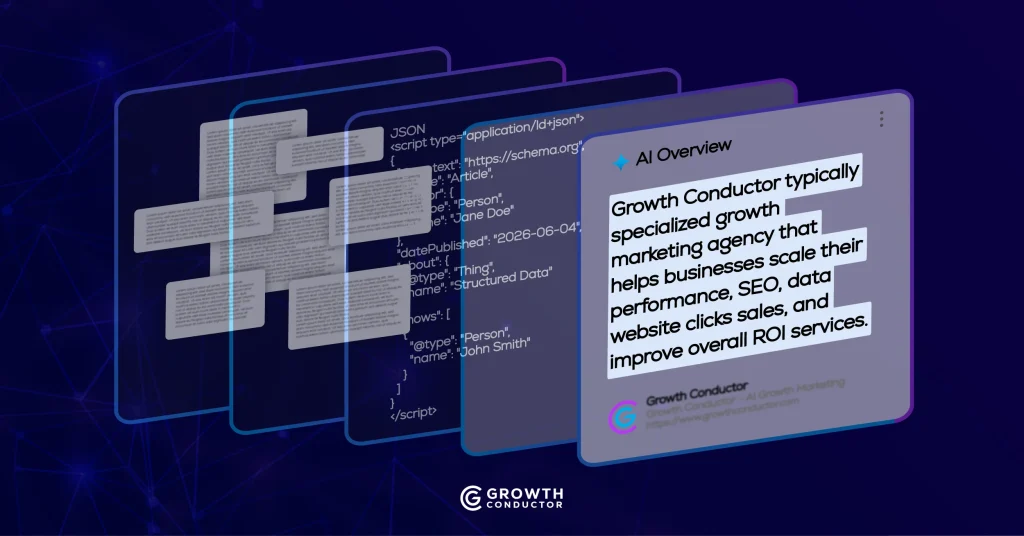
AI search engines do not read your website the way humans do. They do not skim your homepage, get a feel for your brand, or appreciate your headline copy. They read your code. And if your code does not explicitly tell them what your content is about — who wrote it, what it covers, how it relates to other things on the web — they often choose to cite someone whose code does.
That is the new reality of AI-driven search. Structured data is no longer a nice-to-have SEO enhancement reserved for recipe sites and product pages. It has become the layer that determines whether your content is even interpretable by the AI systems now driving Google’s AI Overviews, ChatGPT, Perplexity, Claude, and the next generation of search experiences. When an AI system chooses what to cite in its answer, it favors sources it can read with confidence. Structured data is the difference between being a confident citation and being an also-ran.
This reality also explains why schema strategy has shifted in 2026. Google has been quietly retiring visual rich result features for years — most recently completing the deprecation of FAQ rich results on May 7, 2026. But the underlying schema types themselves remain valid, and AI systems continue to use them heavily for content interpretation and citation. Schema today is not about earning visual SERP features. It is about being understood by the AI systems that now decide who gets cited.
Quick Summary: Structured data tells AI search engines exactly what your content is about, who wrote it, and how it relates to other entities. Sites with comprehensive schema markup are cited by AI Overviews at significantly higher rates than sites without it. Schema does not replace good content — it amplifies it. The brands winning in AI search treat schema as operational infrastructure, not a one-time SEO task.
This article gives you a working framework for structured data and AI search. We will cover what it is, why it matters more in generative search than it ever did in traditional rankings, which schema types drive the most citation lift, and what a real schema implementation actually looks like once you move past the plugin-and-pray approach. By the end, you should understand why getting schema right is a strategic decision rather than a checklist task.
What Is Structured Data and Why Does AI Search Depend On It?
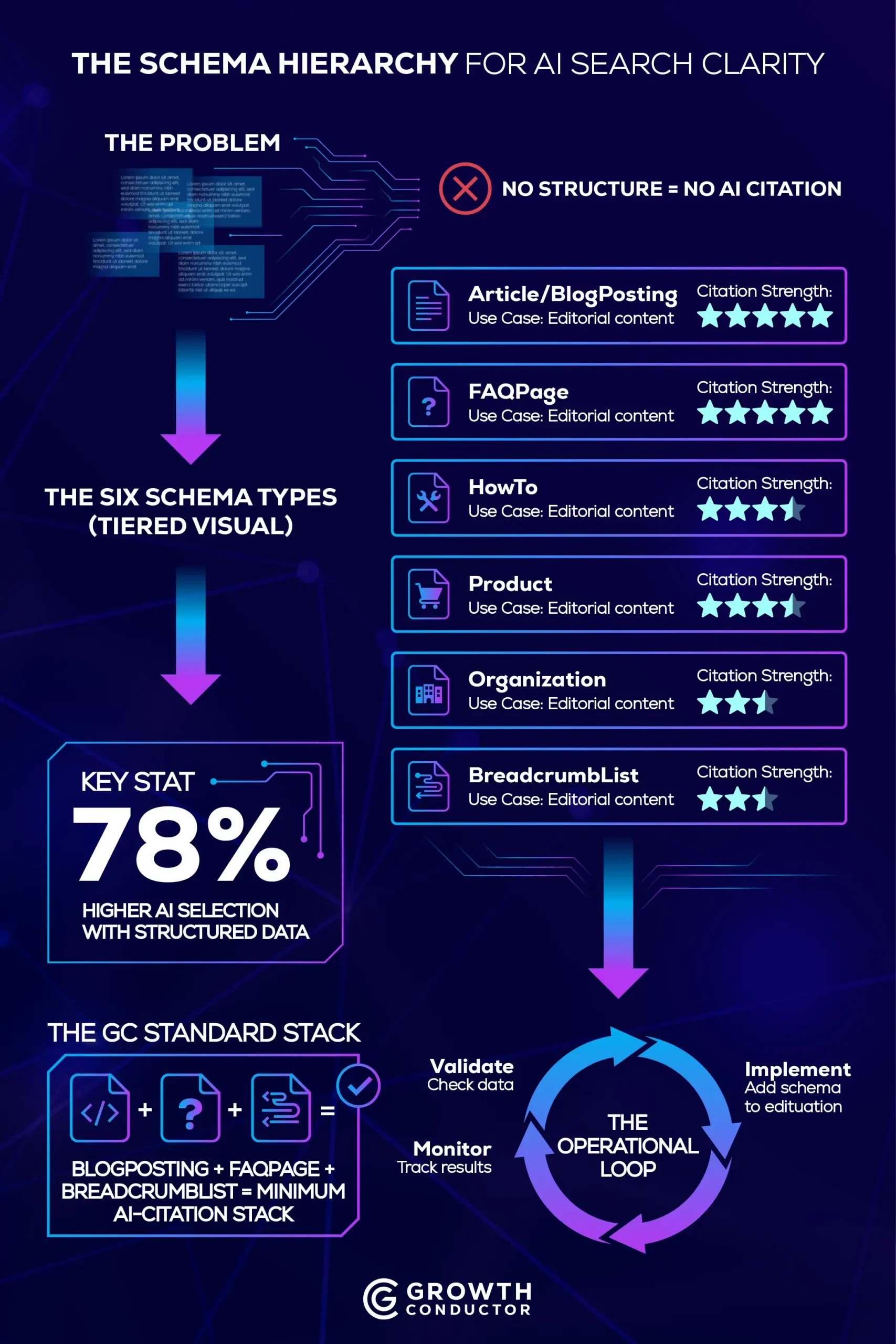
Structured data is a standardized format for labeling page content so search engines and AI systems can interpret it without guessing. Implemented through Schema.org vocabulary and delivered as JSON-LD code in the page head, structured data turns ambiguous web text into machine-readable entities. For AI search engines, this transforms content from possible source material into confidently citable knowledge.
Traditional SEO assumed that search engines could figure out what your page was about by reading the words on it. For most of the web’s history, that assumption was mostly correct, mostly. As the web grew from millions of pages to trillions, that assumption broke. Structured data was invented as the fix — a way to tell search engines explicitly what your content is, rather than asking them to infer it.
In a traditional search world, structured data was a helpful enhancement. It earned you rich results, star ratings in search listings, and the occasional featured snippet. In an AI-first search world, it has become foundational. AI systems summarize and cite content from across the web, and they need to know with certainty what they are summarizing and who they are citing. Without that certainty, they default to safer sources that have made themselves easier to understand. Schema is how you make yourself one of those safer sources.
Structured Data, Schema.org, and JSON-LD — Defining the Stack
Three terms get used interchangeably in most SEO conversations, and that confusion makes the whole topic harder than it needs to be. They are not the same thing, and understanding the difference makes the rest of the strategy easier.
Structured data is the broadest of the three. It is the general concept of using a standardized format to label content so machines can interpret it. Any agreed-upon system for tagging meaning in web content qualifies as structured data.
Schema.org is the specific vocabulary almost everyone uses. It is a shared dictionary of entity types — Article, Product, Person, Organization, FAQPage, HowTo, and hundreds of others — along with the properties each type can carry. Schema.org is supported jointly by Google, Microsoft, Yahoo, and Yandex, which is why it has become the practical standard.
JSON-LD is the format Google recommends for delivering Schema.org markup. It is a block of JavaScript-style code that lives in the head of your page. Users never see it. It does not affect your layout, your design, your fonts, or anything else about how your page looks. It exists solely to give machines a clear, structured explanation of what the page contains. Other formats exist, including Microdata and RDFa, but JSON-LD has won because it is cleaner to implement and easier to maintain at scale.
The reason this matters comes down to what AI search engines actually parse. They do not look at your design. They do not care about your font choices, your layout, or your hero image. They parse meaning, and they parse it from the most reliable source they can find. Schema is how you give them that meaning in a format they can trust without having to guess.
How AI Search Engines Actually Use Structured Data
When an AI system encounters a page with clean structured data, three things happen, and each of them quietly increases the probability that your content will be the one cited in the answer.
The first is entity disambiguation. Your page mentions Apple. Is that the fruit, the technology company, or a person named Apple? A human reader figures it out from context. An AI system trying to cite your content at scale, across millions of queries, cannot afford that ambiguity. Schema tells the AI definitively which Apple you mean, by linking the mention to a specific entity with known properties. That clarity is the difference between being a candidate citation and being a confident one.
The second is citation eligibility. AI systems generating answers prefer sources they can confidently attribute. When an AI Overview pulls a statement from your article and credits you as the source, it is making a small bet that the attribution is correct. Schema reduces the risk of that bet by providing explicit author, publisher, and date signals. The AI no longer has to infer who wrote your content or when it was published. It knows. And content the AI knows about is content the AI cites.
The third is Knowledge Graph reinforcement. Every page on your site that includes Organization schema, with a clear name, logo, and sameAs links to your verified profiles, contributes to the AI’s understanding of your brand as a recognized entity. Over time, this compounds. Brands that show up consistently as well-structured entities across hundreds of pages become known entities. Brands that show up as unmarked text strings do not. The Knowledge Graph effect is one of the most underrated long-term benefits of structured data, and it is one of the hardest to retrofit later.
None of this happens by accident. It happens because your page told the AI system exactly what it needed to know, in a format the AI system was built to read.
Does Schema Markup Actually Help You Get Cited in AI Overviews?
Yes — schema markup increases the probability of being cited by AI Overviews and other generative search features. Structured data shows up to 73% higher AI selection rates because it gives AI systems explicit, machine-readable confirmation of entities, authorship, and relationships. Schema is not a ranking factor on its own, but it is a clarity factor — and AI systems consistently prefer clarity.
This is the question every marketer asks before they invest in schema, and it deserves a direct answer. The honest version is yes, schema helps you get cited by AI search features, but with a caveat that matters more than the answer itself. Schema increases your citation probability. It does not guarantee citation, and it absolutely does not compensate for content that is not worth citing in the first place.
The reason schema works is mechanical, not magical. AI systems that generate citations need to attach a source to a claim with high confidence. Schema provides that confidence in a way unstructured text simply cannot. The AI knows the author. The AI knows the publication date. The AI knows the topic and how it relates to other entities. With those signals in place, citing your content is a low-risk choice for the AI. Without them, citing your content is a higher-risk choice, and AI systems tend to default to lower-risk alternatives when they exist.
What the Data Shows on Schema and AI Citation
Google’s own documentation has confirmed that structured data is one of the inputs AI search features use when evaluating content for citation. Industry analysis through early 2026 has consistently shown a measurable gap in citation rates between pages with comprehensive schema markup and otherwise comparable pages without it. The lift varies by content type and query category, but the pattern is clear and reproducible.
Pages with clean, well-implemented schema are cited at substantially higher rates than pages without it. The most-cited industry analyses have measured lifts of up to 73 percent in AI selection rates when structured data is present and properly validated. That number is not a guarantee for any specific page, but the directional finding is consistent across every credible study we have seen. Schema correlates with citation lift, and the correlation is strong enough that ignoring it is no longer a defensible strategy.
The mechanism behind the lift is the same one we described earlier. AI systems prefer sources they can attribute confidently. Schema removes the inference work the AI would otherwise have to do. Less inference equals less risk, and less risk equals more citations.
Where Schema Helps Most — and Where It Doesn’t
Schema is a clarity layer. It works best when it is layered on top of content that is already worth citing. Layered on top of weak content, it does almost nothing, and in some cases it can hurt.
The strongest lift shows up on pages with FAQPage, HowTo, Article, Product, and Organization schema applied to substantive, original content. These are the schema types AI systems extract from most reliably, and they are the types where good content gets the biggest boost. A well-written article with proper BlogPosting and FAQPage markup is the kind of page AI Overviews love to cite, because the answer is already structured for them in the markup.
The lift gets minimal — close to zero in many cases — when schema is applied to thin content, AI-generated rehashes, or generic listicles that say the same thing every other page in the search results already says. Schema can make commodity content slightly easier for AI to find, but commodity content is not what AI systems prefer to cite. They prefer specificity, expertise, and original perspective, and they have become measurably better at identifying which is which.
There is also a way schema can actively hurt you. If your schema describes content that is not actually present on the page — claiming to have FAQs that do not exist, or rating data that does not appear visibly to users — Google explicitly flags the markup as deceptive. Deceptive markup can suppress your visibility rather than enhance it. This is one of the most common ways DIY schema implementations backfire, and it is one of the reasons schema strategy matters more than schema technique.
“Schema is a clarity layer, not a content shortcut. It makes good content easier for AI to find, trust, and cite. It does not make weak content worth citing”
This is something we see repeatedly in the engagements we run. Clients who pair non-commodity content with clean schema infrastructure see compounding gains in AI search visibility. Clients who try to schema-tag commodity content do not see the same lift, because there is no underlying signal for the schema to amplify. The schema works exactly the way it is supposed to. The content was the limiting factor.
Which Schema Types Drive the Most AI Search Clarity?
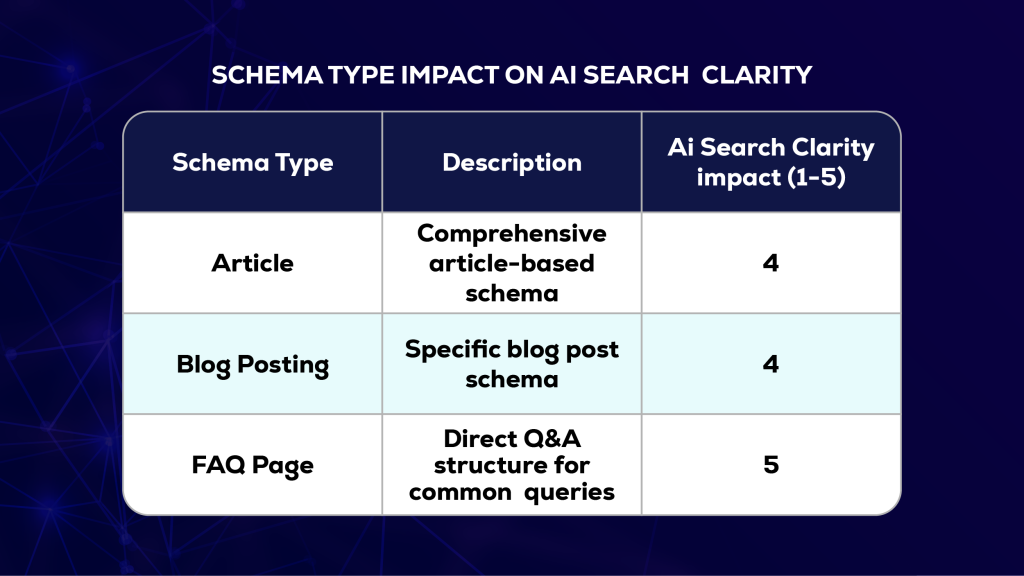
The schema types with the highest impact on AI search clarity are Article and BlogPosting for editorial content, FAQPage for question-answer extraction, HowTo for procedural content, Product for commercial pages, and Organization for site-wide entity authority. Each type encodes a specific signal that AI systems use to evaluate citation worthiness.
There are hundreds of entity types in the Schema.org vocabulary. Most marketing sites will never need more than six or seven of them. The schema types that drive the largest share of AI citation lift are the ones AI systems extract from most reliably, and understanding why each one matters helps you decide where to prioritize implementation effort.
Article and BlogPosting are the editorial backbone. They tell AI systems that the page is a defined piece of content with an author, a publisher, a publication date, and a headline. Every article, guide, or blog post on your site should carry one or the other. These are the schema types that establish the page as a citable source rather than a generic web page.
FAQPage is one of the highest-citation schema types available, and it is one of the most misunderstood after a recent shift in how Google handles it. As of May 7, 2026, Google has fully discontinued FAQ rich results in Google Search. The visual dropdown blocks that used to appear in search results are gone, including for the government and health sites that retained eligibility through 2023. But — and this is the critical distinction most coverage glosses over — the FAQPage schema itself remains a fully valid Schema.org type, and AI search systems continue to use it heavily.
⚠ Important Schema Update — May 2026
Google officially discontinued FAQ rich results in Google Search on May 7, 2026. While the visual SERP dropdowns have been phased out, the FAQPage schema itself remains a valid structured data type. Google has confirmed it continues to use the markup to understand pages, and AI search systems — including ChatGPT, Perplexity, Claude, and Gemini — actively parse FAQPage data when selecting citations.
Our recommendation: keep your FAQPage markup live. The Google rich result it was originally chasing is gone, but the AI citation value it carries is now arguably more important than the rich result ever was.
Source: Google Search Central — Changes to HowTo and FAQ rich results (official Google announcement, updated through May 2026).
This is exactly the kind of nuance that separates schema strategy from schema technique. The headline reads “Google killed FAQ rich results” and a lot of teams will rip the markup out of their templates. That would be a mistake. The visual feature is gone, the underlying signal is not, and the underlying signal is what AI search citations now run on.
HowTo schema follows a similar pattern to FAQPage. Google deprecated HowTo rich results on desktop in 2023, and the visual feature has been fully retired across surfaces. The schema itself, however, remains valid and continues to be parsed by AI search systems for instructional queries. If your business goal is AI citation for how-to content, HowTo schema still serves that purpose. If your business goal was the visual HowTo block in Google Search, that opportunity is gone. Use HowTo deliberately, with full awareness of what it gives AI permission to do — once HowTo schema is on a page, AI systems may pull your entire step list directly into an Overview answer.
Product schema applies to commercial and SaaS pages where price, availability, reviews, and offers matter. This is the schema type that powers the rich product cards in search results and increasingly drives presence in AI shopping experiences. If you sell anything, this is non-negotiable.
Organization schema is the schema that anchors your brand as a known entity. It tells AI systems your business name, logo, founding date, and verified social profile links. Most sites underinvest here, and it shows up later as weaker Knowledge Graph presence. Strong Organization schema, implemented site-wide, is what allows the rest of your schema strategy to compound over time.
BreadcrumbList schema closes the loop. It signals to AI systems how your content is organized — which pillar pages connect to which cluster articles, which categories contain which guides. This reinforces topical authority across your site and helps AI systems understand the relationships between your pages, not just the contents of individual pages.
Article vs BlogPosting — Which to Use When
This is one of the most common implementation questions, and the answer is more straightforward than most explanations make it sound. BlogPosting is a subtype of Article. It inherits everything Article does and adds a few blog-specific properties. They are not competing choices. They are a hierarchy, and the right pick depends on the content.
Use Article schema for long-form guides, pillar pages, and standalone in-depth content where the editorial gravity is higher than a typical blog post. Use BlogPosting for cluster articles, regular blog content, and shorter editorial pieces that live in your blog feed. In either case, layer FAQPage on top when the article includes a Q&A section, because the FAQPage lift compounds rather than replaces the Article or BlogPosting signal.
The table below summarizes the practical decisions. Note that AI Citation Strength reflects how AI search engines use these schema types for citation selection — separate from whether the schema produces a visual rich result in Google Search.
| Schema | Use Case | AI Citation Strength | GC Standard |
|---|---|---|---|
| Article | Long-form guides, pillar pages, in-depth reports | High | Pillar guides |
| BlogPosting | Cluster articles, blog posts, regular editorial content | High | All cluster articles |
| FAQPage | Question-and-answer sections; PAA-targeted content | Very high | Required on every article |
What Does a Real Schema Implementation Actually Involve?
A real schema implementation is a strategic decision tree, not a checklist. It requires matching schema types to business intent, structuring nested entities so they reinforce site-wide authority, validating output across multiple tools, and maintaining the markup as templates and content evolve. Most failed schema implementations fail at the strategy phase, not the code phase.
There are tutorials all over the internet that promise to teach you schema in twenty minutes. Most of them describe how to install a plugin and toggle a few settings. That is not a schema implementation. That is a schema starting point, and it is the starting point where most DIY efforts quietly plateau, leaving most of the available AI search visibility on the table.
A real implementation is a sustained piece of strategic and operational work. It involves four distinct phases, and each phase is where most teams encounter problems they did not know to expect.
The Four Phases of a Real Schema Implementation
The first phase is audit and schema-type selection. Every page on your site has a different business intent. A product page is not a blog post. An about page is not a service page. A case study is not a category archive. Matching the right schema type to each page is the foundational strategic decision, and it is the one most DIY implementations get wrong. The audit is not about deciding whether to add schema. It is about deciding which schema, where, and why.
The second phase is entity architecture and JSON-LD build. Schema becomes meaningfully more powerful when entities are nested and linked. Your Article schema references your Organization. Your Organization carries sameAs links to your verified profiles. Your BreadcrumbList ties each article back to its pillar page. This is architecture work, not copy-paste work, and the difference between a site that has schema and a site whose schema actually compounds across pages comes down to this phase.
The third phase is validation and deployment. Cross-tool validation is the discipline of confirming the schema is correct before it goes live, using more than one tool, and checking that what passes validation also triggers the rich results and AI signals it was supposed to. Schema that passes Google’s Rich Results Test can still fail Schema.org’s Markup Validator. Schema that passes both can still fail to trigger rich results if the strategy was wrong. Validation catches the syntax errors. Strategy catches everything else.
The fourth phase is ongoing monitoring and re-validation. Schema breaks quietly. Every theme update, every plugin upgrade, every template change is a potential breakage event, and most teams do not discover the breakage for weeks or months — usually only after AI citation traffic has already declined. Without an ongoing monitoring process, the work from the first three phases slowly erodes.
Where Most DIY Schema Implementations Go Wrong
After running schema work across dozens of client sites, the same failure modes show up repeatedly. They are almost never failures of effort. They are failures of strategy, and they usually pass validation, which makes them harder to catch.
The most common failure is choosing the wrong schema type for the page intent. A blog post tagged with WebPage instead of BlogPosting still passes Rich Results Test. The validator does not know what the page is supposed to be. It only knows whether the markup is syntactically valid. The article ends up technically correct but functionally weak, and the AI citation lift that should have been there never materializes.
The second is missing or incorrectly nested entity properties. Schema fires, the validator approves it, but it does not qualify for rich results or AI citation because the high-value properties were skipped. Required properties are sometimes missed entirely. Optional but high-impact properties get left blank because the implementer did not know they mattered.
The third is the absence of global entity linkages. Every page is treated as an isolated island instead of a connected entity graph. The site loses the compounding effect that comes from reinforcing the same Organization entity across every page, and the Knowledge Graph presence that should have built over time never does.
The fourth is conflicting schema types stacked on the same page without a clear primary. Three different schema blocks on a page, none designated as the main entity, and AI systems end up with mixed signals about what the page is actually for. The schema becomes noise.
The fifth is the lack of any maintenance plan. Markup breaks silently after a theme update, a plugin change, or a content migration, and by the time anyone notices, the citation impact has already happened. The fix is straightforward once the problem is identified. The damage from not having noticed is harder to undo.
The sixth is single-tool validation. Passing Google’s Rich Results Test alone does not mean passing Schema.org’s Markup Validator. Schema can be eligible for Google rich results while still violating vocabulary specifications that other AI systems care about. Validating in only one tool gives you false confidence.
“A schema implementation that passes Rich Results Test can still fail at the strategy level. Validation tools confirm syntax — they do not confirm strategy”
This is the work we handle for clients as part of an SEO and Web Ops engagement. The plugin-based starting point gets a site to schema-present. The strategic implementation gets a site to schema-effective. The gap between those two states is where most of the available AI citation traffic actually lives, and closing that gap is rarely a self-service exercise.
Why Schema Validation Is an Operational Discipline (Not a One-Time Task)
Schema validation is an operational discipline, not a one-time setup task. Schema markup breaks quietly — a single theme update, plugin change, or content migration can invalidate site-wide markup without anyone noticing for months. The teams that win in AI search treat schema like uptime: monitored continuously, validated after every change, and owned by someone accountable.
This is the part of schema strategy that almost nobody talks about, and it is the part that quietly undoes most schema work over time. Setup is the visible work. Maintenance is the invisible work that determines whether the setup keeps paying off.
Schema is not a deliverable you ship once and check off. It is infrastructure that has to be maintained continuously, in the same way uptime, security patches, and performance monitoring are maintained. Treating it as a one-time setup is how sites end up with broken markup, declining AI citations, and no clear understanding of why their organic visibility has slipped over the past few quarters.
Why Schema Breaks (and Why You Won’t Notice)
Schema markup is far more fragile than most teams realize. Several common events can invalidate site-wide markup without producing any visible symptoms on the page itself.
Theme and plugin updates are the most frequent culprit. Every WordPress update cycle, every plugin patch, every theme refresh is a potential schema overwrite event. The site keeps functioning. The pages keep loading. The schema in the page head may have been silently replaced, modified, or stripped entirely. Nothing breaks visibly. Citations just stop coming.
Content migrations are the second. Moving a site between platforms, switching CMS providers, or restructuring URL paths commonly drops structured data entirely. The content moves to the new home. The markup does not always follow. Teams that migrate without a schema preservation plan often discover months later that the markup was never reinstated.
Developer changes to global templates are the third, and they are particularly dangerous because they cascade. A single edit to a header template can invalidate schema on every page that uses it. The change looks small. The downstream impact is enormous, and it is the kind of thing that only gets caught if someone is actively monitoring schema health.
Google Search Console will eventually flag the errors, but by the time it does, the AI systems have already adjusted their citation patterns. The lag between breakage and visibility loss is where most of the damage accumulates. Search Console is a diagnostic tool, not an alarm system.
The Validation Tools — and Why Tool Names Are Not a Strategy
There are two validation tools every marketer should know by name. Google’s Rich Results Test confirms whether your schema is eligible for Google’s rich results and AI features. Schema.org’s Markup Validator confirms whether your schema is compliant with the broader Schema.org vocabulary specification. Both tools are free, both are public, and both are necessary.
That part is the easy part. The harder part is knowing what to do when the two tools disagree, when the markup passes both but does not trigger rich results, or when validation passes today and breaks after next month’s theme update. Tool literacy is not the same as schema strategy. Knowing how to read a validator output is the entry-level skill. Knowing what to do with the output, when to act on it, and how to prevent the same issue from recurring is the actual work.
How Growth Conductor Builds Schema Validation Into Client Engagements
For the clients we work with, schema is never a one-and-done project. It is integrated into the operational rhythm of the engagement, and it is treated with the same discipline as any other piece of infrastructure that has to keep working over time.
Validation is included as part of every SEO and Web Ops engagement we run. It is not a separate line item or an upsell. It is part of the underlying infrastructure work that supports the rest of the SEO program. Re-validation is triggered after every site template change, so theme updates, plugin upgrades, and template edits all kick off a schema check before the change ships to production. Quarterly schema audits catch the drift that incremental monitoring misses, and they give us a chance to update the strategy as Schema.org evolves and as Google’s rich result eligibility shifts.
Most importantly, there is a single point of accountability. Someone owns the schema, knows when it was last validated, knows what has changed since, and knows what needs re-testing next. Without that ownership, schema decays. With it, schema compounds.
“Schema is operational infrastructure. Treat it like uptime monitoring, not a one-time SEO project”
Why Schema Alone Isn’t Enough — The Human + AI Difference
Schema markup makes AI search engines understand your content, but it does not make your content worth citing. Google has been clear since the Search Central Live event in April 2026: AI search rewards non-commodity content — material that reflects real experience, real decisions, and real results. Schema amplifies that signal; it does not replace it.
This is the part where most articles about schema stop. We are going to keep going, because the schema-only framing is incomplete, and it is the incomplete version that has led many brands to invest in schema while continuing to lose AI search visibility. The schema works. The content underneath it does not.
Schema Without Substance Is a Wasted Signal
At Google Search Central Live in Toronto in April 2026, Danny Sullivan laid out Google’s framework for AI search success. The framework had four parts: SEO fundamentals, structured data, great page experience, and non-commodity content. Three of those four are technical or operational. The fourth is editorial, and it is the part most brands misread. (Search Engine Roundtable’s coverage of Sullivan’s slides captures the framework in detail.)
Google defines commodity content as generic advice anyone could write. The kind of content that sounds the same regardless of who published it. The kind of article that you could swap the byline on and nobody would notice. Non-commodity content is the opposite. It reflects real experience, specific examples, real strategic decisions, and real measurable outcomes. It is the kind of content that could only have come from someone who has actually done the work, with details that AI cannot fabricate from training data alone.
Schema makes commodity content easier for AI to find. It does not make it worth citing. AI systems are increasingly trained to distinguish between the two, and they consistently prefer non-commodity sources because non-commodity sources are more useful to the people asking the questions. Schema-tagged commodity content is still commodity content. The clarity layer cannot fix what is missing underneath it.
The Growth Conductor Approach — Human Strategy Plus Schema Infrastructure
Our model is built on the intersection of three things, and the three only work when they work together.
The first is human-led content with real experience signals. Real client work, real strategic decisions, real measurable outcomes. The kind of content that AI cannot generate from training data alone, because the source material does not exist in any training corpus. It exists only in the engagements we have actually run.
The second is AI-assisted research and scoring through our Content Engine workflow. Every piece runs through our 110-point SEO and AIO scoring matrix before publish, and AI accelerates the analysis at every step. But the judgment calls — what to include, what to leave out, what perspective to take, what insight is worth elevating — those stay with humans. AI is a force multiplier on the workflow. It is not the source of the perspective.
The third is clean schema infrastructure on every published page. Operational, not aspirational. Validated, monitored, and maintained as a permanent piece of the site, not a one-time project. The schema makes the content legible to AI systems. The content makes the schema worth applying.
This combination is what AI search systems reward. Human judgment makes the content non-commodity. AI execution makes the workflow scalable. Schema infrastructure makes both signals legible to the machines doing the citing. Drop any one of the three, and the other two stop compounding.
“The Growth Conductor formula: Human judgment × AI-assisted execution × Clean schema = AI search visibility”
Frequently Asked Questions
Structured data is the broader concept — any standardized format that helps machines interpret web content. Schema markup is the specific implementation of structured data using the Schema.org vocabulary. In everyday SEO conversation, the two terms get used interchangeably, and that is usually fine. When someone says they are adding schema or adding structured data, they almost always mean the same thing: implementing Schema.org entity labels on web pages, typically through JSON-LD.
Not directly. Google has stated that schema is not a ranking factor on its own. What schema does is make your content clearer to search engines and more eligible for rich results, AI Overview citations, and Knowledge Graph reinforcement. The downstream effect is usually higher visibility and higher click-through rates, which indirectly support rankings over time. The right way to think about schema is as a clarity and eligibility layer, not as a ranking lever.
You can install a plugin and get baseline schema running quickly, and for many sites that is enough to get started. The plugin approach is a starting point, not a strategy. Most schema plugins handle Article and BlogPosting markup adequately but fall short on entity architecture, cross-page linking, validation discipline, and the strategic decisions about which schema types belong on which pages. If AI search visibility is a business priority, plugins get you to schema-present. Strategic implementation gets you to schema-effective.
Minor errors usually mean your schema is ignored. The rich result or AI citation lift simply does not materialize, and you may never realize what you are missing because nothing visibly breaks. Major errors, especially schema that describes content not actually present on the page, can be flagged by Google as deceptive markup. Deceptive markup can suppress your visibility rather than enhance it. Validation tools catch syntax errors. They do not catch strategic errors like the wrong schema type chosen for the page intent.
No. Google officially discontinued FAQ rich results in Google Search on May 7, 2026, completing a phase-out that began in 2023, but the FAQPage schema itself remains a fully valid Schema.org structured data type. According to Google’s official Search Central announcement, Google continues to use the markup to understand page content, and AI search engines including ChatGPT, Perplexity, Claude, and Gemini still parse FAQPage data when selecting citations. The visual SERP dropdown is gone. The AI citation value is not, and that value is now arguably more important than the rich result ever was. Keep your FAQ markup live.
This is the harder question, and it is where most teams discover they need help. Validation tells you the schema is correct. It does not tell you whether the schema is driving citations, whether your AI Overview impressions are increasing, or whether competitors with cleaner implementations are quietly taking your visibility. Answering those questions requires comparative diagnostics across Google Search Console, AI search monitoring tools, and citation pattern analysis. That is a meaningfully different skill set from setting schema up in the first place.
Key Takeaways
- Structured data is how AI search engines confirm what your content actually means, not just what it looks like. Without it, AI systems have to infer your meaning from unstructured text — and inference creates risk, which pushes citations toward safer alternatives.
- Schema markup does not replace strong content. It amplifies non-commodity content, and it exposes commodity content for what it is. The clarity layer only works when there is something underneath it worth being clear about.
- BlogPosting plus FAQPage plus BreadcrumbList is the minimum schema stack for every cluster article that wants AI citations. Layer Organization schema site-wide to anchor your brand as a known entity.
- Real schema implementation is a four-phase strategic process, not a checklist task. The strategy phase is where most DIY efforts fail, because validation tools confirm syntax but not strategy.
- Schema breaks quietly. Theme updates, plugin upgrades, content migrations, and template edits all create invisible breakage events. Validation has to be operationalized as a recurring discipline, not treated as a one-time setup.
- AI search rewards clarity layered on top of substance. Schema is the clarity layer. Non-commodity content is the substance. The two compound when they work together and do almost nothing when they do not.
Ready to make your site AI-search-ready?
Schema strategy is one piece of an AI-ready SEO foundation. The other pieces — non-commodity content, site architecture, technical SEO, and operational monitoring — are how the schema actually pays off.
See how Growth Conductor’s SEO services bring all of it together