


Most marketing teams don’t struggle with AI because the technology is confusing. They struggle because no one clearly owns the work. Data lives in one place, tools live in another, approvals happen somewhere in the middle, and measurement shows up too late to matter.
This article supports a broader AI-driven marketing strategy by focusing on execution—specifically, how to structure your marketing team so AI initiatives actually ship, scale, and improve over time instead of stalling in planning cycles.
Executive Summary: How an AI-Ready Marketing Team Is Structured
An AI-ready marketing team assigns ownership across strategy, operations, analytics, and execution. SMB teams succeed by using a small cross-functional pod, prioritizing high-impact use cases, and running time-boxed pilots with clear accountability. Lightweight governance keeps AI outputs accurate and aligned as adoption scales.
What an AI-Ready Marketing Team Structure Means
An AI-ready marketing team structure defines who decides, who builds, who reviews, and who measures AI-powered workflows.
In practical terms, it means your team can answer four questions without debate: who prioritizes AI use cases, who owns the tools and workflows, who validates data and outputs, and who monitors performance and risk. When those answers are unclear, AI becomes fragmented experimentation rather than a system.
Step 1: Inventory Your Current Reality
AI readiness starts with clarity, not ambition.
Before changing roles or buying tools, document what already exists across four areas: people, tools, data, and workflow. Identify channel owners, approvers, analysts, and operators. List the platforms in use across CRM, analytics, ads, content, and automation. Call out which data is reliable and which is incomplete. Then map how work actually moves from idea to execution to reporting.The output of this step should be a one-page snapshot of your current state. This becomes the baseline for every AI decision that follows.
Step 2: Define Practical AI Use Cases
A strong AI use case solves a repeatable business problem with clear inputs, outputs, and measurable impact. It is not defined by a vendor or a feature.
For SMB and mid-market teams, practical AI use cases often include lead scoring to prioritize sales follow-up, audience segmentation for lifecycle messaging, content assistance for briefs or ad variations, and PPC support for bid or budget recommendations.If a use case cannot be described without naming a specific tool, it is not ready yet. Start with the problem, then determine how AI can assist using the right AI marketing tools to support the workflow rather than dictate it.
Step 3: Prioritize AI Projects by Impact vs Effort
AI initiatives stall when teams try to do too much at once.
An impact-versus-effort framework helps teams decide what to launch first by weighing business upside against implementation complexity. Impact can include revenue influence, time saved, pipeline quality, or retention. Effort includes data readiness, workflow changes, approvals, and risk.For most SMB teams, the best starting point is high-impact, low-effort projects such as content workflows, segmentation, or operational automation. These create momentum and reusable systems without overwhelming the organization.

Step 4: Use a Pod Model Instead of Reorganizing the Team
The fastest way to become AI-ready is not a full reorganization. It is a small, focused pod with clear ownership.

A typical SMB AI pod includes clearly defined AI-ready team roles, starting with a strategy owner who sets priorities, a marketing operations owner who builds and maintains workflows, and an analytics owner who defines KPIs and validates outputs. Channel owners remain responsible for execution and plug into the pod for feedback and refinement.This model preserves speed while creating accountability.
Step 5: Assign Ownership with a RACI Model
Most AI initiatives fail due to unclear accountability.
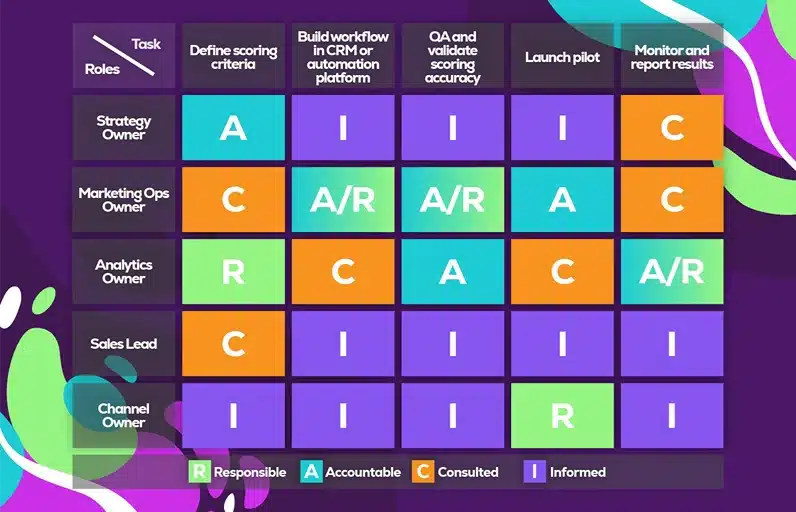
A RACI model—outlined clearly in Atlassian’s guide to the RACI responsibility assignment matrix —defines who is Responsible for execution, Accountable for outcomes, Consulted for input, and Informed of progress. Using RACI prevents stalled launches and duplicated effort by making ownership explicit.
For example, in a lead scoring pilot, strategy may define criteria, marketing operations builds the workflow, analytics validates accuracy, and sales is consulted on outcomes.
Step 6: Add Lightweight AI Governance
Governance does not mean bureaucracy. It means guardrails.
Lightweight AI governance documents approved use cases, data access rules, human review requirements, brand standards, and monitoring cadence. This ensures AI outputs remain accurate and aligned as usage scales.
Frameworks like the NIST AI Risk Management Framework help organizations think through AI risks, accountability, and oversight in a structured but flexible way. Similarly, Google’s Responsible AI principles reinforce the importance of transparency, human oversight, and accountability as AI systems scale. For SMB teams, governance should fit on a single page and evolve over time.
Step 7: Run a 30-Day Pilot
Every AI initiative should begin with a time-boxed pilot.
A typical 30-day rollout includes finalizing the use case and KPIs in week one, building workflows and QA checks in week two, launching to a limited audience in week three, and evaluating results in week four. The goal is not perfection but repeatability.
Over time, these pilots evolve into documented AI automation workflows that reduce friction and make future launches faster and more reliable.
Step 8: Scale Through Capability, Not Hype
Scaling AI adoption is usually a capability problem, not a headcount problem.
Teams that scale successfully invest first in marketing operations and analytics so workflows and measurement can expand without breaking. This is also where clearly defined AI marketing KPIs become critical, ensuring AI systems are measured by business outcomes rather than activity.Only after systems are stable does it make sense to add channel-specific roles.
Final Takeaway
An AI-ready marketing team is not defined by tools. It is defined by ownership.
Clear roles, focused pilots, and repeatable workflows turn AI from experimentation into infrastructure. When paired with a strong AI-driven marketing strategy, this team structure allows organizations to scale intelligently instead of reactively.
FAQs
1: What makes a marketing team “AI-ready”?
An AI-ready marketing team has clear ownership for strategy, operations, analytics, and execution. Instead of experimenting with tools ad hoc, the team uses defined workflows, accountable roles, and measurement standards so AI initiatives can be launched, monitored, and improved consistently.
2: Do small businesses really need AI governance in marketing?
Yes. Small and mid-market businesses need AI governance because limited resources leave less room for errors. Lightweight AI governance—such as defining approved use cases, human review steps, and data access rules—helps prevent inaccurate outputs, brand risk, and wasted effort as AI adoption grows.
3: What roles are needed for an AI-ready marketing team?
An AI-ready marketing team typically needs three core roles: a strategy owner to prioritize AI use cases, a marketing operations owner to build and manage workflows, and an analytics owner to validate data and performance. Channel owners support execution and provide feedback.
4: What is the best first AI use case for a marketing team?
The best first AI use cases are high-impact and low-effort, such as content assistance, audience segmentation, or lead prioritization. These projects typically require less complex data integration while still delivering immediate time savings or performance improvements.
5: How do you measure whether AI is actually working in marketing?
AI performance should be measured using business-focused KPIs, not activity metrics. This includes lead quality, conversion rates, time saved, cost efficiency, or revenue impact. Clear KPIs ensure AI systems are improving outcomes rather than just increasing output.