


Small businesses don’t struggle with AI because the technology is confusing. They struggle because they don’t have time, clean data, or clear ownership.
This article supports a broader AI-driven marketing strategy by focusing on practical execution—how small businesses can use AI to improve marketing results without adding complexity or risk.
What an AI-Driven Marketing Strategy Means (In Plain English)

An AI-driven marketing strategy is a plan for using data and automation to make better marketing decisions while keeping humans in control.
In practical terms, your business should be able to answer three questions without debate: what you want to improve, how you will measure success, and who reviews AI-generated work.
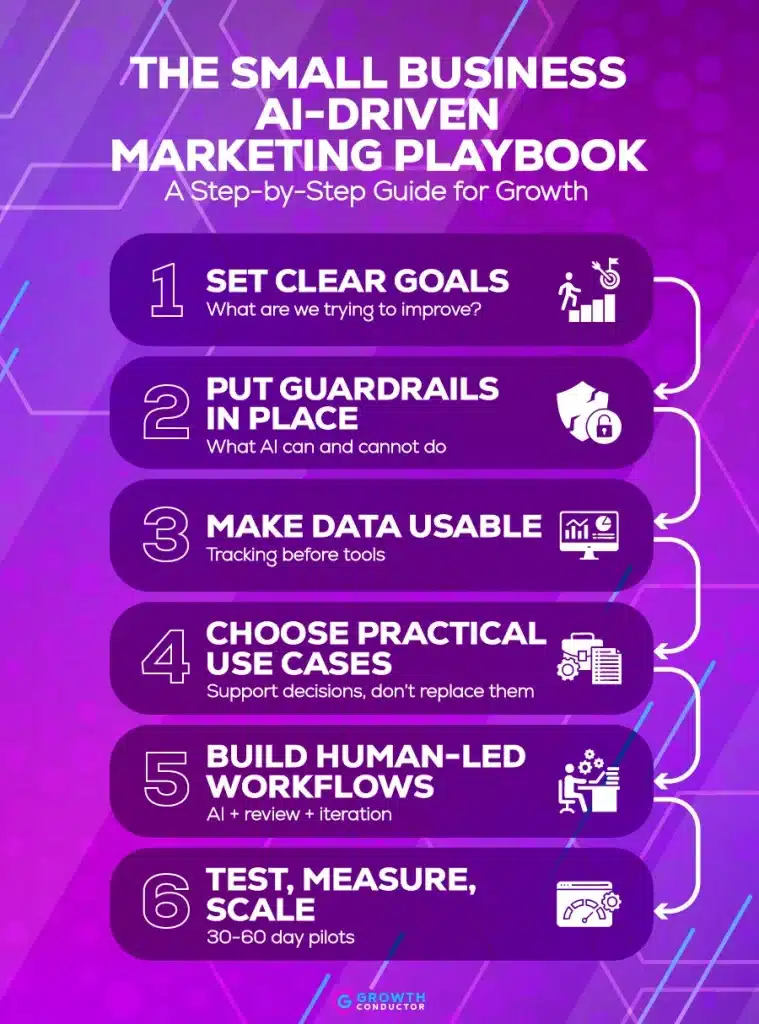
Step 1: Define Clear Business Goals
AI works best when it supports a specific outcome. Choose one or two goals that matter most, such as:
- More qualified leads
- Lower cost per lead
- Better ad performance
- More repeat customers
Write your goals down in one page and share them with anyone involved in marketing. If AI isn’t tied to a goal, it becomes busywork.
Step 2: Set Simple AI Rules and Guardrails
Small businesses should set basic rules so AI saves time without creating risk. Even lightweight guardrails align with principles outlined in the NIST AI Risk Management Framework, which emphasizes human oversight and accountability.
At a minimum:
- Do not paste customer personal information (PII) into AI tools
- Review anything public-facing (ads, landing pages, emails, blog posts) before publishing
- Avoid sensitive or regulated claims unless a qualified human approves them
These guardrails keep your brand safe while still letting you move faster.
Step 3: Make Sure Your Data Is Usable
You don’t need perfect data to start using AI, but you do need usable data. Most small businesses need basic analytics like GA4 event-based tracking to understand which actions actually drive leads or sales.
- A way to track leads or sales (forms, calls, purchases)
- A basic CRM or contact list
- Website analytics (like GA4)
Fix obvious tracking gaps before testing AI features. Otherwise, you won’t know if AI helped—or hurt.
Step 4: Choose AI Use Cases That Support Decisions — Not Replace Them
Small businesses get into trouble when AI is treated as an autopilot instead of a decision-support system.
AI should help your team see patterns faster, test ideas more efficiently, and surface opportunities — but final decisions should remain human-led.
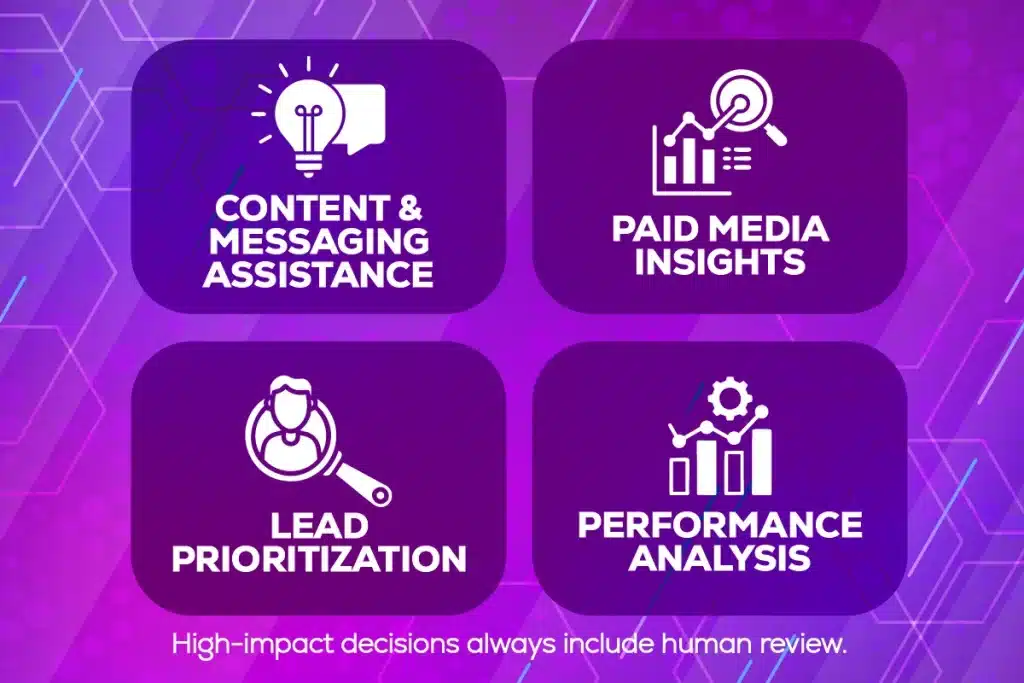
For most small businesses, the most effective AI use cases include:
- Content and messaging support
- Drafting outlines or variations
- Identifying themes that resonate with buyers
- Speeding up content production without sacrificing quality
- Paid media insights and recommendations
- Identifying which keywords, audiences, or creatives are underperforming
- Highlighting budget inefficiencies or missed opportunities
- Supporting bid and budget decisions — not making them blindly
- Lead prioritization and routing
- Flagging higher-intent leads for faster follow-up
- Supporting sales prioritization with data signals
- Improving handoffs between marketing and sales
The key rule:
If a decision materially impacts revenue, brand trust, or customer experience, a human should always be in the loop.
This is where expert oversight turns AI from a risk into a growth lever.
Step 5: Use AI as an Assistant Inside a Human-Led Marketing System
Many platforms now include AI features, but turning them on without strategy or monitoring often creates more problems than progress. Many platforms design AI features around human review and transparency, consistent with Google’s Responsible AI principles.
For small businesses, AI should be used to:
- Surface recommendations
- Speed up analysis
- Support testing and experimentation
—not to fully automate spend, messaging, or targeting decisions.
For example AI can:
- AI can suggest bid or budget adjustments, but humans should review performance trends and approve changes.
- AI can generate content drafts, but humans must refine messaging, accuracy, and tone.
- AI can flag anomalies in performance, but humans decide what action to take.
This is where structured performance marketing execution becomes critical. Instead of “set it and forget it,” experienced teams:
- Review AI recommendations weekly
- Validate changes against real business outcomes
- Adjust strategy based on context AI cannot see
AI is most effective when it accelerates expert decision-making — not when it replaces it. For small businesses, this balance between automation and oversight is difficult to maintain internally, which is why many teams partner with specialists who manage AI-supported marketing execution while protecting performance and budget control.
Step 6: Build Simple Human-in-the-Loop Workflows

For small businesses, AI creates the most value when it’s used inside a repeatable content system, not as a one-off shortcut.
AI can help with:
- Researching topics and questions buyers care about
- Creating outlines and first drafts
- Suggesting variations for headlines, intros, and calls to action
But without a system, most teams run into the same problem:
content gets created faster, but quality, consistency, and performance suffer.
A strong AI-supported content workflow looks like this:
- Strategy first
Topics are chosen based on search demand, buyer intent, and business goals — not AI suggestions alone. - AI-assisted production
AI is used to accelerate research, outlines, and early drafts, reducing production time. - Human refinement
Content is reviewed for accuracy, brand voice, positioning, and trust signals that AI cannot reliably handle. - SEO structure and optimization
Pages are structured for search visibility, internal linking, and long-term performance — not just readability. - Measurement and iteration
Content performance is monitored, insights are captured, and future content improves over time.
This is where many small businesses hit a ceiling internally. Maintaining speed, quality, SEO rigor, and consistency at the same time is difficult without dedicated processes.
That’s why teams often rely on our Content Engine approach — where AI accelerates production, but experienced strategists and editors ensure every piece supports search visibility, brand authority, and conversion goals.
In this model, AI increases output — the system ensures results.
Step 7: Test for 30–60 Days Before Scaling
Treat every AI initiative like a pilot. Run a small test for 30–60 days, compare results to your baseline, and scale only what clearly improves performance.
If results are unclear, reduce variables: test one change at a time and make sure tracking is correct.
Final Takeaway
An AI-driven marketing strategy for small businesses is not about chasing tools. It is about clarity, discipline, and steady improvement.
When paired with a strong AI-driven marketing strategy, small teams can use AI to compete more effectively—without adding complexity.
In practice, maintaining that balance requires structured workflows, human oversight, and consistent optimization. That’s why many growing teams rely on AI-assisted content workflows to turn strategy into repeatable results—without adding complexity or risk.
FAQs
It’s a practical plan for using data and automation to improve marketing decisions while keeping humans in control.
Yes. Lightweight rules (like human review and data boundaries) prevent mistakes and protect your brand.
High-impact, low-effort projects such as content assistance, ad optimization, or lead prioritization.
Most small businesses can evaluate results within 30–60 days when goals and tracking are clear.