



You are publishing more than you ever have. AI made that possible and it made it cheap. Your traffic chart looks respectable. And you still cannot say whether a single piece of it has brought in money.
That gap is the whole problem. AI content marketing ROI is the value your content generates minus what it cost you, divided by what it cost you. The formula is not complicated. Almost nobody arrives at a number they can trust, because most businesses undercount what content costs, credit its value to the wrong place, and then judge the whole thing over a stretch of time far too short to see any return at all.
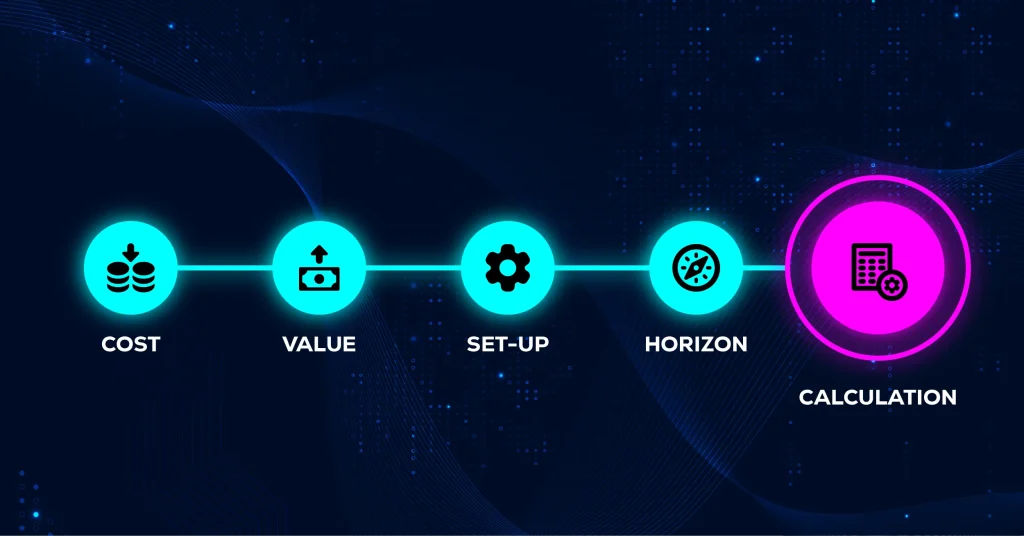
What follows is the entire method: five steps, a worked example with real arithmetic, and the settings inside your analytics that decide whether your number means anything. Nothing is held back for a sales call. For the broader picture, our guide to AI content marketing covers the discipline; for the math, stay here.
One thing will become obvious as you work through it. Measuring AI content is hard for the same reason producing good AI content is hard: both come down to judgment calls no tool makes for you. What counts as a cost. What a touchpoint is worth. Which topics deserve the investment. Get those right and the software becomes powerful. Get them wrong and you have automated your way to a confident, useless number.
How Do You Calculate AI Content Marketing ROI?
AI content marketing ROI is calculated as the value generated minus the total content cost, divided by the total content cost, then multiplied by 100. Spend $10,000 across a year, produce $25,000 in value, and your ROI is 150 percent. The formula has not changed since AI entered the picture. What changed is what belongs on each side of it, and that is precisely where most calculations come apart.
Report the result two ways
That same outcome is also a ratio of 2.5 to 1. Owners think in ratios and accountants think in percentages, so give both.
AI changed both sides of the equation
Your price per article almost certainly dropped, but new costs appeared and your total spend may well have risen because you publish more than you used to. On the value side, two sources of worth now exist that did not a few years ago: visibility inside AI-generated answers, and money you no longer spend on work AI handles.
Here is the trap. Compare a lower per-article cost against a value model you never updated and you will conclude that AI improved your ROI when all you have done is move money between columns. Paid search does not behave this way; spend and return land in roughly the same month. Content does not.
Why Can’t Most Businesses Measure AI Content ROI?
Three failures account for nearly every unreliable content ROI figure. The cost side is incomplete, so the number comes out inflated. The value is credited to the wrong channel, so content appears to do nothing. And the measurement window is too short to capture a return that takes months to arrive. Fix those three and the math becomes almost mechanical.
The cost side is incomplete
Most businesses count the AI subscription and whoever writes the words. They do not count editing hours, fact-checking time, the thinking that goes into deciding what to write about, or the cost of building the tracking that tells them any of it worked.
Leave that out and your denominator is too small, which makes your ROI look considerably better than it is. The number holds up right until somebody examines it.
The value goes to the wrong channel
Picture a customer who reads one of your articles in March, then in June searches your company by name and books a call. Most default reporting hands the credit to that search, not to the article that put your name in their head three months earlier.
Content is rarely the last thing someone touches before buying, and very often the first, so good programs get cut for succeeding quietly. Before attempting any ROI math, settle which KPIs actually matter in an AI marketing strategy; measuring the wrong things carefully is no better than measuring nothing.
AI performance goes untracked
Many businesses have adopted AI across their content process without adding a single measurement to check whether it helped. Without that, you cannot separate “AI made this faster” from “AI made this better,” and only one of those is worth paying for.
Step 1: What Does AI-Assisted Content Actually Cost?
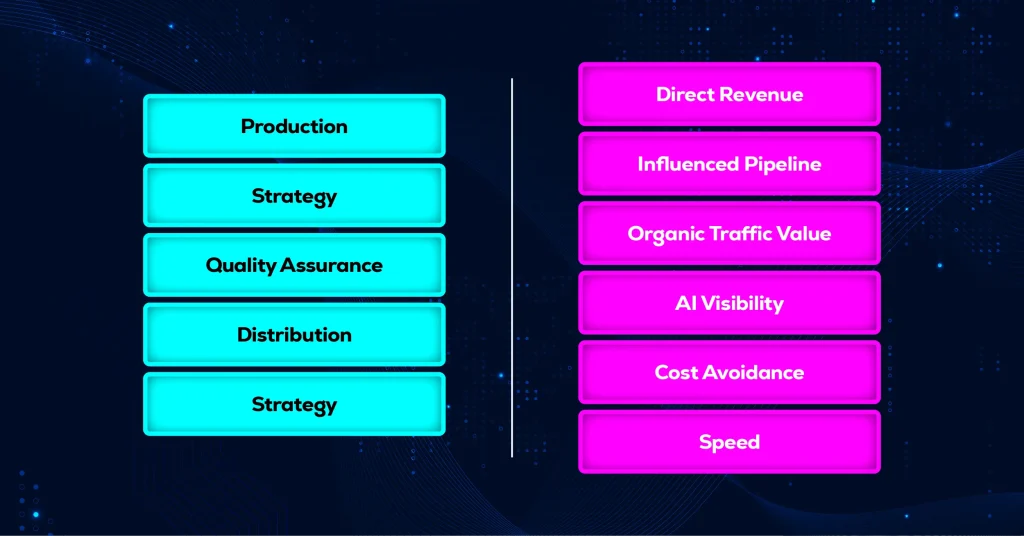
The true cost of AI-assisted content falls into five categories: production, strategy, quality assurance, distribution, and measurement. Most businesses count only the first. Quality assurance and measurement vanish from budgets most reliably, and in AI-heavy workflows both are substantial. Counting them honestly is what separates a real number from a flattering one.
The five cost categories
| Category | What it covers |
|---|---|
| Production | AI tools, subscriptions, writers, editors |
| Strategy | Choosing topics, researching keywords, building outlines |
| Quality assurance | Fact-checking, verifying sources, correcting errors, brand voice review |
| Distribution | Design, video, email, paid promotion |
| Measurement | Building the tracking, maintaining the dashboard |
Three of these deserve more attention than they usually get.
Tooling is rarely one subscription. Most teams end up running a writing tool, a research tool, often an image generator, and increasingly paying for API usage on top of all three. Add the line items up before you conclude that AI made content cheap. The number is usually larger than the one people quote.
Verification became a real cost. AI moved the work from writing to checking. Every statistic has to be traced to its source, every link opened, every claim confirmed. Those hours are not overhead. They are production, and they belong in the same column as the writing they replaced.
Then there is the cost of being confidently wrong. AI does not hedge when it invents a statistic or attributes a study to the wrong researcher. It states the thing plainly, in clean prose, which makes the error harder to catch than a human writer’s would be. Budget for the time spent finding those. And understand that the real expense is the one you miss, because a single wrong number in a published article costs you more trust than the article earned.
Measurement belongs on the list for the same reason: knowing costs money too.
Pricing a single article
Take a realistic hourly rate, multiply by hours, then add a share of fixed costs by dividing monthly tooling across however many pieces you publish that month.
The one thing owners skip almost universally is their own time. If you are the person writing, that time counts and should be valued at a real rate. Unpaid owner hours are the single most common reason a small business content program looks profitable when it is not.
The two costs almost nobody counts
Quality assurance and measurement. AI did not remove work, it moved it: from writing to verifying, and from drafting to catching what the draft got confidently wrong. Building your tracking is a cost of the program rather than a separate project. Leave both out and your ROI is overstated by a wide margin.
Step 2: How Does AI-Driven Content Create Value?
Content creates value in six ways: direct revenue, influenced pipeline, organic traffic value, AI visibility, cost avoidance, and speed. Only one of them is direct revenue. Counting that one alone is the fastest route to concluding that content does not work, when in truth you have measured a fraction of what it does.
Direct revenue and influenced deals
Direct revenue is a sale with content clearly in the path. Influenced deals are the ones where content appeared in the journey without being the final step.
The mistake is valuing them at either zero or full price. Pick a weight instead, something like 25 percent of deal value, and apply it the same way every time. Consistency matters more than precision, because what you are building is a number you can compare against itself next quarter.
Organic traffic value
This accounts for readers who never convert. That traffic is still worth something, and the cleanest way to value it is to ask what those clicks would have cost in Google Ads.
Report it separately from your headline figure. It is a proxy, not revenue, and blending the two produces a number that looks better than your bank account does.
AI visibility
This is the newest of the six and the least understood. When an AI-generated answer resolves a question without sending a click, that is not nothing; it shows up as more people searching your name directly and better-quality visits from those who do arrive.
Google’s own guidance on AI features and your website points site owners to Search Console for this rather than analytics sessions, which matters because AI Overview clicks are folded into your overall web totals rather than broken out.
There is an earlier signal too, and almost nobody looks at it. Before any AI tool can cite your article, its crawler has to fetch the page, and those visits appear in your server logs under names like GPTBot, ClaudeBot, and PerplexityBot. Which pages they return to, and how often, moves months ahead of revenue. Reading it means working with raw server logs rather than opening a dashboard, which is why most small businesses never do.
Worth saying plainly: AI systems do not cite generic content. They cite pages that answer a question cleanly, come from a source with a track record on the subject, and say something the other twenty results did not. That is an editorial problem before it is a technical one, and it is why a pile of AI-generated posts rarely produces AI visibility. Volume is not the input. Substance is.
Cost avoidance and speed
Cost avoidance is work you no longer pay for, and it counts only if those freed hours went somewhere useful. Speed counts because publishing sooner starts the return sooner: going from six weeks to two means every article begins earning a month earlier.
Step 3: Build the Measurement Setup
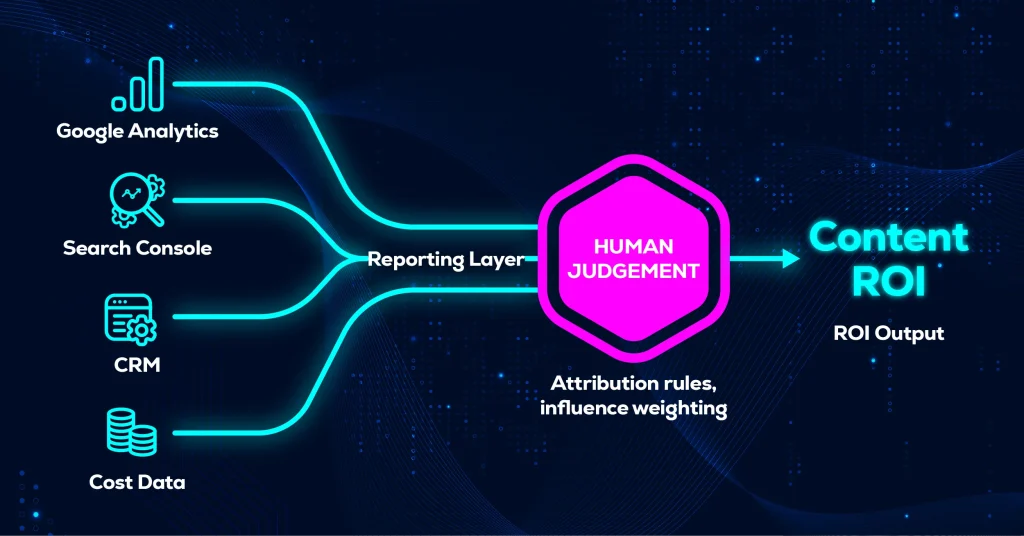
Three tools supply the inputs. Google Analytics 4 gives you conversions and attribution, Google Search Console gives you search and AI visibility data, and your CRM or booking system tells you what a customer is worth. None is sufficient alone, and the genuinely difficult part is not any single tool. It is connecting them so their numbers agree.
What Google Analytics tells you
Two settings decide almost everything.
The first is your attribution model. GA4 offers three: data-driven, paid and organic last click, and Google paid channels last click. The older models much published advice still recommends, including first click, linear, and time decay, were retired in November 2023, so any article telling you to use them is out of date. Use data-driven attribution, which spreads credit across the touchpoints in a customer’s path rather than dumping all of it onto the last one.
The second is your key event lookback window, and it quietly ruins more content ROI reporting than anything else. If it is set to 30 days while your customers take three months to decide, your content will appear to do nothing. It is not doing nothing. You have told the tool to stop looking before the interesting part happened.
What Search Console tells you
Search Console handles the other half, showing what people searched for and where you appeared, including performance inside AI features. Analytics shows what happened after the click. Neither answers the other’s question.
Connecting them is the actual work
This is where content ROI usually breaks. Traffic lives in one place, conversions in another, costs in a spreadsheet, customers in a CRM, and all four will happily disagree about what counts as a lead.
You can build this yourself. A Looker Studio dashboard pulling from all three, with a written definition of every metric, is well within reach for a small team. Budget a week to set up and a few hours a month to keep honest.
At Growth Conductor, ConductorIQ unifies that data across search, paid, and content, and Conduit runs the analysis. But a strategist still sets the attribution rules and the influence weighting, and that is the point worth taking whether you work with us or not. The infrastructure produces the data. A person decides what it is allowed to mean. That is why our marketing analytics and attribution setup begins with decisions rather than dashboards.
Step 4: How Long Does It Take Content Marketing to Show ROI?
Content ROI compounds over roughly 6 to 18 months. The cost lands the month you publish. The return builds slowly afterwards as the article ranks, earns links, and gets cited. Measuring on a single quarter will almost always show a loss, because you are weighing the entire cost against a fraction of the return. This is the most common reason a healthy program gets cancelled.
Why quarterly reviews kill good programs
A quarterly view is not measuring performance. It is measuring timing, and it is biased against content in a way no amount of good work can overcome. The fix is to group your articles by publication month and track each group’s cumulative return. Once you can see the curve, month four stops being alarming.
A three-tier reporting rhythm
| Cadence | What you check | What it tells you |
|---|---|---|
| Weekly | Published, indexed, being read | Operational. Catches problems early |
| Monthly | Rankings, AI visibility, assisted conversions | Directional |
| Quarterly | Full ROI on articles two quarters or older | Financial |
Two rules follow. Never calculate ROI on content younger than a quarter, and never report a program-wide number without breaking it out by publication cohort.
Why a quarterly review kills healthy content programs
You pay for an article in January. It ranks in April, earns links in June, and closes a deal in September. A first-quarter review sees the full cost and none of the return, so the program looks like a failure at exactly the moment it starts working.
Step 5: Run the Calculation
Here is a full year for an illustrative services company of about 20 employees, publishing two to three articles a month with a part-time marketer and AI-assisted drafting. These figures are illustrative rather than a client result. The point is the contrast at the end: the same twelve months, counted two different ways, produces two answers far enough apart to justify opposite decisions.
The rigorous method
| Cost category | Amount |
|---|---|
| Production (30 articles) | $8,100 |
| Strategy (120 hours) | $5,400 |
| Quality assurance (45 hours) | $2,025 |
| Distribution | $3,000 |
| Measurement | $2,100 |
| Total cost | $20,625 |
| Value category | Amount |
| Direct revenue (7 deals at $6,000) | $42,000 |
| Influenced pipeline (10 deals at 25 percent) | $15,000 |
| Cost avoidance | $2,400 |
| Total value | $59,400 |
That gives an ROI of $59,400 minus $20,625, divided by $20,625, times 100, which is 188 percent. A ratio of 2.9 to 1. Organic traffic value came to roughly $6,800 and was reported separately.
The same year, measured the common way
Now count only the tools and the writer, $8,100, and leave the lookback window at its default 30 days against a four-month sales cycle. Five of those seven deals lose their content credit, because the article was read outside the window. ROI becomes 48 percent. A ratio of 1.5 to 1.
Same year, same articles, same customers. One number says invest more, the other says cut it. That gap is not a rounding error. It is the difference between a correct setup and a default one.
What to do with the number
It should drive three decisions: which topics deserve more investment, which older articles should be refreshed rather than replaced, and whether your AI workflow is saving money or merely relocating it.
What Is a Good ROI for Content Marketing?
A workable target is 3 to 1 in value against cost within 12 months, improving as your library grows and older pieces keep earning. But the only benchmark you can fully trust is your own program’s previous figure, calculated the same way. Published ROI numbers rarely disclose what they counted as cost, which makes comparing against them close to meaningless.
Compare against yourself first
Run the calculation this quarter, then run it identically next quarter. The direction of travel tells you more than any industry average could. When you compare content against paid media, use the same time horizon for both; judging content on 30 days while giving paid a full year rigs the comparison before you start.
Be skeptical of the enormous figures that circulate. Returns in the hundreds of percent get repeated without anyone showing their cost side, and you should never benchmark against a number whose denominator you cannot see.
Do you actually need help with this?
If you publish fewer than two pieces a month and you can measure them, you probably do not need an agency yet. That is a real answer, not false modesty, and you should be suspicious of anyone who cannot give it.
The case for outside help begins somewhere specific. When you publish enough that you can no longer tell which pieces are working. When the tracking has been on your list for six months and keeps losing to client work. When AI made producing content easy enough that your real bottleneck moved to deciding what is worth producing. Or when you look at a year of output and cannot say which topics earned their keep, so next quarter’s plan is a guess dressed up as a strategy.
Those are not volume problems. They are judgment problems, and that is the point at which a system starts paying for itself.
And if somebody is pitching you content services, ask three questions: how will you attribute revenue to an article, what lookback window will you set and why, and what will you count as a cost? A vendor who cannot answer those cannot measure what they are selling you.
The Mistakes That Distort the Number
Five errors account for most unreliable content ROI figures: counting only the AI subscription as cost, leaving attribution on its default, judging on a single quarter, treating publishing volume as an outcome, and pooling AI-assisted and human-written content together. Each is fixable in an afternoon, and they share a common shape. Every one makes the number easier to produce and less connected to what actually happened.
| The mistake | What it does to your number |
|---|---|
| Counting only the AI subscription as cost | Inflates ROI by shrinking the denominator |
| Leaving attribution on its default | Credits content with almost nothing |
| Judging on a single quarter | Measures timing, not performance |
| Treating publishing volume as an outcome | Proves throughput, tells you nothing about value |
| Pooling AI-assisted and human-written content | Makes it impossible to learn about either |
None of this is difficult mathematics. It is a series of judgment calls about what counts, and those judgment calls are the part that no tool will make for you. AI can produce the data. Deciding what it means is still yours.
What a Content Program Built to Be Measured Looks Like
Most content programs bolt measurement on at the end, which is why the numbers never quite work. A program built to be measured makes the decisions up front: what the piece is for, what it should be judged on, and what evidence will exist afterwards. The difference is not more software. It is a sequence with human approval built into it.
The judgment happens before the writing
Every piece starts as an outline, and that outline is approved before a paragraph is drafted. It sounds bureaucratic until you have paid for three articles nobody needed. The outline is where the expensive decisions live: which question the piece answers, which keyword it targets, which existing pages it connects to, and what a good outcome would even look like.
AI is genuinely useful at this stage and genuinely bad at deciding it. It will produce a plausible outline for a topic worthless to your business, instantly and with total confidence.
Every piece is scored before it publishes
Drafts run through a 110-point SEO and AI-optimization review before anything goes live: structure, extractability, source accuracy, internal linking, brand voice. A piece scores 80 to publish and 90 to count as cornerstone. Statistics that cannot be traced to a primary source get cut, and links are verified live rather than assumed.
That last part matters more than it sounds. A confidently wrong statistic is the fastest way to lose the trust an article spent 2,000 words building, and AI produces those effortlessly.
Measurement is wired in from day one
Because the tracking, the attribution rules, and the influence weighting are decided at the start, the ROI calculation at the end is arithmetic rather than archaeology. You are not reconstructing what happened; you already know what you were measuring and why.
That is what Content Engine is: AI doing the work it is good at, inside a process where a person makes every decision that matters. Not a content mill with a language model attached, and not a human team pretending AI does not exist.
Frequently Asked Questions
A reasonable target is 3 to 1 in value against cost within 12 months, improving over time as older articles keep earning. Your own prior figure, calculated identically, is a more reliable benchmark than any published average, because most published averages never disclose what they counted as cost.
Roughly 6 to 18 months. Costs land the month you publish, while the return builds as the article ranks, earns links, and gets cited. Judging a program on one quarter compares all of the cost against a small slice of the return, which is why healthy programs often get cut early.
Track it as visibility rather than traffic. Watch for growth in people searching your brand name directly, and for higher-quality visits from those who do click through. Search Console is where AI-surface performance is reported, since AI Overview clicks are combined into your overall web totals.
It can be, but only if you can measure it. A program that publishes consistently and tracks results compounds in a way paid advertising does not, because articles keep working after you stop paying for them. A program nobody measures is a guess with an invoice attached.
If you publish fewer than two pieces a month and can measure them, doing it yourself is reasonable. The case for hiring begins when your publishing volume outgrows your ability to track results, or when the measurement setup itself becomes the bottleneck.
Key Takeaways
- AI content marketing ROI is value minus cost, divided by cost, times 100. Getting the inputs right is the work, not the arithmetic.
- Your true cost has five parts. Quality assurance and measurement are the two that vanish from most budgets.
- Content creates value six ways, and only one is direct revenue. Counting that one alone guarantees content looks like it failed.
- Data-driven attribution and a lookback window matched to your sales cycle are not optional details. They decide your answer.
- Content ROI compounds over 6 to 18 months. Judge it on cohorts at least two quarters old, never on a single quarter.
- The math is easy. The judgment calls about what counts are the part that does not automate.
Where to Start
Everything you need to run this calculation is above. Take an hour this week, put your real numbers into it, and see what comes out. Whatever the figure is, you will know more than you did, and that alone beats another quarter of guessing.
Most owners who try hit the same wall: the data exists, but it is scattered across three tools that have never been introduced to each other, and reconstructing a year of it by hand is not a good use of a Saturday.
If that is where you land, there are two ways we help. If tracking is the problem, our marketing analytics and attribution setup connects what you already have into one model that produces a real figure. If the deeper issue is producing content without a system for deciding what is worth producing, that is what Content Engine was built for.
Either way, you should be able to answer the question this article opened with. Most businesses cannot, and it is costing them more than they think.