
Heather
Hi! My name is Heather Shoup and I am a web growth engineer.
Share
Quick Summary: AI content marketing uses large language models (LLMs), natural language processing (NLP), and generative AI to accelerate research, planning, creation, and optimization — with human strategy driving every stage.
Google’s AI Overviews, powered by its Knowledge Graph and Gemini model, now appear in 50–60% of searches. Traditional SEO is necessary but no longer sufficient for full search visibility.
AI-assisted content (human-led, AI-accelerated) consistently outperforms fully AI-generated content for E-E-A-T compliance, reader trust, and long-term ranking stability.
A structured 5-stage AI content workflow — Research, Outline, Draft, Optimize, Measure — is the foundation of scalable, high-quality content production.
Growth Conductor’s Human + AI model keeps strategy and creative assets human-led while AI tools like Claude (Anthropic) and Gemini (Google) drive efficiency and scale.
Most marketing teams are producing more content than ever and getting less return on it. Not because content stopped working — but because the environment content competes in has been restructured by artificial intelligence. Google’s AI Overviews, powered by the Gemini large language model and Google’s Knowledge Graph, now dominate the top of the search results page for more than half of all queries. Conversational AI platforms like ChatGPT (OpenAI) and Perplexity are answering the questions your prospects used to find through blog posts. And every competitor with a structured AI content workflow is building topical authority faster than teams still operating without one.
AI content marketing is not a shortcut. It is a strategic operating model — one that combines the efficiency of generative AI and machine learning with human expertise, creative judgment, and brand authority to produce content that ranks, resonates, and converts at a scale that was not achievable before. Done correctly, it does not replace the writer, the strategist, or the creative director. It gives them a force multiplier.
This guide covers the full picture: what AI content marketing is and how it works technically, how it compares to traditional content operations, the risks you need to manage, how Google actually evaluates AI-assisted content, real-world applications across industries, the tools and workflow architecture that make it scalable, and how to measure performance. Whether you are just beginning to integrate AI into your content process or formalizing a production system, this is the definitive resource.
What Is AI Content Marketing?
AI content marketing is the strategic use of artificial intelligence technologies — including large language models (LLMs), natural language processing (NLP), generative AI, and machine learning — to research, plan, create, optimize, and measure content at scale. It is not about replacing human marketers with automation. It is about giving strategists, writers, and analysts tools that compress timelines, surface deeper insights, and enable consistent execution across a larger content ecosystem than any team could sustain manually.
Understanding what AI content marketing actually means requires understanding the underlying technologies involved — because the terminology is used loosely and the distinctions matter for both strategy and SEO performance.
The Technologies Powering AI Content Marketing
Large Language Models (LLMs) are the foundation of modern AI writing tools. LLMs — including OpenAI’s GPT-4o, Anthropic’s Claude, and Google’s Gemini — are deep learning systems trained on massive text datasets that enable them to generate coherent, contextually relevant written content from prompts and structured inputs. They power drafting tools, research synthesis engines, and content optimization platforms.
Natural Language Processing (NLP) is the branch of machine learning that enables computers to understand, interpret, and generate human language. NLP powers the intent analysis, entity recognition, and semantic matching that tools like SEMrush, Ahrefs, and Google Search use to understand what a piece of content is actually about — beyond keyword matching.
Generative AI refers specifically to AI systems that create new content — text, images, data — rather than simply classifying or analyzing existing content. In content marketing, generative AI handles first-draft copy, FAQ scaffolding, meta descriptions, social captions, and structured content variations.
Machine Learning enables AI tools to improve over time based on performance data. In content marketing, machine learning powers predictive content planning, content decay detection, and performance forecasting — helping teams prioritize which content to create, refresh, or retire based on historical signal patterns.
Google’s Knowledge Graph is Google’s structured database of entities — people, places, organizations, concepts, and the relationships between them. Content that explicitly references and contextualizes entities recognized in the Knowledge Graph receives stronger semantic relevance signals than content that relies on keyword proximity alone. This is why explicit entity mention is critical for AI Overview eligibility.
AI-Assisted vs. AI-Generated Content: What’s the Difference?
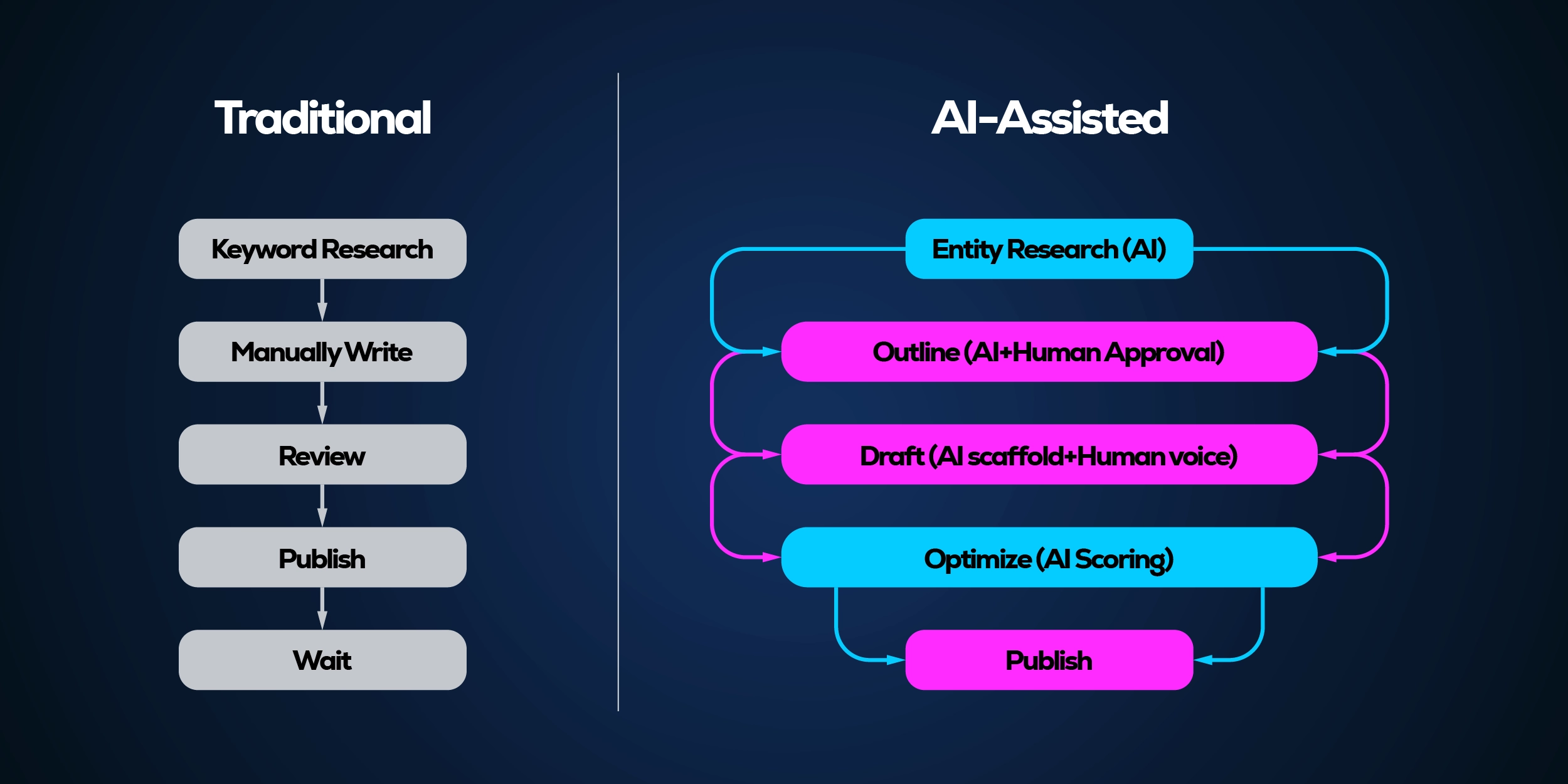
AI-assisted content means a human strategist leads every meaningful decision — defining intent, approving structure, refining the draft, verifying facts, and calibrating brand voice — while AI tools accelerate the time-intensive tasks: topic research, competitive gap analysis, outline generation, first-draft scaffolding, and SEO scoring. The human is the author. The AI is the infrastructure.
AI-generated content involves minimal human input. A prompt goes in, content comes out, and the review layer is thin or absent. This approach can produce volume quickly, but it consistently underperforms on the signals that matter most in 2026: depth, original insight, accurate sourcing, and the authentic expertise markers that Google Search rewards through its E-E-A-T evaluation framework.
“AI-generated content is not a content strategy. It is a production method with no quality guarantee. The brands winning with AI in 2026 are those using it to do more of what their best humans do well — not to replace them”
Growth Conductor’s Content Engine operates on AI-assisted production with human creative and strategy ownership. Our writers, strategists, and creative team lead the work. AI tools — including Claude (Anthropic) and Gemini (Google) — power the research, structural scaffolding, and optimization layers. This model produces the outcomes that matter: content that ranks, earns AI Overview citations, and converts.
AI Content Marketing vs. Traditional Content Marketing
AI content marketing and traditional content marketing share the same goal — producing high-quality content that attracts, engages, and converts a target audience — but they differ fundamentally in speed, scale, cost structure, and research depth. Traditional content operations rely on manual research, individual writer expertise, and sequential production. AI-assisted operations use LLMs, NLP-powered research tools, and structured workflows to compress every stage while maintaining human quality control at defined checkpoints.
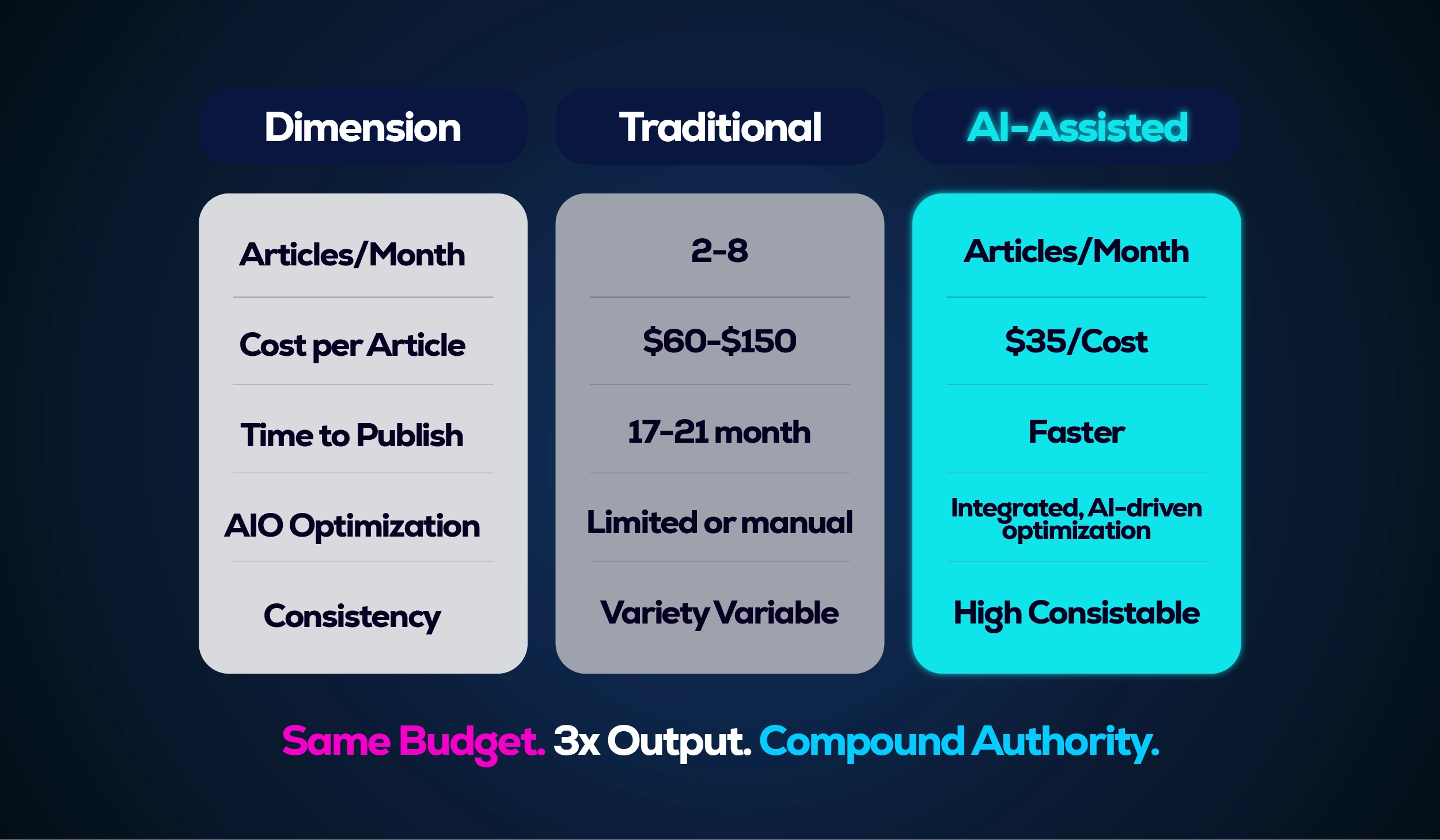
The comparison is not about which approach is better in principle — it is about what your content operation needs to accomplish at your current scale, with your current team, in your current competitive environment. For most marketing teams in 2026, the question is not whether to integrate AI but how to do it without sacrificing the editorial quality that drives long-term organic performance.
| Traditional Content | AI-Assisted Content | |
|---|---|---|
| Articles / Month | 4–8 (typical team, manual) | 12–25 (same team, AI-assisted workflow) |
| Research Time / Article | 3–5 hours | 30–60 minutes with AI research tools |
| Cost Per Article | $400–$1,200 (freelance/agency) | $80–$300 (AI-assisted in-house or managed) |
| Keyword & Entity Coverage | Dependent on writer knowledge | Systematic — AI maps full semantic landscape |
| AIO Optimization | Rarely structured for AI extraction | Built into workflow — citation blocks, schema, FAQ |
| Consistency at Scale | Variable — depends on individual writers | Enforced through SOPs, scoring matrices, templates |
| E-E-A-T Signals | Strong when expert writers are involved | Strong when human review layer is maintained |
| Time to Publish | 7–14 days per article | 3–5 days with structured AI workflow |
The cost comparison deserves specific attention because it drives the ROI case for AI content marketing more than any other factor. A traditional content marketing operation producing 6 articles per month at an average cost of $700 per article spends $4,200 monthly for 72 articles per year. An AI-assisted operation producing 18 articles per month at $180 per article spends $3,240 monthly for 216 articles per year — roughly the same budget delivering three times the output volume, broader topical coverage, and faster topical authority accumulation.
The productivity gain compounds over time. Brands that build AI content infrastructure in 2026 will have a coverage and authority advantage in 2027 that pure-manual competitors will not be able to close by adding headcount alone.
“A marketing team that invested in an AI content workflow 12 months ago has likely published 150–200 more articles than an equivalent team that did not. In organic search, that gap does not close quickly”
Why AI Content Marketing Matters in 2026
Three forces have made AI content marketing a strategic necessity in 2026: content demand has outpaced what traditional teams can sustain, Google’s AI Overviews — powered by the Gemini model and Knowledge Graph — have restructured how content gets discovered and cited, and the competitive gap between AI-enabled and traditional content operations is widening every month. Brands operating without AI content workflows are not just slower — they are structurally disadvantaged in both search and AI-assisted discovery.
According to HubSpot’s 2026 State of Marketing Report, content volume demands have increased more than five times since 2020, while the average marketing team’s headcount has grown by less than 20 percent. The math does not work without AI — and the data on content marketing confirms this is not a future problem, it is a current one. Meanwhile, Salesforce’s State of Marketing 2026 found that 83 percent of marketers using AI in their content workflows report significant time savings, with the average team reclaiming 8–10 hours per week per person on research and drafting tasks alone.
How Google AI Overviews Changed the Search Landscape
Google AI Overviews — generated using the Gemini large language model and structured by Google’s Knowledge Graph entity relationships — now appear in 50–60 percent of all searches as of early 2026. The top result for most informational queries is no longer a blue link. It is a synthesized answer that cites sources. Only 38 percent of those citations come from the traditional top-10 organic results. The remaining 62 percent come from content that was structured and optimized specifically for AI extraction, regardless of its rank position.
This shift requires a fundamentally different content optimization approach. Traditional on-page SEO — keyword placement, heading structure, internal links — remains necessary for rank position. But AIO optimization — citation block architecture, entity reinforcement, semantic completeness, schema markup — determines whether your content gets surfaced in the AI Overview that most users see before they ever reach the organic results.
“As of early 2026, 62% of AI Overview citations come from content outside the traditional top-10 search results. Structured content with explicit entity context and clear answer blocks is the differentiator — not domain authority alone”
The Business Case for AI in Content Marketing
- Speed to publish: AI reduces research and outline time by 40–60% per piece
- Cost per article: AI-assisted production costs 60–75% less than equivalent manual production
- Coverage: More articles means broader keyword and entity coverage across the topic landscape
- Topical authority: Deeper, more frequent publishing builds semantic authority signals faster
- AIO visibility: Structurally optimized content earns AI Overview citations that keyword-optimized content misses
The Risks of AI Content Marketing — and How to Manage Them
AI content marketing carries real risks that must be actively managed: LLM hallucination (AI generating plausible-sounding but false information), content homogenization (AI-produced content that mirrors competitors because it was trained on the same data), bias in AI model outputs, E-E-A-T erosion from publishing content without genuine expertise signals, and Google Search enforcement against low-quality, scaled AI content. None of these risks make AI content marketing inadvisable — but all of them require deliberate human oversight at defined checkpoints in the production workflow.
LLM Hallucination: The Risk of Plausible Falsehoods
Large language models like GPT-4o, Claude, and Gemini are trained to generate statistically probable text — not to verify factual accuracy. This produces a specific failure mode: hallucination, where the AI generates confident, coherent statements about facts, statistics, or events that are fabricated or distorted. Hallucinated content is the most damaging risk in AI-assisted marketing because it can pass an inattentive review and publish incorrect information that damages brand credibility and violates Google’s accuracy standards.
The mitigation is non-negotiable: every statistic, data point, named study, and factual claim generated in an AI draft must be verified by a human reviewer against the cited source before publication. At Growth Conductor, fact verification is a defined step in the SEO and AIO optimization stage — not an optional review pass. Any claim that cannot be verified against a credible, named source is either removed or replaced with a properly sourced alternative.
AI RISK: Never publish statistics or specific factual claims from an AI draft without verifying them against the original source. LLMs frequently generate plausible-sounding data points that do not exist. This is a non-negotiable human checkpoint in every production workflow.
Content Homogenization: When AI Content Sounds Like Everyone Else’s
Because LLMs like GPT-4o, Gemini, and Claude are trained on overlapping datasets that include the top-ranking web content on any given topic, AI-assisted content faces a structural risk of homogenization — producing articles that cover the same angles, use the same examples, and reach the same conclusions as every competitor who used the same tools. This is a genuine E-E-A-T problem: content that adds no original perspective to the existing conversation does not demonstrate expertise, and Google’s quality evaluation framework is specifically designed to identify and discount it.
The solution is deliberate original value injection: every piece of AI-assisted content must include at least one element that cannot be found in competitor content — a proprietary framework, a specific client example, an original data analysis, a counterintuitive professional observation, or a brand-specific positioning statement. This is a human responsibility, not an AI task.
AI Bias in Content
AI models reflect the biases present in their training data. For marketing content, the most common manifestation is demographic and cultural bias — AI tools that default to certain geographic markets, buyer profiles, or industry contexts because those are overrepresented in the datasets they were trained on. For B2B content in particular, LLMs may default to enterprise use cases, US-centric regulatory examples, or technology-sector framing that does not match your audience.
Bias mitigation in content production requires explicit audience context in every prompt, human review for cultural or demographic relevance, and editorial policies that flag and correct default assumptions in AI drafts before publication.
AI Content Detection and Google’s Stance
Google’s official position on AI-generated content is that it evaluates content quality, not production method. Google Search does not penalize content for being AI-assisted — it penalizes content for being low quality, regardless of how it was produced. The Helpful Content System, which became a core component of Google’s ranking algorithm in 2023 and was strengthened through 2025 updates, specifically targets content that was produced primarily for search engines rather than for human readers — a description that applies to mass-produced AI content without human oversight, not to professionally reviewed AI-assisted content.
However, the practical risk is real: at scale, AI-generated content without strong human review frequently produces exactly what Google’s Helpful Content System targets — thin coverage, generic framing, unverified claims, and no original value. The penalty is not triggered by AI involvement; it is triggered by the quality outcomes that careless AI usage tends to produce.
GOOGLE STANCE: Google does not penalize AI-assisted content. It penalizes low-quality content — which mass-produced AI generation without human oversight reliably produces. The safeguard is the human review layer, not the avoidance of AI tools.
AI content detection tools — including GPTZero, Originality.ai, and similar platforms — have become widespread among publishers, academic institutions, and some enterprise procurement teams. These tools have meaningful false positive rates and should not be used as sole quality indicators. The most reliable protection against both AI detection concerns and genuine quality issues is the same: maintain strong human authorship, original insight, and factual accuracy in every published piece.
How AI Transforms the Content Strategy Process
AI transforms content strategy by enabling marketers to analyze search intent at scale using NLP-powered tools, map entire topic ecosystems through entity and Knowledge Graph relationships, identify competitive gaps faster than manual research, and predict which content formats and subjects will earn AI Overview citations — work that previously took weeks now takes hours. The shift is not just about speed. It makes strategy more comprehensive and more precisely targeted than manual processes can achieve.
Using AI for Keyword Research and Topic Discovery
Traditional keyword research produced lists — single phrases ranked by search volume. AI-powered topic research produces semantic maps. Rather than identifying keywords in isolation, NLP-powered tools analyze the full entity landscape around a topic: the Knowledge Graph entities associated with it, the questions users are asking across Google Search, Bing, and AI assistants, the subtopics that signal domain expertise, and the gaps in competitor coverage that represent ranking opportunities.
Tools like SEMrush and Ahrefs now integrate machine learning-driven topic modeling that identifies not just what people search for, but the complete web of related concepts — entities, relationships, intent patterns — that a piece of content must address to be considered authoritative by Google’s AI evaluation systems. Understanding how AI tools transform keyword research into topic discovery is the foundation of every AI content strategy worth building.
At Growth Conductor, this research layer is used to build semantic content maps for every client engagement — structured blueprints showing which pillar pages and cluster articles need to exist, how they interlink, and which topics must be covered to close the entity and semantic gaps that are currently costing organic visibility. Understanding how to build content clusters that strengthen topical authority starts with having a complete map of the semantic landscape, not just a list of target keywords.
What Is Predictive Content Marketing?
Predictive content marketing uses machine learning models, search trend signals, and historical performance data to forecast which topics are gaining momentum before they peak — and prioritizes content production accordingly. Tools like Exploding Topics, Google Trends API integrations, and BuzzSumo’s trend analysis surface topics rising in search interest weeks or months before they reach peak competition, giving brands with efficient AI production workflows a timing advantage that is difficult to replicate manually.
- Identify trending topics before peak competition using search momentum signals
- Anticipate content refresh windows based on historical algorithm update cycles
- Prioritize production by projected traffic and AI citation potential, not current search volume alone
- Plan seasonal content 8–12 weeks ahead to capture emerging demand curves
The AI Content Workflow: A 5-Stage Framework
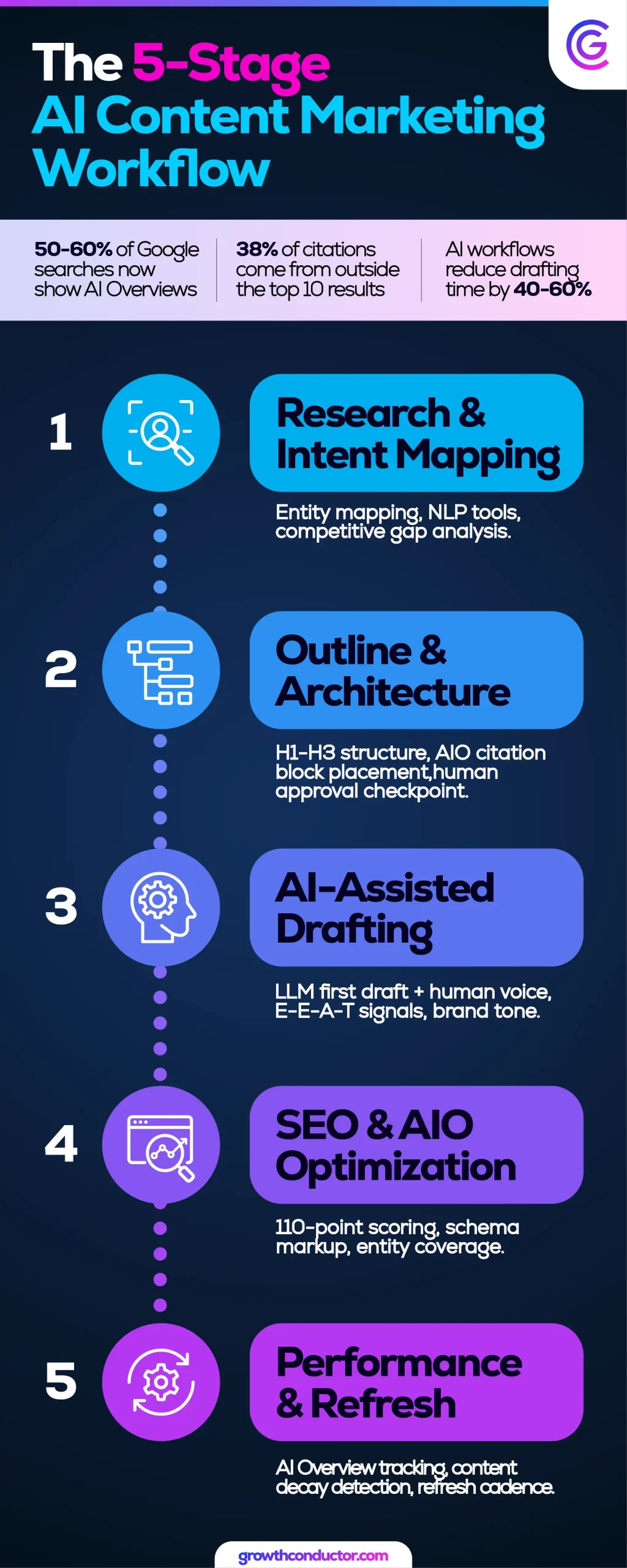
A structured AI content workflow has five stages: Research and Planning (NLP-powered tools map topics, entities, and competitive gaps), Outlining (AI generates content architecture that a human strategist approves), Drafting (an LLM produces a first draft that human writers refine for voice, accuracy, and original insight), Optimization (AI scoring tools evaluate SEO and AIO signals against a structured matrix), and Performance Analysis (machine learning tools identify which content to refresh, scale, or retire based on ranking and citation data). Each stage has a defined human checkpoint. No stage is fully automated.
The benefits of content marketing compound over time only when production is consistent and quality is maintained at scale. A workflow architecture — not just a publishing calendar — is what makes both possible simultaneously.
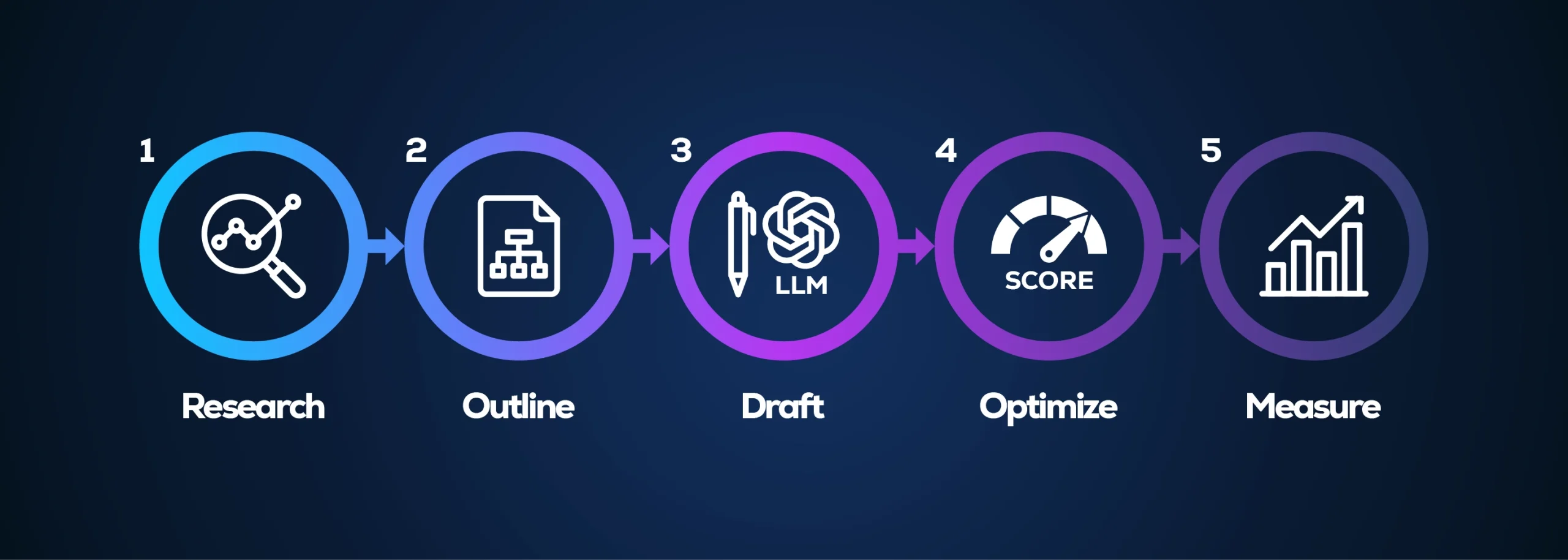
Stage 1: Research and Intent Mapping
Every piece of content begins with research — and this is where AI delivers its most significant efficiency gain. In a traditional workflow, comprehensive topic research for a single article takes a skilled writer 3–5 hours: reading competitor articles, identifying gaps, mapping related questions, sourcing statistics, and building a keyword list. With NLP-powered research tools, the same output takes 30–60 minutes.
The AI-powered research stage covers: primary keyword and intent analysis using tools like SEMrush and Ahrefs; entity mapping against Google’s Knowledge Graph to identify which named concepts must be addressed; competitor gap identification using machine learning-driven content analysis; PAA (People Also Ask) question extraction for AIO targeting; and external source curation from credible, dateable publications. A human strategist reviews and validates the research brief before any structure is built — because AI research surfaces patterns but cannot evaluate which patterns are strategically meaningful for a specific client’s positioning.
Stage 2: Outline and Architecture
The outline is the most important document in the content workflow. It defines H1-to-H3 heading hierarchy, AIO citation block placements, internal and cluster link targets, schema recommendations, and the semantic entity checklist that the article must satisfy. AI can generate outlines quickly from research briefs — but AI-generated outlines require human approval before drafting begins.
GC’s workflow treats the outline as a hard checkpoint. No article draft begins without an approved outline. This is not bureaucratic process — it is the quality gate that prevents the most common AI content failure: structurally complete articles that are strategically misaligned with the client’s positioning, missing key entity coverage, or optimized for keyword pattern-matching rather than genuine reader value.
The outline stage is also where content cluster architecture is enforced: every cluster article is mapped to its pillar page, every pillar page accounts for its full cluster ecosystem, and every internal link is planned before a word of the draft is written.
Stage 3: AI-Assisted Drafting and Human Creative Review
LLMs like Claude (Anthropic) and GPT-4o (OpenAI) generate structurally sound first drafts from approved outlines — covering section scaffolding, definition passages, FAQ answer frameworks, and transition copy. What AI drafts well, it drafts efficiently. But first drafts are not finished articles.
What human writers add that no LLM can replicate: genuine practitioner perspective earned through real experience, brand-specific voice developed over client engagements, nuanced judgment about tone and framing, original insight that is not present in the training data of any existing model, and creative instinct that makes content memorable rather than merely informative.
“At Growth Conductor, human creative assets — article copy, featured images, video scripts, infographic concepts — are always human-led. LLMs and generative AI tools accelerate the process. Humans own the output and every meaningful editorial decision”
Stage 4: SEO and AIO Optimization
Once a draft is approved at the content level, it goes through a structured optimization pass scored against both traditional SEO signals and AIO-specific criteria. Technical SEO foundations for AI-ready websites extend beyond on-page optimization — ensuring the article sits within a technically sound site architecture that search engine crawlers and AI extraction systems can both navigate effectively.
Traditional SEO optimization covers: primary keyword presence in H1, meta title, meta description, and slug; supporting keyword and entity distribution; internal link placement with descriptive anchor text; external authority source verification; and image alt text including entity-relevant descriptions. AIO optimization adds: verifying each H2 opens with a self-contained 50–70 word citation block, FAQ section compliance (minimum 4 items, 7+ for pillar content), question-based heading ratio, and schema markup flagging for developer implementation.
Growth Conductor scores every article against a 110-point SEO and AIO matrix before publish. Minimum 80 points to publish; 90 or above for cornerstone and pillar content. Ten automatic fail conditions — including no internal links, missing FAQ section, and unattributed statistics — block publication regardless of total score.
Stage 5: Performance Monitoring and Content Refresh
Content is not finished at publication. In an AI Overview environment, content that is not regularly refreshed loses citation eligibility faster than it loses rank position. Fresh content averages 6 AI Overview citations compared to 3.6 for outdated content — a 67 percent difference driven by recency signals. Google’s systems, powered by its machine learning infrastructure, continuously re-evaluate content freshness and factual currency as part of the ranking and citation selection process.
Performance monitoring at Growth Conductor covers: organic rank and traffic tracking via Google Search Console and GA4, AI Overview citation monitoring through Semrush’s AI Visibility reports and manual SERP audits, engagement signal tracking (time on page, scroll depth, bounce rate), and content decay identification. Content refresh schedules are built into every client content calendar from the start — not as a reactive fix but as a proactive compounding strategy.
AI Writing Tools: What to Use and When
AI writing tools fall into three functional layers: research and ideation tools that use NLP and machine learning to surface topics, entities, and competitive gaps; LLM-powered drafting tools — including Claude (Anthropic), GPT-4o (OpenAI), and Gemini (Google) — that generate structured content from briefs and outlines; and optimization tools that score content against SEO and AIO criteria. The most effective AI content workflows combine all three layers. No single platform currently achieves best-in-class performance across all three.
Research and Ideation Tools
- SEMrush — NLP-powered keyword, entity, and topic modeling with AI-driven competitive gap analysis
- Ahrefs — Backlink-informed content opportunity identification and semantic content mapping
- Exploding Topics — Trend signal monitoring using machine learning to surface rising topics pre-peak
- Perplexity — AI-powered research synthesis that surfaces authoritative sources with citation context
- Google Search Console — First-party search data and AI Overview impression tracking
LLM Drafting Tools
- Claude (Anthropic) — Strong structured reasoning, long-form pillar content, and precise prompt-following; preferred for complex content requiring careful tone and positioning calibration
- ChatGPT / GPT-4o (OpenAI) — Versatile first-draft generation with strong FAQ-style and conversational content output
- Gemini (Google) — Aligned with Google’s own Knowledge Graph entity relationships; useful for content where Google entity context is strategically important
- Jasper — Template-driven production with brand voice training for teams scaling consistent-style content at volume
Optimization Tools
- SurferSEO — Real-time content scoring against top-ranking competitors with keyword density and NLP entity recommendations
- Clearscope — Semantic keyword coverage analysis and entity completeness scoring
- Frase — Research brief generation combined with AIO-aware optimization scoring in a single workflow
For SMBs building an AI content workflow for the first time, the most common mistake is leading with a drafting tool before establishing a research and strategy foundation. The LLM that generates the draft is the least consequential decision in the stack. What matters most is the quality of the semantic research brief going in — and the depth of the human editorial review coming out.
AI Content Optimization: Ranking in Traditional and AI Search
AI content optimization in 2026 requires a dual-layer approach. The first layer — traditional SEO — uses keyword targeting, technical site architecture, internal links, and on-page structure signals to earn rank position in Google Search. The second layer — AIO optimization — uses self-contained answer blocks, Knowledge Graph entity reinforcement, schema markup, semantic completeness, and FAQ architecture to earn citation in Google AI Overviews. As of early 2026, only 38% of AI Overview citations come from top-10 organic results, making the second layer a distinct and equally important discipline.
For brands investing in organic growth, adding AIO optimization to the content workflow is not optional — it is the layer that captures the majority of AI-influenced search visibility that traditional SEO alone misses.
Optimizing for Google SGE — the search generative experience that now powers AI Overviews — requires specific structural decisions that go beyond traditional on-page SEO. Here is what those decisions look like in practice.
What Are AIO Citation Blocks and Why Do They Matter?
An AIO citation block is a 50–70 word self-contained answer passage that opens every major H2 section. Its function is to give Google’s AI Overview system — which uses Gemini’s NLP capabilities to match content passages to user queries — a directly extractable response that does not require surrounding context to be meaningful. Every word in a citation block must stand alone. The block must directly answer the implied question of its section heading and must lead with the answer rather than with preamble.
This structure matters because Google AI Overviews do not read articles the way humans do. They use NLP to scan for semantically dense, self-contained passages that match query intent with high precision. Content that front-loads direct answers in structured blocks gets cited. Content that buries answers in narrative paragraphs — regardless of its rank position — does not.
“Write every H2 opening block as if Google’s AI system will read it in isolation and decide in milliseconds whether it is a citable answer. If the block requires surrounding context to make sense, rewrite it until it stands alone completely”
Semantic Content Strategy for AI Search
Understanding what semantic SEO is and why it matters for AI search is the strategic foundation of AI content optimization. Semantic SEO is the practice of building content that covers an entire topic ecosystem — addressing related entities, question patterns, and conceptual relationships — rather than targeting isolated keywords. Google’s NLP systems evaluate semantic completeness as a primary factor in both ranking and AI Overview selection.
Understanding entity SEO — how Google’s Knowledge Graph interprets meaning through named entities and their relationships rather than keyword strings — is equally critical. Content that explicitly names and contextualizes entities recognized in Google’s Knowledge Graph (organizations like OpenAI and Anthropic, technologies like LLMs and NLP, concepts like generative AI and machine learning) receives measurably stronger relevance signals than content that relies on keyword proximity alone.
Understanding how schema markup helps you appear in AI Overviews is the technical complement to semantic strategy. Structured data — implemented via JSON-LD in the page head — tells Google’s systems exactly what type of content a page contains, what entities it addresses, and how its structural elements (FAQ items, HowTo steps, article metadata) relate to each other. Gartner’s 2026 AI in Marketing Hype Cycle cites properly implemented schema markup as associated with a 73 percent higher AI Overview selection rate compared to equivalent content without it.
AI and Human Content Collaboration: The Growth Conductor Model
Effective AI and human content collaboration assigns LLMs and machine learning tools to tasks where they excel — data processing, competitive analysis, structural drafting, keyword and entity mapping, and optimization scoring — while human strategists own brand voice, creative direction, original insight, and quality control. This division of labor produces content that is operationally efficient and strategically authentic. It is the model that satisfies Google’s E-E-A-T standards while enabling the output volume that modern content marketing requires.
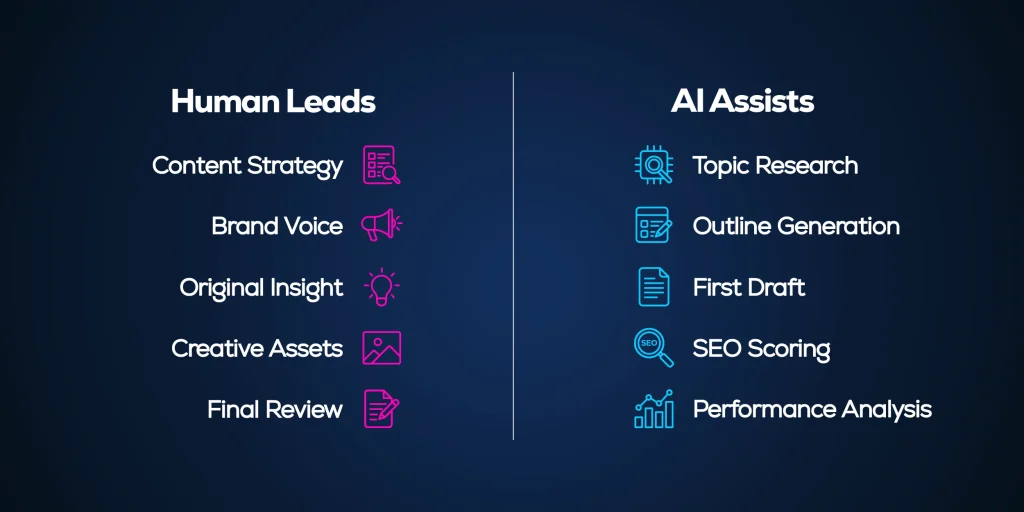
Growth Conductor was built on a specific operational belief: the best marketing outcomes come from human creativity and expertise operating at its highest level, supported by AI infrastructure that eliminates friction and repetition. In practice, this means every content engagement runs on a clearly defined division of responsibility between what AI tools handle and what human professionals own.
Human-Led:
- Content strategy, editorial direction, and client positioning
- Brand voice calibration and tone consistency across all published content
- Original insight, practitioner perspective, and real-world examples
- Creative asset development — article copy, featured images, infographics, video scripts
- Final review, fact-checking, entity verification, and publish approval
AI-Assisted:
- Topic research, competitive gap analysis, and Knowledge Graph entity mapping
- Outline generation and content architecture drafts using LLM tools
- First-draft copy scaffolding from approved outlines via Claude, GPT-4o, or Gemini
- SEO and AIO optimization scoring against structured criteria
- Performance data analysis and content refresh prioritization using machine learning signals
E-E-A-T and AI Content: How to Stay Credible
Understanding how E-E-A-T impacts AI-driven rankings is essential for any brand using AI tools in content production. Google’s quality evaluator guidelines define E-E-A-T — Experience, Expertise, Authoritativeness, and Trustworthiness — as the primary framework for assessing genuine content value. Google’s NLP systems and human quality raters both evaluate these signals when determining how to rank and cite content in both traditional search results and AI Overviews.
Maintaining E-E-A-T compliance in an AI-assisted workflow requires: practitioner-level examples drawn from real client work or direct professional experience; statistics and claims cited from credible, named, dateable sources; a point of view specific to your brand’s positioning rather than generically accurate; and named human authorship associated with the published content. LLMs can scaffold the structure of an E-E-A-T compliant article — but only humans can supply the Experience and Expertise signals that make it genuine.
AI Content Marketing by Industry: Real-World Use Cases
AI content marketing is not a one-size-fits-all strategy. How LLMs, NLP tools, and generative AI are applied depends on the industry, audience type, purchase cycle length, and content goals. B2B companies use AI to build deep topical authority across complex subject domains. SaaS brands use AI to scale product education and comparison content. Local businesses use AI to optimize for geographic entity targeting. E-commerce operations use AI to produce product content at catalog scale. Each use case has distinct requirements and distinct success metrics.
B2B Companies
For B2B marketing teams, AI content marketing’s highest-value application is topical authority development across complex subject domains — the kind of deep, comprehensive content ecosystem that signals genuine expertise to both enterprise buyers and Google’s quality evaluation systems. B2B purchase cycles are long and research-intensive. Buyers read 7–10 pieces of content before engaging sales. AI-assisted workflows make it economically viable to cover every subtopic, comparison query, and use case scenario a B2B buyer might research.
A professional services firm using AI content marketing can build a comprehensive resource library across 15–20 topic clusters — content that would take a manual team 18 months to produce — within 6 months of implementing a structured AI workflow. The result is a topical authority footprint that captures buyer research at every stage of the decision journey.
SaaS Brands
SaaS content marketing has specific requirements: product education content that reduces time-to-value for new users, comparison content that captures high-intent buyers researching alternatives, and technical documentation that builds integration-level credibility. AI-assisted workflows are particularly effective for SaaS because the subject matter is highly structured and the intent signals are clearly defined.
An AI workflow for a SaaS brand might use NLP-powered research to map every competitor comparison query in its category (e.g., ‘[Product] vs. [Competitor]’), generate structured outlines for each, and produce first drafts that human writers then personalize with product-specific positioning and genuine feature comparisons. The resulting content cluster captures high-intent comparison traffic that consistently converts at rates significantly above top-of-funnel informational content.
Local Businesses
For local businesses, AI content marketing’s most impactful application is geographic entity optimization — building content that explicitly references local entities (neighborhoods, landmarks, service areas, local organizations) in ways that Google’s Knowledge Graph can interpret and associate with local search intent. AI tools help local businesses produce location-specific service pages, local resource guides, and community-relevant blog content at a volume that would be prohibitive with manual production alone.
A local HVAC company using AI content workflows might produce 24 location-specific service pages and 12 seasonal content pieces per year — content that covers every service area and seasonal search pattern in its market — for a fraction of the cost of equivalent manual production. The entity-rich, locally contextual content earns both organic rank positions and local pack visibility that generic service pages cannot achieve.
E-Commerce Brands
E-commerce operations have some of the highest content volume requirements of any business type: product descriptions, category pages, buying guides, comparison articles, and review-driven content — often across thousands of SKUs. AI-assisted production is not just beneficial for e-commerce at scale, it is the only economically viable model for brands operating large catalogs.
Beyond product descriptions, e-commerce brands use AI content marketing to build informational content ecosystems — buying guides, how-to articles, comparison frameworks — that capture organic traffic at the research stage of the purchase journey and convert readers into buyers through structured internal linking to product pages. NLP-powered keyword research identifies the question clusters that high-intent buyers search before purchasing in any category, and AI-assisted content workflows produce the articles that capture that traffic systematically.
Building a Scalable AI Content System
A scalable AI content system is built on four operational pillars: a standardized production workflow with defined human checkpoints at every stage, a library of reusable prompts and content templates that enforce structural consistency, a content scoring framework that maintains quality standards regardless of output volume, and a performance feedback loop that continuously improves the process based on ranking data, AI Overview citation frequency, and conversion attribution. Without all four, scaling produces volume without sustained quality.
The content architecture layer — building content clusters that strengthen topical authority by organizing articles around pillar hubs with structured internal linking — is the strategic framework that makes a scalable system worth building in the first place. Without it, scaling content production generates volume without semantic authority, and volume without authority does not produce compounding organic growth.
The Infrastructure of a Scalable AI Content Workflow
- Content SOPs: Step-by-step production guides for every content type — pillar pages, cluster articles, landing pages — with defined tool usage, review checkpoints, and quality criteria at each stage. SOPs enforce the workflow even when team members change.
- Prompt libraries: Standardized, tested prompts for research briefs, outline generation, AIO citation block drafting, FAQ scaffolding, and optimization passes. Reusable prompts produce consistent structural output and eliminate the variance that ad-hoc LLM prompting creates.
- Scoring frameworks: A structured scoring matrix applied to every article before publish. GC’s 110-point matrix evaluates keyword and entity targeting, technical SEO, content quality and E-E-A-T signals, AIO optimization, structure and UX, and brand alignment — with ten automatic fail conditions.
- Performance feedback loops: A monthly review analyzing which published content is ranking, earning AI Overview citations, and converting — and using those signals to improve research briefs, prompts, and editorial standards for future production cycles.
How to Audit Your AI Content Workflow for Quality
Even well-designed workflows drift over time. Writers develop shortcuts. Prompts get repurposed beyond their intended scope. Optimization steps get abbreviated under deadline pressure. A quarterly workflow audit catches these issues before they accumulate into a content quality problem that affects ranking stability.
A content workflow audit covers: brand voice consistency across the last 20 published pieces; accuracy of internal linking execution (are cluster articles linking to their pillar pages?); AIO optimization completeness on recently published content; entity coverage against the semantic map; and performance trends that may signal structural production issues.
Separately, auditing your site for semantic relevance — evaluating whether your published content ecosystem comprehensively covers the topic domains you are targeting — is the strategic layer that identifies which new content to prioritize and which existing content to consolidate or refresh.
Measuring AI Content Marketing Performance
AI content marketing performance is measured across three layers: organic visibility — Google Search rank positions, traffic, and AI Overview citation frequency; engagement quality — time on page, scroll depth, and click-through rates that signal content usefulness to Google’s machine learning ranking systems; and business impact — lead generation, pipeline contribution, and attributed conversions. Measuring only the first layer produces misleading results. Content that ranks but does not engage or convert is not performing, regardless of its traffic numbers.
The measurement framework for AI content marketing has two important differences from traditional content analytics. First, it must include AI Overview visibility — a metric that does not appear in standard Google Analytics reporting and requires deliberate monitoring through Google Search Console’s Search Appearance reports, Semrush’s AI Visibility module, and periodic manual SERP audits. Second, it must connect content activity to pipeline outcomes through CRM attribution — a connection that many content teams leave broken, making it impossible to demonstrate business value.
Using predictive analytics to identify SEO opportunities extends measurement beyond current performance into forward-looking opportunity identification — surfacing which published content is at risk of decay, which emerging topics are underserved, and which existing articles can be optimized to improve AI Overview citation frequency. Growth Conductor’s ConductorIQ platform provides unified performance visibility that connects content activity to revenue outcomes in a single dashboard, combining Google Search Console data, GA4 engagement metrics, and CRM pipeline attribution.
Content ROI: How to Prove the Value of AI Content Investment
The most common failure in content marketing ROI reporting is measuring outputs — articles published, traffic generated — rather than outcomes: leads generated, pipeline influenced, and conversions attributed. AI content marketing makes the ROI calculation more favorable across every metric, but only if the measurement framework captures the full picture.
A practical ROI framework for AI-assisted production includes: cost-per-article (total production cost divided by articles published monthly); organic traffic value (estimated equivalent CPC value of organic traffic driven by content); lead attribution rate (percentage of leads with a content touchpoint in the 90 days before conversion); and AI Overview citation frequency as a topical authority proxy metric.
The compounding nature of content investment matters in ROI analysis. An article published today generates organic traffic for 12–36 months, with refreshes extending that lifespan. At an average CPC equivalent of $3.50 for B2B informational content, an article driving 800 monthly organic sessions represents $2,800 per month in traffic value — an ROI that compounds every month the article maintains its rank position.
Ready to build a content system that ranks, earns AI Overview citations, and scales without sacrificing quality?
Growth Conductor’s Content Engine combines human strategy with AI-powered production workflows — LLMs for efficiency, human experts for brand voice and original insight — to deliver consistent, high-performing content that builds compounding topical authority.
Key Takeaways
AI content marketing combines LLMs, NLP, generative AI, and machine learning with human strategy and creative expertise — neither layer works at full effectiveness without the other.
AI-assisted content with strong human oversight outperforms both fully manual and fully automated content for SEO performance, E-E-A-T compliance, and long-term ranking stability.
The risks of AI content — LLM hallucination, homogenization, E-E-A-T erosion — are real and manageable through defined human checkpoints, fact verification, and original value injection.
Google does not penalize AI-assisted content. It penalizes low-quality content — which careless AI usage reliably produces without a disciplined review process.
Google AI Overviews (powered by Gemini and the Knowledge Graph) now appear in 50–60% of searches. AIO optimization — citation blocks, entity coverage, schema markup — is a distinct discipline from traditional SEO.
Explicit entity reinforcement — naming LLMs, NLP, generative AI, OpenAI, Anthropic, Google Gemini, Knowledge Graph — directly improves AI Overview citation eligibility.
AI content marketing delivers 3x the output volume of traditional manual production at 60–75% lower cost per article — a compounding competitive advantage over 12+ months.
Performance measurement must include organic visibility, AI Overview citation frequency, engagement quality, and pipeline contribution — not traffic alone.
Frequently Asked Questions
What is AI content marketing?
AI content marketing is the strategic use of artificial intelligence technologies — including large language models (LLMs), natural language processing (NLP), and generative AI — to research, plan, create, optimize, and measure content at scale. Rather than replacing human strategy and creativity, AI handles time-intensive and data-heavy tasks like topic research, competitive analysis, draft generation, and SEO scoring, freeing human marketers to focus on brand voice, original insight, and the strategic decisions that determine whether content earns rankings, AI Overview citations, and conversions.
Can AI replace human content writers?
AI cannot replace human content writers because LLMs lack genuine experience, original perspective, and the creative judgment that produces content readers trust and search engines reward with long-term rankings. AI tools generate structurally sound first drafts efficiently, but human writers supply the E-E-A-T signals that matter most: real expertise demonstrated through specific examples, nuanced positioning, accurate sourcing, and an authentic voice that reflects a specific brand’s point of view. The writer’s role evolves with AI — it does not disappear.
Does Google penalize AI-generated content?
Google does not penalize content for being AI-assisted. Google Search’s Helpful Content System targets content that is low quality, thin, or produced primarily for search engines rather than human readers — a description that applies to mass-produced AI content without meaningful human oversight, not to professionally reviewed AI-assisted content. The practical risk is not AI involvement itself; it is the quality outcomes that careless AI usage reliably produces: generic framing, hallucinated statistics, homogenized structure, and absent original insight.
What are the biggest risks of AI content marketing?
The primary risks are LLM hallucination (AI generating plausible but false information that a human reviewer must catch before publication), content homogenization (AI-assisted content that mirrors competitors because it draws from similar training data), E-E-A-T erosion from insufficient human expertise signals, and Google Helpful Content System enforcement against low-quality scaled content. All are manageable with a disciplined production workflow that includes human review checkpoints, fact verification protocols, and original value injection at the drafting stage.
What AI tools are best for content marketing?
The most effective AI content marketing stacks combine tools across three layers: research tools (SEMrush, Ahrefs, Exploding Topics) for NLP-powered topic discovery and entity mapping; LLM drafting tools (Claude by Anthropic, GPT-4o by OpenAI, Gemini by Google) for generating structured first drafts from approved outlines; and optimization tools (SurferSEO, Clearscope, Frase) for scoring content against SEO and AIO criteria before publication. The specific tools matter less than having capability across all three layers — and maintaining a strong human review process regardless of which platforms you use.
How does AI content marketing affect Google AI Overviews?
AI content marketing directly improves Google AI Overview visibility through two structural mechanisms: semantic completeness — covering all entities, questions, and related concepts that Google’s Knowledge Graph expects a thorough treatment of the topic to include — and citation block architecture — placing 50–70 word self-contained answer passages at the opening of every major section so Gemini’s NLP systems can extract and cite them without surrounding context. Content optimized for both traditional Google Search and AI Overview signals consistently earns more citations and broader organic visibility than content optimized for keywords alone.
What is a content cluster and how does AI help build one?
A content cluster is a group of strategically related articles organized around a central pillar page, where each cluster article covers a specific subtopic and links back to the pillar, building semantic authority signals across the entire topic domain. AI helps build content clusters by using NLP and machine learning to map the full entity landscape of a topic — identifying which subtopics exist, which competitors have covered them, and which represent uncontested ranking opportunities. A manual process that takes weeks of research can be completed in hours with AI-powered topic modeling, producing a complete cluster architecture with clear publishing priorities and internal linking plans.
Share
Heather
Hi! My name is Heather Shoup and I am a web growth engineer.
Get tips delivered straight to your inbox
By clicking “Subscribe” you agree to GrowthConductor Privacy Policy and consent to GrowthConductor using your contact data for newsletter purposes