


Almost every marketing team has already made the decision. AI is in the content workflow. The question now is not whether to use it. The question is why the output still is not good enough.
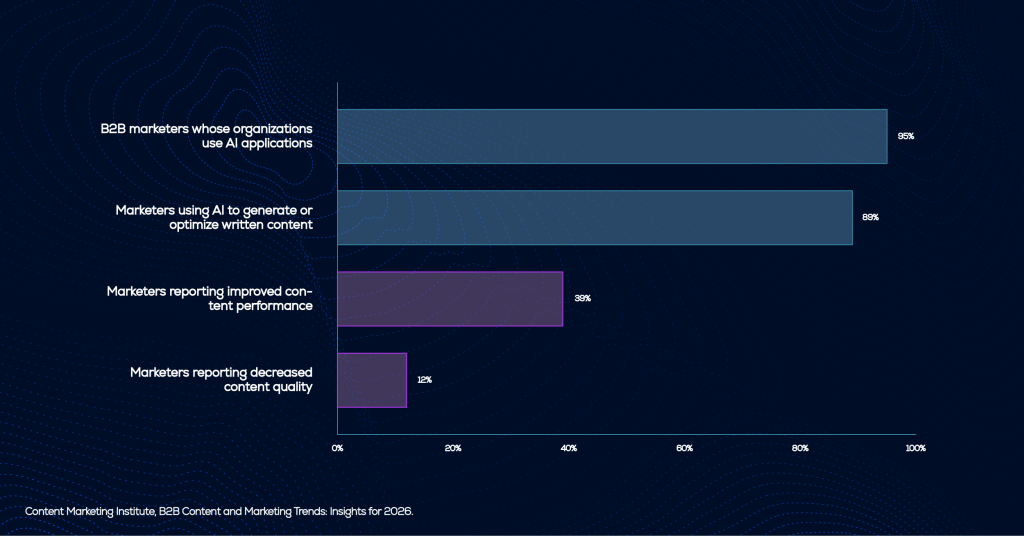
The numbers make the gap hard to ignore. In the Content Marketing Institute’s B2B Content and Marketing Trends: Insights for 2026, 89% of B2B marketers said they use AI tools to generate or optimize written content. Only 39% said content performance actually improved. Twelve percent said content quality got worse.
That is not an AI problem. That is a workflow problem. Teams handed the writing to a machine and assumed the rest of the process would take care of itself. It does not. The value was never in the typing.
This article covers what AI genuinely does well, what only a human writer can contribute, and the six-step handoff we use to keep the two in their lanes. If you want the wider view of how this fits into a smarter, scalable content strategy, start with our pillar guide. If you want the working model, keep reading.
Why “AI vs. Human” Is the Wrong Question
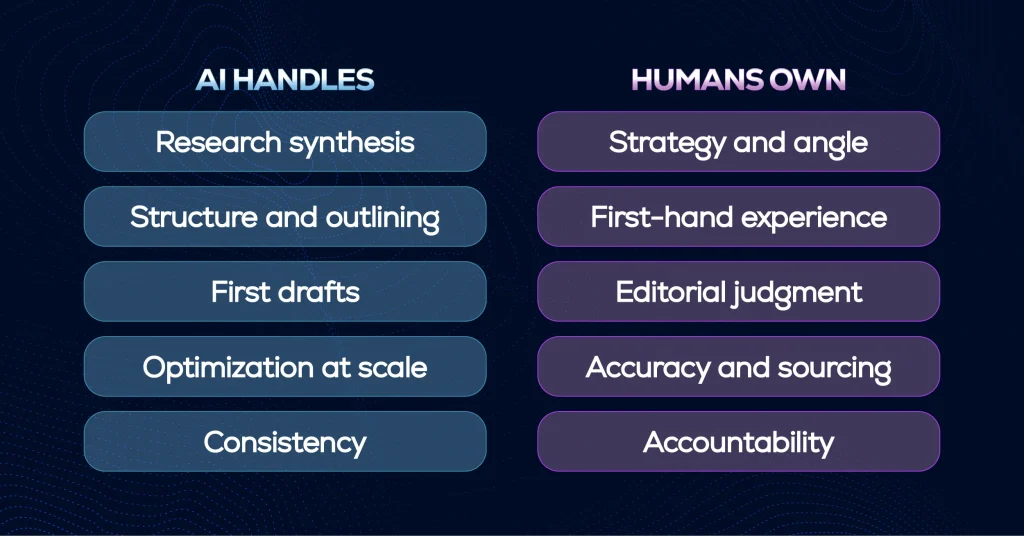
AI and human writers work together best when AI handles research, structure, and first-draft speed, and humans handle strategy, judgment, first-hand experience, and final accountability. AI produces volume. Humans produce the specificity that makes content worth ranking.
The industry keeps litigating whether AI replaces writers. The teams producing content that performs stopped asking that question a while ago. They asked a better one: who owns which decision?
What the adoption data actually shows
CMI’s 2026 survey of more than 1,000 B2B marketers found that 95% of organizations now use AI-powered applications somewhere in their marketing operation. Content creation is the most common use case by a wide margin.
The outcomes are more complicated. The reported gains cluster around productivity and operational efficiency. The measures that matter to a business, meaning creativity, content quality, and content performance, lag well behind. More than a fifth of users say AI has not moved the needle on quality at all.
Speed went up. Quality did not follow.
Faster production of average content is not a competitive advantage. It is a way to publish your mediocrity more efficiently.
The reason is structural. A language model is trained on an enormous volume of existing text, and it is very good at producing the statistical center of that text. Ask it about content strategy and it will give you a competent, accurate, entirely unremarkable summary of what everyone already publishes about content strategy. It is correct. It is also invisible, because it reads exactly like the fourteen other results on the page.
The thinking is the part that never got delegated successfully. It also happens to be the part search engines and readers are actually rewarding.
What AI Does Well in a Content Workflow
Credibility here depends on not underselling the tool. AI earns its place in the workflow, and pretending otherwise leads teams to the opposite mistake.
Research, structure, and the first pass
AI is genuinely strong at synthesis. Point it at a body of source material and it will cluster related subtopics, surface the questions a piece needs to answer, and pressure-test an outline for gaps faster than a person can.
Google says the same thing in its own documentation, describing generative AI as “particularly useful when researching a topic, and to add structure to original content.” That is a precise description of where the leverage sits. Research and structure. Not judgment, and not experience.
Scale, consistency, and optimization
The unglamorous work is where AI quietly pays for itself. Meta descriptions. Image alt text. Internal link candidates. Schema drafts. Fifteen headline variants when the first three are flat. Turning one approved article into the channel formats it needs to live in.
Human teams are inconsistent at volume because humans get tired. AI does not, and consistency at scale is a real strength worth using. We covered this trade-off in more depth in our breakdown of the pros and cons of using generative AI for marketing copy.
Where AI reliably hits its ceiling
Four limits show up in every workflow, no matter how good the prompt is.
It has no first-hand experience. It cannot tell you what happened on a client account last quarter, because it was not there.
It produces confident errors. Fluency is not accuracy, and a wrong sentence reads exactly as smoothly as a right one.
It regresses to the mean. Trained on the average of the internet, it returns the average of the internet.
It has no stake in the outcome. It cannot be accountable for a claim, and accountability is a load-bearing part of publishing.
What Human Writers Do That AI Cannot
This is the layer most teams cut first, usually for speed. It is also the layer that determines whether the content does anything.
Experience-based specificity
The difference between content anyone could have written and content only you could have written is the presence of real clients, real decisions, and real numbers.
A human writer can say: we tested this on a client account in Q2, here is what broke, and here is what we changed. AI can only say what is generally true. Generally true is the definition of non-commodity content failing to happen.
This is also the single highest-leverage input in the whole process, and it is almost never a writing problem. It is a briefing problem. If nobody gave the writer a real example, no amount of editing will produce one.
Editorial judgment and point of view
Good content is defined as much by what is left out as by what is included.
AI optimizes for completeness. It will cover every angle, because covering every angle is what the training data rewards. Editors optimize for usefulness, which means deciding which of five true things actually matters to this reader, and cutting the other four. Those two instincts pull in opposite directions, and only one of them produces something worth reading to the end.
Taking a position is part of this. A piece that presents both sides of every question and recommends nothing has told the reader nothing.
Accuracy, sourcing, and accountability
Every statistic in this article was traced back to the study it came from, and every URL was checked as live before it was written into the draft. That is not a nice-to-have. Misattributed data is the fastest way to lose a reader who knows the subject.
Then there is the byline. A named person whose reputation is attached to the claims is doing something no model can do, and it maps directly to what Google describes as experience and trustworthiness in its guidance on creating helpful, reliable, people-first content. Those are properties of a person, not properties of a draft.
The Handoff Model: A Six-Step Workflow
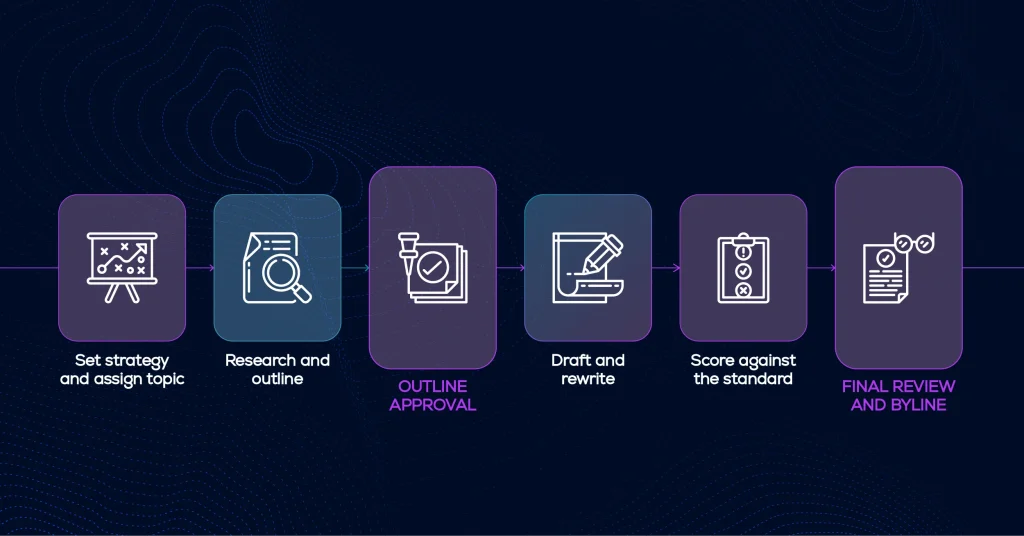
Here is the sequence we run inside Content Engine. Two of the six steps are hard gates, meaning nothing moves forward until a human signs off.
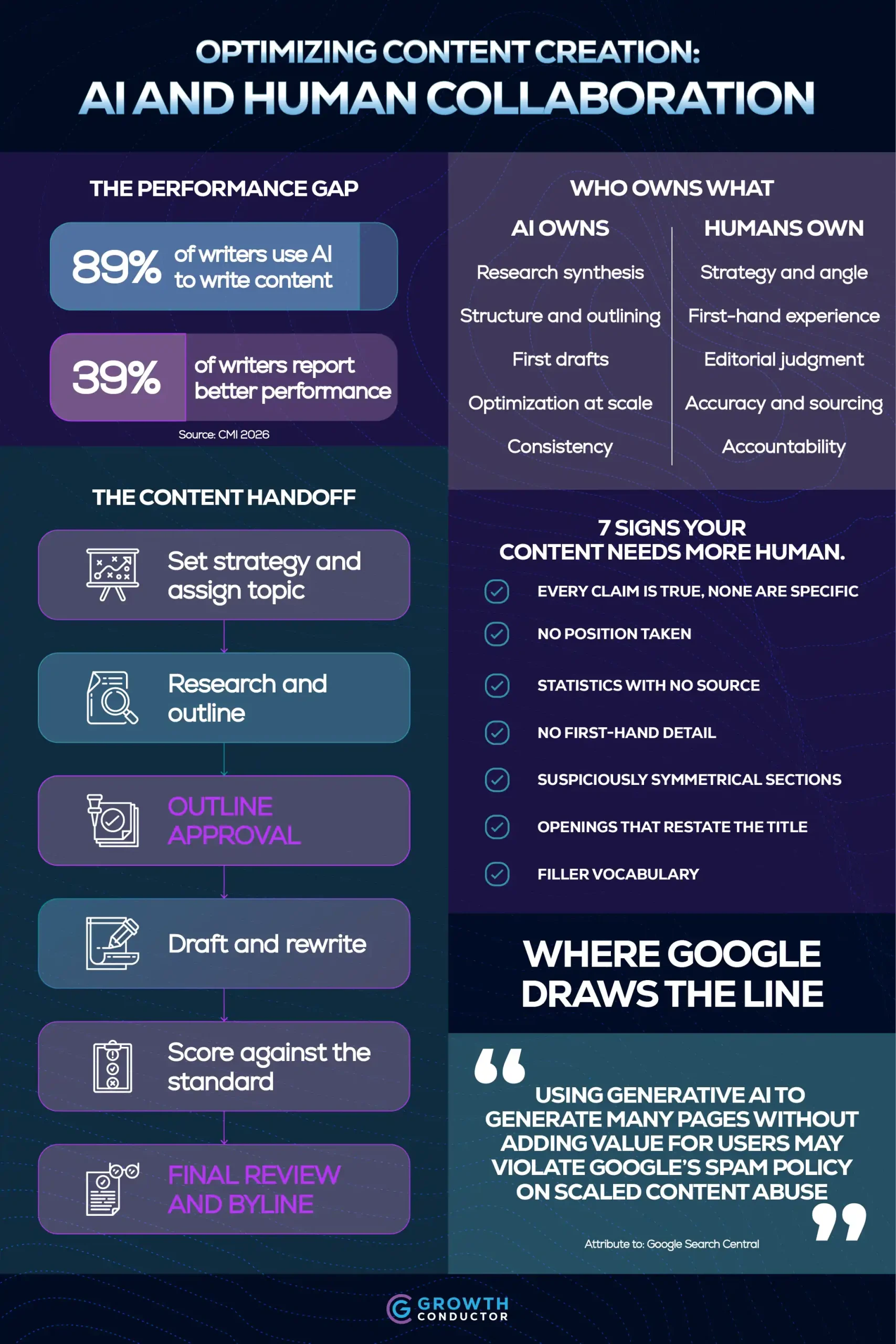
- A human sets strategy and assigns the topic. Keyword, intent, audience, angle, and the position the piece will take. AI does not decide what is worth saying.
- AI assists with research and outline construction. Source gathering, competitive gap analysis, structural draft. Every URL is verified live before it enters the outline.
- Human approval gate. Hard stop. Nothing gets drafted against an unapproved outline. This one gate eliminates most downstream rework, because a bad structure caught at 400 words is cheap and the same structure caught at 2,000 words is not.
- AI assists with drafting. A human rewrites. AI produces the scaffold. The writer replaces the generic with the specific, adds the real examples, cuts the padding, and imposes the voice.
- The piece is scored against a fixed standard. We run a 110-point SEO and AIO scoring matrix covering search fundamentals, structure, extractability, and originality. Publish threshold is 80. Cornerstone and pillar content needs 90.
- Final human review, then the byline goes on. Links tested, sources re-verified, formatting checked, brand voice confirmed, and a named person accepting responsibility for the piece.
Notice what is happening across those six steps. AI touches two of them. Humans own the beginning, the middle checkpoint, and the end.
What Google Actually Says About AI-Assisted Content
A lot of teams are making bad decisions here because they are guessing at the policy instead of reading it.
Google does not penalize content for being AI-assisted. Google penalizes content that is unhelpful, unoriginal, or produced at scale without adding value. The production method is not the violation. The lack of value is.
Where the line actually sits
Google’s guidance on using generative AI content is direct: using these tools “to generate many pages without adding value for users may violate Google’s spam policy on scaled content abuse.”
Read that carefully. The trigger is many pages without added value. Volume plus emptiness. Google also points to its Search Quality Rater Guidelines on main content created with little effort, little originality, and little added value, which is a fair description of what an unedited AI draft is.
Giving users context
Google recommends sharing information about how a piece of content was created where that makes sense for the audience. In practice this is straightforward: a short editorial standards note, or an author bio that states plainly how AI is used in your process and where humans intervene.
Being transparent about an AI-assisted workflow is not an admission. Done well, it is a differentiator, because most competitors cannot describe their process at all.
How to Tell Your Content Has Too Much AI and Not Enough Human
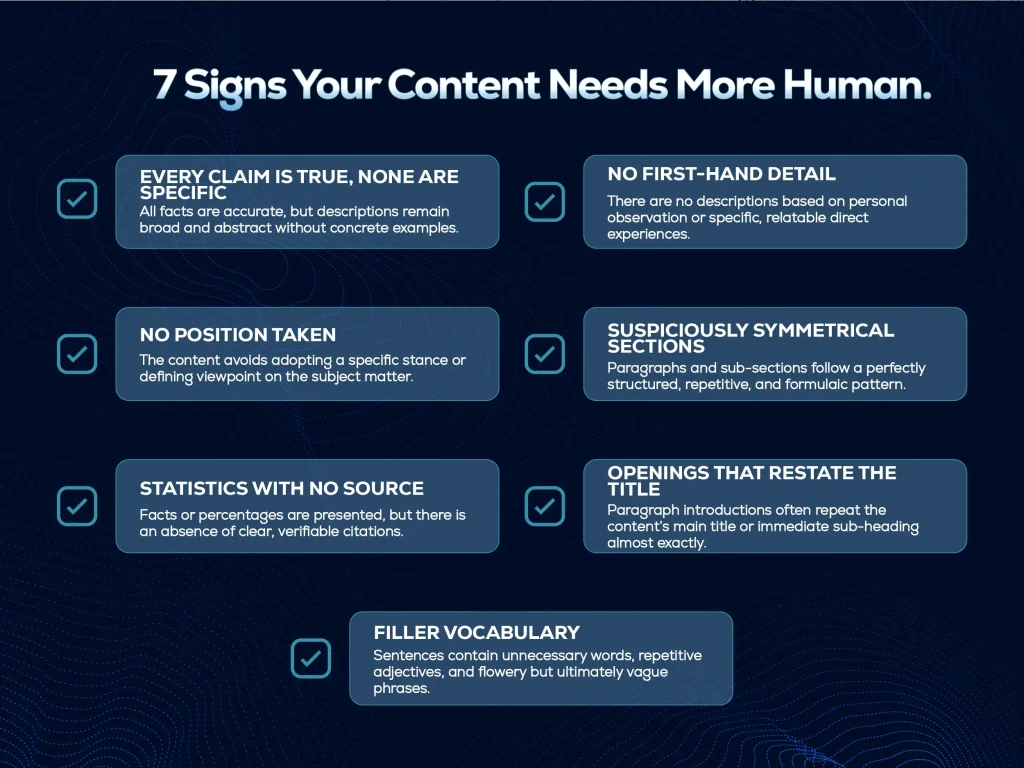
Run this against something you published in the last quarter. Seven tells:
- Every claim is true and none are specific.
- No first-hand detail. No client, no number, no date, no consequence.
- No position. The piece explains both sides and recommends nothing.
- Symmetrical structure, where every section runs the same length because the model padded to balance.
- Statistics with no attribution, or attributed to “studies show.”
- Openings that restate the title before saying anything.
- Vocabulary tells, including “in today’s fast-paced landscape,” “it is important to note,” and “delve.”
The fix is upstream, not in the edit
Here is the part most teams get backwards. Editing generic content into specific content costs more than briefing it properly did.
By the time a draft exists, the missing example is still missing, and the writer is now working around 1,800 words of scaffolding instead of starting from a real idea. The lever is at the outline stage and in the source material the writer is handed. It is not in the polish pass.
Building the System: Roles, Guardrails, and Scoring
Fixing one article is a task. Fixing every article is an operating model.
Name who owns which decision. Strategy, drafting, review, and publish authority, assigned explicitly. Ambiguity is where quality dies at scale, because when everyone is responsible for the final read, nobody is.
Make the gates non-negotiable. An approval gate that gets skipped under deadline pressure is not a gate. It is a suggestion.
Score every piece before it publishes. A fixed rubric turns “this feels off” into a number someone can act on, and it makes quality auditable across a team of writers instead of dependent on who happened to draft it.
Measure the right outcome. Volume published is not the metric. Rankings, extraction into AI answers, qualified traffic, and conversions are.
The Work That Cannot Be Automated Is the Work That Matters
AI is not what is holding your content back. The missing human layer is. Once you decide which decisions belong to people and build gates that protect them, AI becomes what it should have been from the start: a very fast assistant working inside a system that a person designed.
Our Content Engine runs this exact workflow, including the outline approval gate, human rewriting against real client experience, and the 110-point scoring standard every piece has to clear before it publishes. If your content is coming out faster and landing softer, that is the gap we close.
Frequently Asked Questions
No. Google’s guidance is method-neutral and focused on quality. What violates its spam policies is using automation to produce many pages without adding value for users, which Google calls scaled content abuse. AI-assisted content that is original, accurate, and useful is not a violation.
There is no correct percentage, and chasing one misses the point. The better rule is which decisions AI makes, not how many words it produces. Research and structure are safe to delegate. Strategy, first-hand examples, editorial judgment, and final sign-off should stay with a person.
Four things: contribute first-hand experience from real work, exercise judgment about what to cut, verify that claims and sources are accurate, and take accountability for what gets published under a real name. These map directly to the experience and trustworthiness signals Google rewards.
Disclosure is not required, but Google recommends giving readers context about how content was created where it makes sense for your audience. An editorial standards page or an author bio explaining where AI assists and where humans intervene handles this cleanly.