


For the past two years, SEO teams have been flying blind on the fastest-growing part of search. AI Overviews now reach 2.5 billion monthly users. AI Mode has surpassed 1 billion. And until this week, Google Search Console gave site owners exactly zero dedicated data on how their content was performing inside either surface.
That changed on June 3, 2026. Google launched dedicated Search Generative AI performance reports in Search Console. For the first time, site owners have a separate, dedicated view of their visibility inside AI Overviews and AI Mode. It landed two weeks after Google I/O 2026, where Elizabeth Reid, Google’s VP of Search, declared AI Mode the new default search experience globally and announced the biggest upgrade to the Google Search box in over 25 years.
These two announcements belong together. I/O 2026 established AI search as the new standard. The Search Console report is how you now measure performance inside that standard. If you manage SEO for your business or your clients, this is the data you’ve been waiting for, and it comes with real limitations you need to understand before acting on it.
TL;DR: Google’s new Search Console Gen AI Performance Report shows how often your pages appear in AI Overviews and AI Mode, broken down by page, country, device, and date. It tracks impressions only; click data is not yet included. It’s rolling out to a subset of sites globally, starting in the UK. Meanwhile, Google I/O 2026 confirmed AI Mode as the default search experience for over 1 billion monthly users. This article explains what the report shows, what’s missing, and what to do with the data.
What Google Announced: Two Headlines That Belong Together
In the span of two weeks, Google made two announcements that together redefine what search performance measurement means in 2026. On May 19, Google declared AI Mode the new default search experience globally. On June 3, Google gave site owners their first dedicated tool to measure visibility inside that experience. The two are inseparable. One without the other is either a standard without a scoreboard, or a scoreboard without a game.
What Changed at Google I/O 2026
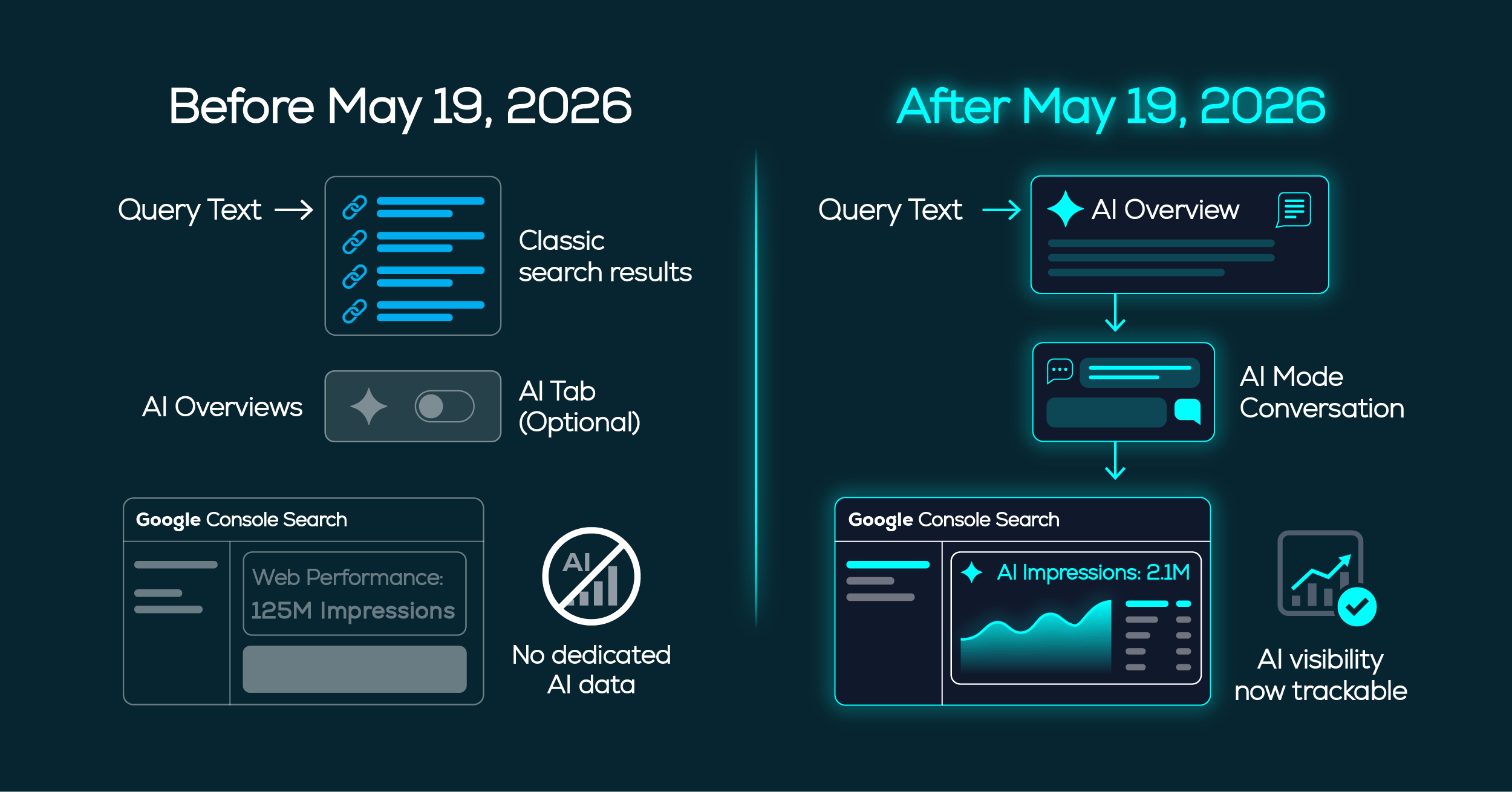
At Google I/O 2026 on May 19, Elizabeth Reid announced what many in the industry had anticipated but not yet seen made official: AI Mode and AI Overviews are now one seamless experience, and it is live globally on desktop and mobile for everyone. You can read the full announcement in Google’s I/O 2026 search post.
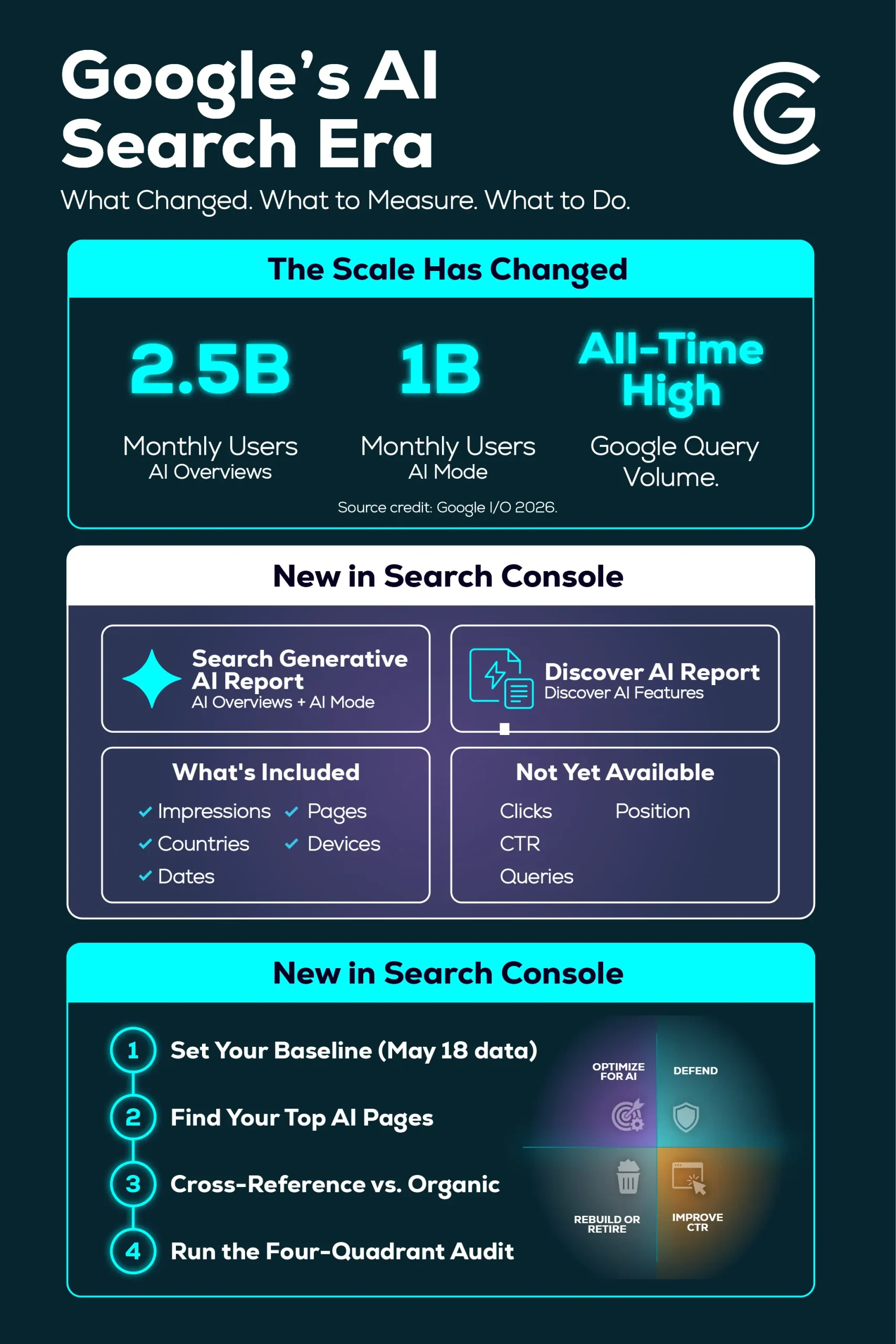
The numbers Reid cited from the stage are the ones that matter for anyone running a search strategy. AI Overviews reached 2.5 billion monthly active users. AI Mode surpassed 1 billion, and queries have more than doubled every quarter since launch. Google Search itself hit an all-time high for query volume last quarter, meaning AI search is not replacing traditional search behavior; it is layering on top of it and expanding it.
Here is what actually changed at I/O 2026 for search:
- Seamless AI search flow: A user types a query, gets an AI Overview at the top of results, and can flow directly into a conversational AI Mode exchange, all without leaving Google or switching modes. This flow is now the default globally.
- Gemini 3.5 Flash as default: Google upgraded the model powering AI Mode to Gemini 3.5 Flash, delivering faster, higher-quality responses across the board.
- New AI Search box: The first significant redesign of the Google search bar in over 25 years. It now accepts text, images, files, videos, and Chrome tabs as inputs, and expands dynamically to accommodate complex queries. Per the 100 I/O 2026 announcements, this is live today in all countries where AI Mode is available.
- Search agents: Persistent background agents that monitor the web 24/7 and surface synthesized updates on topics you specify, rolling out first to Google AI Pro and Ultra subscribers.
“AI Mode has surpassed 1 billion monthly users, with queries more than doubling every quarter since launch.” — Elizabeth Reid, VP of Search, Google I/O 2026
What the Search Console Gen AI Report Actually Is
On June 3, 2026, Hillel Maoz (Search Ecosystem Engineering Manager) and Moshe Samet (Product Manager Lead, Search Console) announced two new dedicated reports inside Search Console:
- Search Generative AI Performance report: Covers AI Overviews and AI Mode on Google Search.
- Discover Generative AI Performance report: Covers generative AI features within Google Discover.
Both reports provide a dedicated view that has never existed before. Your AI surface impressions separated from traditional organic data. The data starts from May 18, 2026 and is currently rolling out to a subset of sites, with UK accounts receiving access first before a global expansion.
What the Report Shows (And What It Deliberately Does Not)
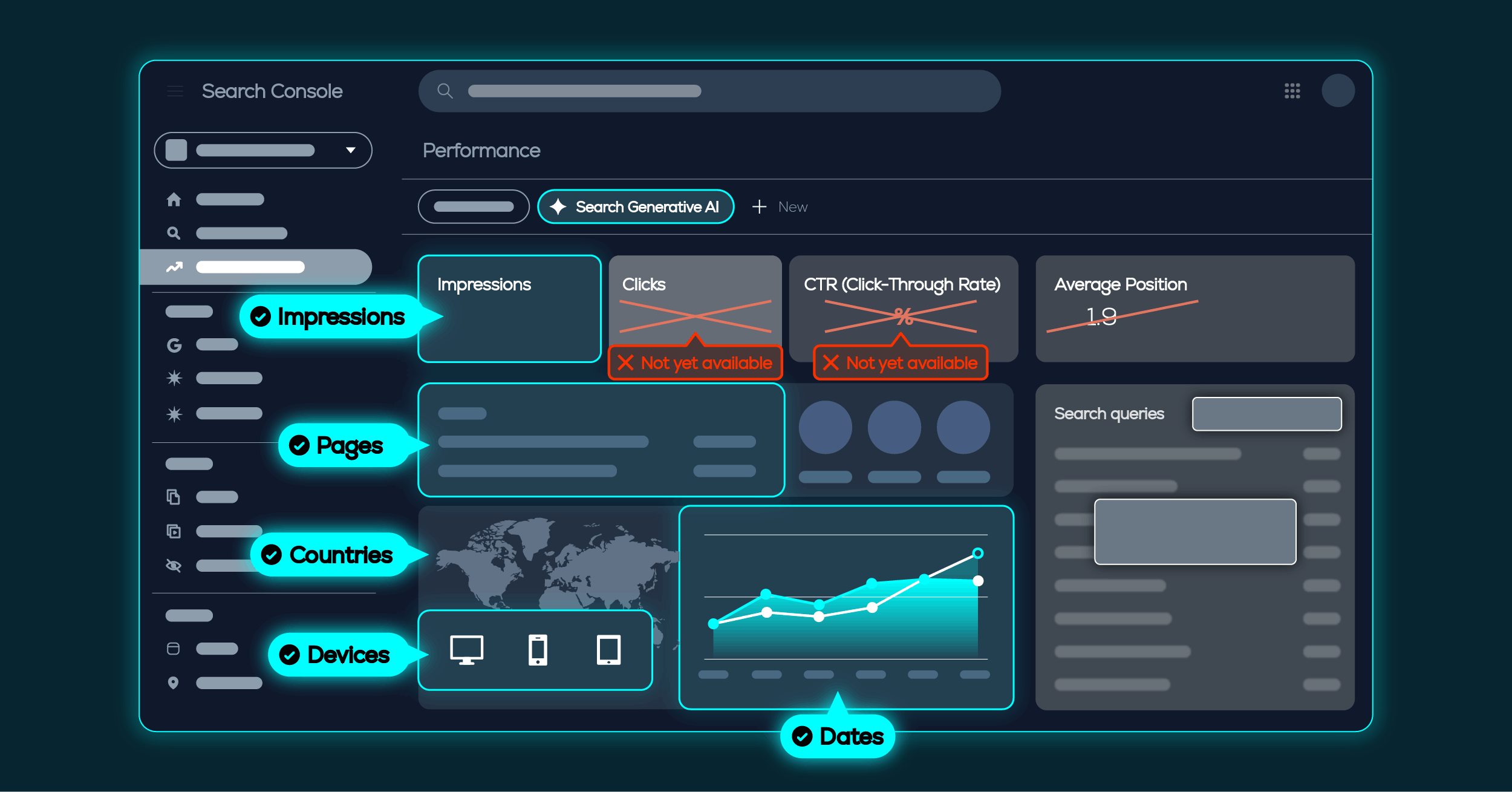
The Google Search Console AI performance report shows impressions, meaning how often your URLs appeared inside AI Overviews, AI Mode, or generative Discover features, broken down by page, country, device, and date, with granularity down to the hourly level. What it does not show: clicks, click-through rate, average position, or query-level data. The report answers “how visible am I in AI search?” but does not yet answer “how much traffic is AI search actually sending me?”
According to Barry Schwartz’s coverage in Search Engine Land, the reporting includes impressions, pages, countries, devices, and dates but does not include click data. Google says more metrics will come over time, but clicks from AI search features are not in the report today.
Here is what the report includes at launch:
- Impressions: How often a URL appeared in a generative AI feature (AI Overview, AI Mode, or Discover AI)
- Pages: Which specific URLs are appearing in AI surfaces
- Countries: Geographic breakdown of where your AI visibility is occurring
- Devices: Desktop vs. mobile breakdown (available for Search results)
- Dates: Performance over time with hourly, daily, weekly, and monthly granularity
What is not in the report:
- Clicks from AI surfaces
- Click-through rate (CTR)
- Average position
- Query-level data (which searches triggered your AI impressions)
“The measurement gap is half-closed, not fully closed. Impressions are now visible. The traffic picture is not.”
Why There Are No Clicks in the Report (And What That Signals)
The absence of click data is not an oversight. AI Overviews and AI Mode surfaces frequently answer queries without requiring a click. Users get a synthesized answer, follow-up conversation, or AI-generated response directly inside Google. Zero-click behavior is structurally higher in AI search than in traditional blue-link results.
This means impressions in AI search do not map 1:1 to traffic the way traditional search impressions do. A page that appears frequently in AI Overviews may generate high impressions and minimal referral traffic. This is not because the content is performing poorly. It is because the AI surface is satisfying the user’s intent before a click is needed. Understanding this distinction is critical before you draw any conclusions from the new report.
Google has confirmed more metrics will be added over time. When click data eventually arrives in this report, it will enable CTR analysis by AI surface, the most useful signal for understanding which AI-visible content is actually driving site visits versus which is being consumed in place.
The Opt-Out Toggle: What It Is and Whether to Use It
Alongside the new report, Google is also testing a toggle that lets site owners block their content from appearing in AI Overviews, AI Mode, and generative Discover features. Per Search Engine Journal’s coverage, both the report and the toggle are rolling out to the same limited subset of UK site owners first.
For almost all businesses: do not use the opt-out. Sites that use the toggle to exclude themselves will not receive traffic or impressions from AI Overviews, AI Mode, or AI Overviews in Discover. Google has confirmed the opt-out will not be used as a ranking signal for search results outside these AI features. Opting out means forfeiting the AI visibility the new report now lets you measure, with no compensating benefit to organic ranking.
The only scenario worth considering opt-out: sites with compelling confidentiality or competitive reasons to not appear in AI-synthesized answers. For everyone else, the goal is to appear more frequently in AI surfaces, not less.
Why AI Impressions Are Now the Most Important Number in Your Search Console
AI Overviews appear in roughly 50–60% of all Google searches. AI Mode is now the default flow for over 1 billion monthly users globally. These surfaces are where your visibility is being won or lost, extending well beyond the traditional blue-link SERP. The new Search Console AI report makes this visible for the first time, giving marketers a dedicated data layer that traditional Search Console performance data has never provided.
Traditional Search Console data (organic impressions, clicks, average position) still matters. But it no longer tells the complete story of how your content performs in Google Search. A page can rank number one organically and have zero AI impressions, meaning it is invisible in the surface where the majority of modern searchers now receive their first answer. Conversely, a page sitting at position eight may be cited consistently in AI Overviews because it matches the structured content signals AI systems reward.
The new report makes this split visible for the first time. That is not a minor reporting update. It is a fundamental shift in how search performance should be defined, measured, and reported to stakeholders.
The Visibility Gap: What AI Impressions Tell You That Rankings Do Not
Traditional rank tracking tells you where a page sits in the blue-link results. It tells you nothing about whether that page is being cited in the AI Overview appearing above those results. These are two completely different visibility layers, and until now there was no way to see both simultaneously.
With the new report, you can for the first time identify:
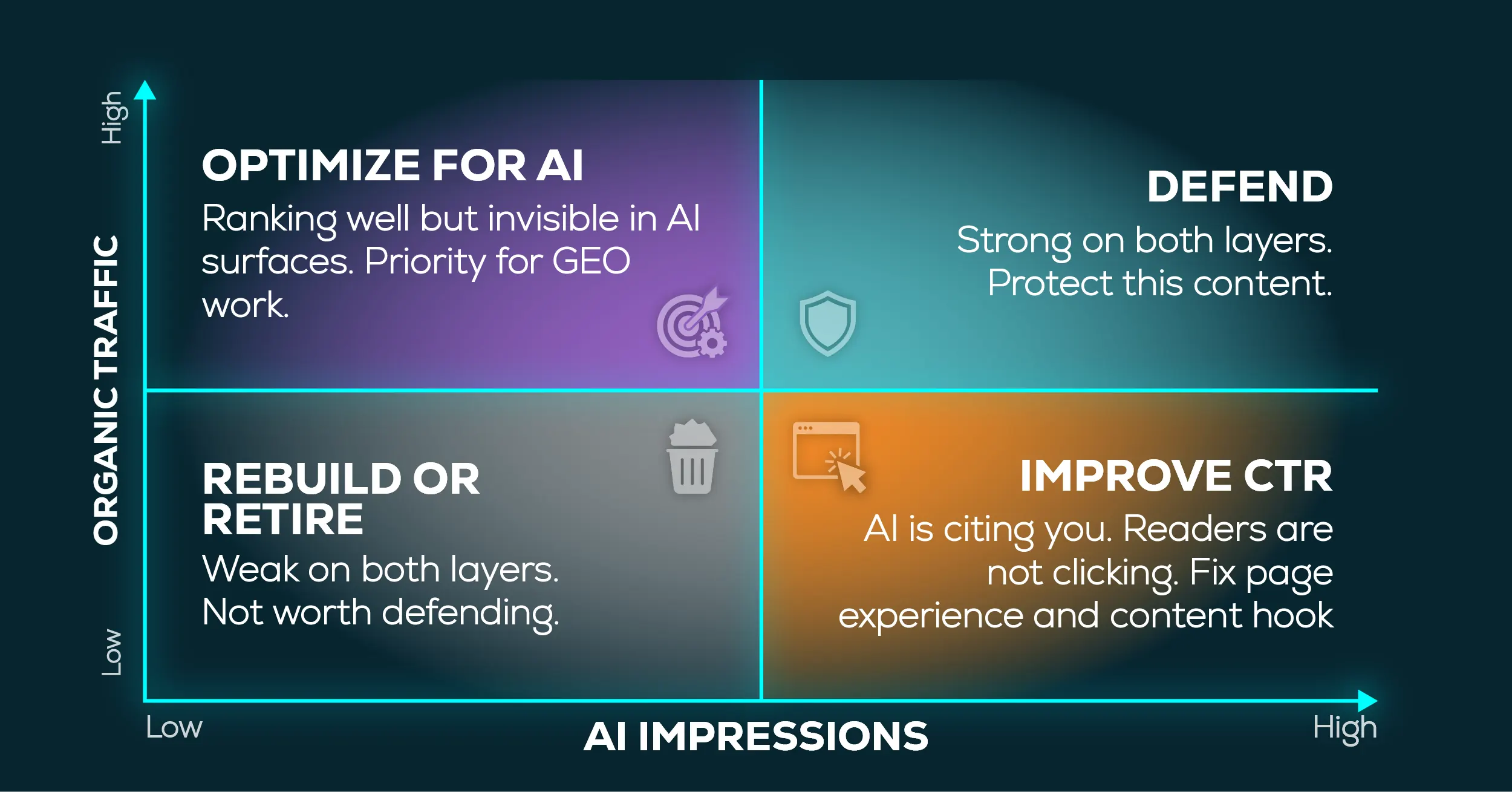
- Pages ranking well organically but absent from AI surfaces: These are your highest-priority AIO optimization targets. Traditional SEO is working; AI citation signals are not.
- Pages with high AI impressions but low organic traffic: AI is surfacing your content but users are not clicking through. Review page experience, CTA clarity, and whether the content creates a reason to visit beyond what the AI Overview already answers.
- Pages performing well on both layers: Defend these. Understand what they have in common and replicate the pattern across your content.
- Pages performing poorly on both layers: Rebuild or retire. Weak content in the AI era does not get a pass because it once ranked.
How to Read the New Report: A Six-Step Audit
Once the report is available in your Search Console account, navigate to Performance and find the dedicated Search Generative AI tab, then work through this audit before making any optimization decisions. If you’re still waiting for access to the dedicated report, the AI Overview tracking workaround in Search Console we covered previously gives you the closest available proxy in the meantime.
- Step 1: Set your baseline. Data starts May 18, 2026. Record your total AI impressions, top AI-visible pages, and top countries before any optimization work. This is your benchmark.
- Step 2: Sort by impressions. Identify which pages are receiving the most AI surface visibility. These are your most AI-cited assets. Understand what they have in common before making any changes.
- Step 3: Cross-reference with standard organic data. Open the standard Performance report alongside the AI report. Flag every page where AI impressions and organic traffic tell a different story.
- Step 4: Run the four-quadrant audit. High AI + High organic (defend), High AI + Low organic (improve CTR signals), Low AI + High organic (AIO optimization priority), Low AI + Low organic (rebuild or retire).
- Step 5: Filter by device and country. Identify whether your AI visibility is concentrated in specific markets or devices. This informs localization priorities and content distribution decisions.
- Step 6: Set a monthly review cadence. Treat the AI report as a separate reporting layer from your standard GSC review. Run both monthly. They measure different things and should be reported separately.
What to Do With This Data: The Strategic Response
The most important first move is establishing your AI visibility baseline before any optimization begins. Set the May 18 data as your starting point, run the four-quadrant audit by page, then prioritize content that is ranking well organically but absent from AI surfaces. These pages already have authority. They simply need to be restructured for AI citation.
The data from this report is only as valuable as the strategy applied to it. That is the gap between having access to AI impression data and knowing what to do with it. This is where Growth Conductor’s AI-optimized content strategy comes in, built specifically to produce content that earns AI citations, not just organic rankings.
Content Signals That Drive AI Impressions
AI systems do not cite pages arbitrarily. They extract content that is structured, authoritative, and semantically complete. The following signals consistently correlate with higher AI impression rates, and every one of them can be applied to existing content through targeted optimization:
- Answer Islands: Open every major H2 section with a 50–70 word self-contained answer. AI systems pull these passages directly and cite them standalone. If your H2 sections open with preamble instead of a direct answer, you are not giving AI systems anything to extract.
- FAQ sections: Every FAQ answer must be 40–70 words and fully self-contained, readable and complete without surrounding article context. AI systems index these as answer targets for conversational queries.
- Question-based headings: At least 25–30% of H2/H3 headings should be phrased as questions or reflect PAA-style queries. AI systems index question-based headings as answer targets.
- Semantic completeness: The article must address the primary topic AND all logically related subtopics a reader would expect. AI systems score semantic breadth as a primary citation factor. A page that only partially covers a topic will lose to a page that covers it completely.
- Structured data / schema: BlogPosting + FAQPage markup shows significantly higher AIO selection rates. Implement via JSON-LD in the page <head>. This is a dev task, not a content task. Flag it for implementation on every new article.
- Word count and section depth: Target 1,500–2,500 words for analysis articles. Sections averaging 120–180 words between heading breaks generate measurably more AI citations than shorter sections.
The Measurement Framework Going Forward
Two numbers now define complete search performance measurement in 2026: organic impressions from the standard Performance report, and AI impressions from the new Gen AI report. Report both, separately, in every performance review or client dashboard. They measure different things and should never be collapsed into a single total.
When click data is eventually added to the AI report, and Google has indicated it will be, the full picture becomes available: AI impressions (visibility), AI clicks (traffic), and AI CTR (how effectively AI-visible content converts to site visits). That will be the complete AI search measurement stack. Until then, impressions plus the four-quadrant audit is the most defensible framework available.
One additional flag: the introduction of Search agents at I/O 2026, specifically the persistent background agents that monitor the web on behalf of users, creates a new attribution layer that neither the standard Performance report nor the current AI report addresses yet. As agents become a standard part of how people interact with search, the measurement conversation will need to evolve again.
What This Means for the Future of Search Measurement
Google’s decision to launch a dedicated AI performance report is an acknowledgment that AI search is now a primary surface, not a secondary feature. Traditional SEO measurement tracked one thing: how you performed in the blue-link results. The new report adds a second track: how you perform inside AI-generated answers. Both tracks now matter. Neither tells the whole story alone.
The brands and agencies that build measurement and content frameworks around AI visibility now, before this data is universally available, will have a meaningful head start when the full picture emerges. The report is in limited rollout. When it reaches your account, the teams with a strategy already in place will be able to act immediately. The teams without one will spend that time figuring out where to start.
Traditional SEO skills like keyword targeting, technical optimization, and internal linking architecture remain necessary. But they are no longer sufficient. Generative Engine Optimization (GEO) is now a required layer of any complete search strategy. If your content is not structured to be cited in AI surfaces, ranking well in traditional results means an increasingly smaller share of total search visibility. Growth Conductor’s Content Engine was built for exactly this transition, producing content that earns AI citations alongside traditional rankings, scored against a 110-point framework that includes specific GEO and AIO signals on every article.
Key Takeaways
- Google’s Search Console Gen AI Performance Report launched June 3, 2026. It is the first dedicated tool showing AI Overviews and AI Mode visibility, separate from traditional organic data.
- The report tracks impressions by page, country, device, and date. Click data is not yet included. Google has indicated more metrics will be added over time.
- Google I/O 2026 (May 19) confirmed AI Mode as the default search experience globally, with AI Overviews at 2.5B monthly users and AI Mode at 1B. These are not experiments. They are the primary search surfaces.
- Your first action: as soon as the report is available in your account, set your AI visibility baseline from May 18 data, then run a four-quadrant audit by page comparing AI impressions against organic traffic.
- Content structured for AI citation, including answer islands, FAQ sections, question-based headings, semantic completeness, and schema markup, should now be the standard for all new content, not an optional add-on.
- The measurement gap is half-closed: AI impressions are now visible. Traffic from AI surfaces is not yet tracked. Build your strategy around what you can see now and plan for click data to arrive later.
Build Content That Gets Cited, Not Just Ranked
The new Search Console AI report gives you the data. What you do with it depends on whether your content is built to perform in AI surfaces in the first place. If your current content strategy is optimized for traditional organic rankings but not for AI citation signals, the report will show you exactly how large that gap is, and it will grow as AI search continues to expand.
Growth Conductor’s Content Engine produces content that is structured for both traditional SEO and AI citation from the ground up, scored against a 110-point framework that includes specific AIO and GEO signals on every article. If you want to close that gap with a strategy that works in both environments, start here.
Frequently Asked Questions
The Google Search Console AI performance report is a dedicated report launched June 3, 2026 that shows how often your pages appear in Google’s generative AI features, including AI Overviews, AI Mode on Search, and generative AI features on Discover. It tracks impressions broken down by page, country, device, and date with hourly granularity. Click data, CTR, average position, and query-level data are not yet included. The report is rolling out to a subset of sites globally, starting with UK accounts.
No. The current report shows impressions only, meaning how often a URL appeared in an AI-powered feature. There are no clicks, click-through rate, average position, or query data at launch. Google has indicated more metrics will be added over time, but clicks from AI search features are not tracked in this report today.
For most businesses, no. The opt-out toggle lets site owners block their content from appearing in AI Overviews, AI Mode, and generative Discover features. Opting out means forfeiting the AI visibility the new report now lets you measure, with no confirmed benefit to organic ranking elsewhere. Google has confirmed the toggle will not be used as a ranking signal for results outside AI features. Only consider opting out if there is a specific, compelling reason related to confidentiality or competitive sensitivity.
At Google I/O 2026 on May 19, Google made AI Mode the default search experience globally. AI Mode surpassed 1 billion monthly users; AI Overviews reached 2.5 billion. Google introduced a seamless flow from a traditional query to an AI Overview to a conversational AI Mode exchange, all without leaving Google. Gemini 3.5 Flash became the default AI Mode model, and a redesigned AI Search box launched globally in all countries where AI Mode is available.
AI Overviews are the summary panels that appear at the top of traditional Google search results. AI Mode is a deeper, conversational experience where users can ask follow-up questions in a multi-turn exchange. As of I/O 2026, the two are now seamlessly connected. A user can receive an AI Overview and flow directly into AI Mode without switching modes or leaving Google. In Search Console, the new Gen AI report tracks impressions from both surfaces together under the Search Generative AI report.
Once Google’s Search Generative AI performance report is available in your Search Console account, navigate to Performance and look for the dedicated AI report tab. You’ll see impressions broken down by page, country, device, and date. Cross-reference this with your standard organic performance report to identify which pages perform well in AI surfaces versus traditional search. If the dedicated report is not yet in your account, use the regex workaround covered in our guide to AI Overview tracking in Search Console.