


Did Google Really Just Kill SEO? (The Short Answer)
No. Google did not announce the end of SEO at I/O 2026, and SEO is not dead. The announcements introduced new AI features inside Google Search — including a redesigned search box, autonomous information agents, and generative interfaces — but Google’s underlying systems still crawl, index, and rank web content the same way they have for over 25 years. What did change is how search results are presented and how content gets cited. SEO has evolved, not disappeared.
If you’ve spent the last week watching headlines declare that Google has killed search as we know it, you are not alone. The TechCrunch piece titled “Google Search as you know it is over” lit up group chats and LinkedIn feeds the moment it was published. Clients have been calling. Teams are nervous. The question “is SEO dead?” is now appearing in our inbox more often than it has in any year since 2013.
Here is what we want you to know first: SEO is not dead. The fundamentals are not obsolete. The work you’ve invested in building search visibility has not evaporated overnight.
What is true: search has changed, and it is going to keep changing. Generic content earns fewer citations and gets summarized away by AI without attribution. Click-through rates are shifting. The set of skills that define a great SEO strategy in 2026 is broader than it was in 2022. We need to address all of that — calmly, with data, and with a path forward.
Quick Summary
- Google announced new AI features at I/O 2026 — they did NOT announce the end of SEO or organic search.
- Google Search still crawls, indexes, and ranks web pages. Top-10 organic rankings remain the single biggest predictor of AI Overview citations.
- What’s changed: traffic patterns (zero-click is normal), measurement (rankings ≠ visibility), and the content quality bar. Non-commodity content (experience-based, specific) earns AI Overview citations. Commodity content (generic, interchangeable) gets summarized away with no citation, no click, no credit.
- Brands cited inside AI Overviews see traffic that converts at 14.2% vs. 2.8% for traditional organic — a 5x quality premium per click.
- The Monday-morning action: audit your content for non-commodity value, confirm your schema is implemented, and add AI citation rate to your reporting.
This article walks through what Google actually announced, the data that contradicts the panic narrative, what genuinely has changed, and the practical steps to take this week. No hype. No theatrics. Just what the evidence supports.
What Google Actually Announced at I/O 2026
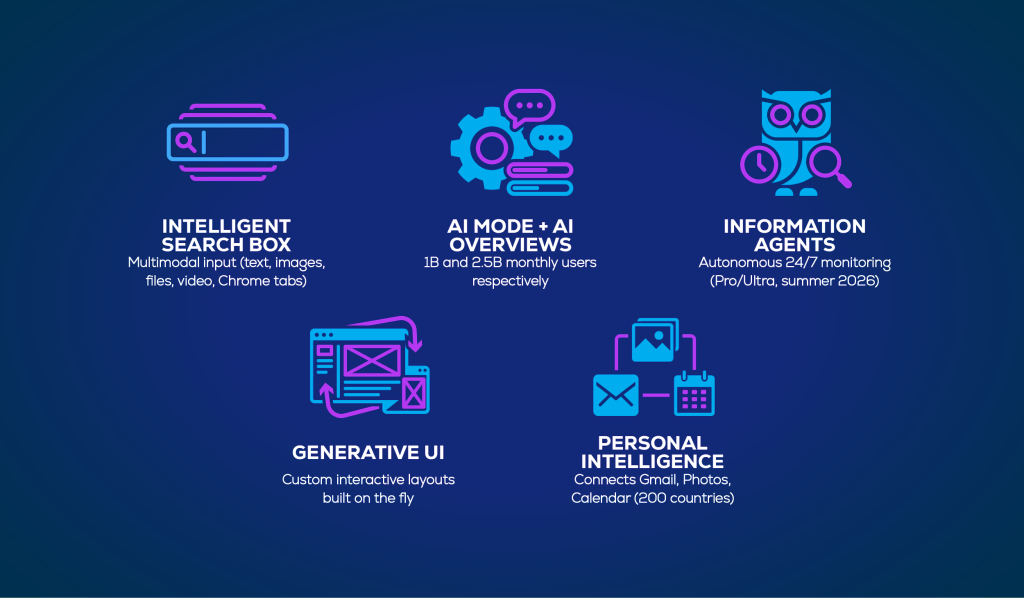
At Google I/O 2026 on May 19, Google announced an AI-powered overhaul of Search centered on a redesigned intelligent search box, autonomous information agents, generative UI, and the expansion of AI Mode and AI Overviews. AI Mode crossed 1 billion monthly users and AI Overviews reached 2.5 billion monthly users. Gemini 3.5 Flash became the new default model in AI Mode globally. Google did not announce the deprecation of organic search results, the end of crawling and indexing, or any change to the fundamental SEO mechanics.
Before we interpret anything, let’s look at the primary source. Below is Google’s own official announcement video, published by the Google channel on May 19, 2026. It runs about five minutes. Watch it before you read any third-party coverage of what was announced.
Here is the complete list of what Google announced for Search at I/O 2026:
1. A redesigned intelligent search box
Google described this as the biggest upgrade to the search box in over 25 years. It dynamically expands to accommodate longer, more conversational queries and accepts multimodal input — text, images, files, video, and Chrome tabs. It also includes AI-powered query suggestions that go beyond traditional autocomplete. The redesigned box is rolling out globally to all users.
2. AI Mode and AI Overviews user milestones
AI Mode has surpassed 1 billion monthly users — in under a year since launch. AI Overviews has reached 2.5 billion monthly users. Importantly, Google noted that AI Mode queries have more than doubled every quarter since launch, and total Google Search query volume hit an all-time high last quarter. People are not searching less because of AI. They are searching more.
3. Gemini 3.5 Flash as the new default model
AI Mode is now powered globally by Gemini 3.5 Flash, Google’s newest and fastest frontier model. Faster responses, longer reasoning chains, more capable agentic behavior.
4. Information Agents — autonomous AI agents inside Search
This is the announcement that generated the most client anxiety, so let’s look at what it actually is. Information agents are autonomous AI features that run in the background, 24/7, monitoring the web for changes related to a user’s specified question. Google’s example: an agent that tracks market movements with specific parameters, then alerts the user when conditions are met. Below is Google’s own product demonstration:
Information agents are rolling out first to Google AI Pro and AI Ultra subscribers in summer 2026. They are not a default Google Search feature for free users. The technology resembles a more capable evolution of Google Alerts, which has existed since 2003.
5. Generative UI in Search
Search can now build custom interactive layouts, visualizations, and even small applications on the fly in response to specific queries. Google’s example: a question about astrophysics that returns an interactive visual instead of a list of links. These generative UI capabilities will be available to all Search users in summer 2026, free of charge.
6. Expanded Personal Intelligence
Personal Intelligence — the feature that lets users connect Gmail, Google Photos, and soon Google Calendar to provide personal context to Search — is expanding to nearly 200 countries and 98 languages. No subscription required. Users always control which apps to connect.
What Google Did Not Announce
This is just as important as what was announced. Google did not announce any of the following:
- Google did not announce the end of organic search results. Liz Reid explicitly stated users will continue to get a range of results, just like today.
- Google did not announce the end of crawling, indexing, or ranking. Those systems are unchanged.
- Google did not announce that websites are being deprecated as a content source. AI Overviews and AI Mode both pull from indexed web content — they cannot function without it.
- Google did not announce that SEO is dead. The phrase appears nowhere in any official Google announcement.
The Quote Everyone Is Misreading
Multiple panic-headlines have quoted Liz Reid saying “Google Search is AI search through and through.” Let’s look at what that statement means in context. Reid said it while introducing the new search box — a box that still returns traditional search results alongside AI-powered features. She also said this in the same announcement:
“This new search box does not mean that you’ll only get AI responses.”
— Liz Reid, VP of Search at Google, May 19, 2026
AI search and traditional search are not two competing systems. They are one integrated experience. The blue links are still there. The index is still there. The crawl is still there. What changed is that AI features now sit alongside the traditional results — not in place of them.
The Data Behind the Panic (And the Data That Tells the Other Story)
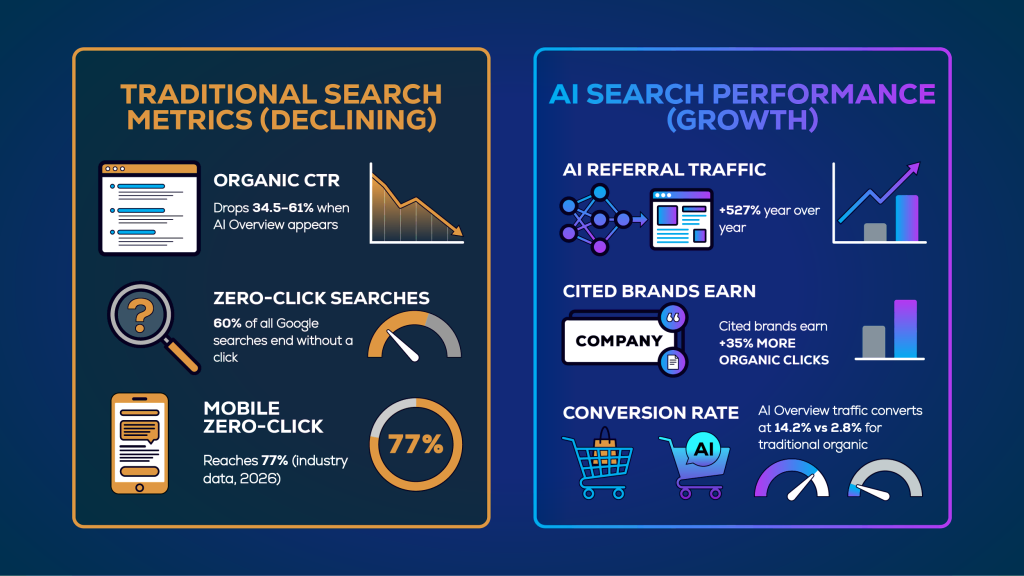
The data on AI search shows two simultaneous patterns: traditional organic click-through rates are declining, and brands cited inside AI Overviews are gaining clicks, conversions, and visibility. Organic CTR drops 34.5–61% when an AI Overview appears for a query, but pages cited inside those overviews earn 35% more organic clicks than uncited competitors and AI Overview traffic converts at 14.2% versus 2.8% for traditional organic. Top-10 organic rankings remain the strongest predictor of AI Overview citation eligibility. The honest summary: search is harder to win, but the rewards for winning are larger.
Let’s look at the data clearly. We are going to share what’s true about the decline — and then what’s true about the upside that most panic-narrative coverage leaves out.
What’s actually declining
Three measurable shifts have happened in the past year:
- Organic CTR on queries with AI Overviews has dropped between 34.5% and 61% depending on the study. Seer Interactive’s September 2025 study of 3,119 informational queries across 42 organizations (25.1 million organic impressions tracked from June 2024 through September 2025) shows organic CTR falling from 1.76% to 0.61% when an AI Overview is present.
- Zero-click search is now the norm, not the exception. Approximately 60% of all Google searches end without a click. On mobile, that figure is 77%. In Google’s newer AI Mode, the zero-click rate reaches 93%.
- Some operators are reporting CTR declines on non-AIO queries as well, suggesting a broad behavioral shift in how people use search regardless of which features are active. (One frequently-cited example from a WordStream roundup showed a single SEO practitioner’s site down 41% in 2024.)
These numbers are real. Pretending they aren’t would be irresponsible. But they are not the complete picture — and the complete picture changes the strategic response substantially.
What’s actually growing
The same studies that show CTR decline also show this:
- AI referral traffic grew 527% year over year in the first half of 2025, according to the Previsible AI Traffic Report covered by Search Engine Land. Sessions jumped from 17,076 to 107,100 across 19 GA4 properties between January and May 2025. This is traffic from ChatGPT, Perplexity, Gemini, and other AI-powered search surfaces.
- Brands cited inside AI Overviews earn 35% more organic clicks (and 91% more paid clicks) than uncited competitors on the same queries, per Seer Interactive’s September 2025 study.
- AI Overview traffic converts at 14.2% versus 2.8% for traditional organic — a 5x quality premium on every click, according to Averi.ai’s April 2026 research (originally measured by RankScience).
- 63% of businesses report that AI Overviews have positively impacted their organic traffic, visibility, or rankings since the May 2024 rollout, according to WordStream’s data.
“Search is harder to win in 2026. The rewards for winning are larger than they have ever been.”
— Growth Conductor
Top-10 Organic Is Still the Path to AI Citations
This is the part of the data that most directly debunks the “SEO is dead” claim. Multiple independent studies have measured the overlap between traditional organic top-10 rankings and AI Overview citations:
- Ahrefs’ July 2025 study of 1.9 million AI Overview citations found 76.1% of cited pages also ranked in the top 10 organic results for the same query. Median ranking position for top-cited pages was position 4.
- More recent Ahrefs analysis from early 2026 shows that overlap has decreased to approximately 38%, suggesting AI is increasingly pulling from a wider pool. BrightEdge’s 2026 measurement puts the figure closer to 17%.
- Position-1 organic pages have a 58% chance of being cited in AI Overviews, according to Growth Memo’s April 2026 research. By position 10, that drops to 14%. By position 30 and below, citation probability drops sharply.
Interpret this carefully. Top-10 organic ranking is no longer a guarantee of AI citation — but it remains the single strongest predictor of citation eligibility. The strategy implication is not “abandon SEO and pivot to GEO.” It is “the SEO bar is now higher, and topical breadth matters more than ranking for a single keyword.”
What February 2026 Already Showed Us
This pattern is not new. Earlier this year, multiple major SaaS sites experienced significant visibility drops of 29–49% concentrated in their blog and resource center subfolders. We analyzed the data in detail in our piece on the February 2026 core update and what it revealed about content quality. The core finding: quality signals now propagate across Google organic, AI Overviews, and LLM citations simultaneously. Sites that lost visibility in Google organic also lost it in AI Overviews and ChatGPT. SEO and AI search are not two separate channels with two separate strategies — they are one integrated quality assessment with different surfaces.
What Actually Wins in the New Search Era
Four signals consistently separate content that earns AI citations from content that gets summarized away without attribution: strong SEO fundamentals, structured data, page experience, and non-commodity content. Non-commodity content — experience-based content with first-hand specificity that AI cannot fabricate from training data — is the highest-leverage of the four. At Google’s April 2026 Search Central Live Toronto event, Google’s Danny Sullivan confirmed all four tips apply equally to traditional search and AI search, meaning there is no separate strategy to manage.
Google itself has now told the industry exactly what to do. At Google Marketing Live 2026 (the day after I/O), Google showed a slide grouping three content qualities — Unique, Helpful, and Agent-Ready — paired with a separate panel reading “SEO Best Practices.” The message was direct: these qualities sit on top of SEO fundamentals, not in place of them.
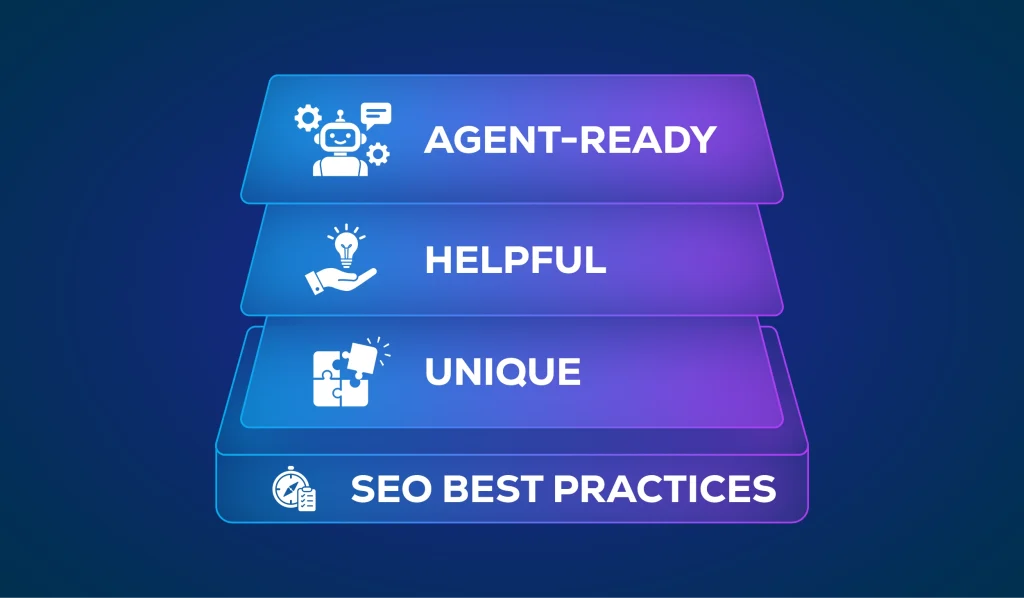
Read carefully, this is Google explicitly telling marketers that SEO best practices are not being replaced. They are the foundation. The new layer is Agent-Ready content — content that AI systems can parse, extract, and cite. That is the entire shift.
Why Non-Commodity Content Is the Differentiator
At Google Search Central Live Toronto in April 2026, Google’s Danny Sullivan drew a line that we’ve explored in detail in our analysis of the commodity vs. non-commodity content framework. Commodity content is generic, interchangeable advice that any writer — or any AI — could produce without real-world experience. Non-commodity content is experience-based: real client situations, real decisions, real outcomes.
The competitive math is straightforward. When an AI can synthesize the top 10 articles on any topic into a single summary, publishing an 11th version of generic advice adds no value to the user and earns no citation from the AI. The content disappears into the summary without attribution.
Non-commodity content gives AI systems something distinctive to extract and cite. Real client examples, real campaign decisions, real performance data — none of that exists in the AI’s training set unless you publish it. That is the irreplaceable layer.
The Technical Signals That Got More Important, Not Less
If anything, the technical SEO bar has risen — not fallen — in the AI search era. The signals that matter:
- Schema markup has become essential. Properly implemented schema is associated with significantly higher AI Overview selection rates. BlogPosting schema for cluster articles, FAQPage schema for FAQ sections, BreadcrumbList for cluster structure, and VideoObject when video is embedded.
- Core Web Vitals and page speed are now trust thresholds for both human users and AI extraction systems. A slow page with great content will lose to a fast page with equally great content.
- Internal linking helps AI systems understand topical authority across a site — the linked cluster of pages on a topic carries more weight than any single page in isolation.
- Question-based H2 and H3 headings now serve a dual purpose: they capture People Also Ask traffic, and they’re indexed by AI systems as direct answer targets.
Notice what’s missing from this list: anything radical, anything new in the last 60 days, anything that requires you to throw out your existing SEO playbook. The fundamentals are still the fundamentals. They just matter more now than they did two years ago.
What’s Actually Changed — And What Hasn’t
What changed in search: traffic patterns (zero-click is now the norm at 60–77% of queries), measurement (rankings no longer equal visibility), the content quality bar (generic content earns fewer AI citations and gets summarized away without attribution), and the metrics that matter (AI citation rate is now a primary KPI). What did not change: Google still crawls, indexes, and ranks web content; organic results still appear above the fold for most queries; internal linking still matters; schema markup still matters; brand authority still compounds; top-10 organic ranking is still the strongest predictor of AI Overview citation.
What changed
- Zero-click search is now the default behavior, not an edge case.
- Rankings and visibility have decoupled — a page can rank well and still get less traffic than it did two years ago.
- Generic informational content is being absorbed into AI summaries and earning fewer citations.
- AI Mode and AI Overviews now share the SERP — for many queries, AI features appear above the traditional organic results.
- Cited brands compound visibility; uncited brands lose share over time.
- AI citation rate has become a meaningful KPI, separate from rankings.
What didn’t change
- Google still crawls, indexes, and ranks web content. The fundamental machinery is intact.
- Organic results still appear for nearly every query, often above the fold.
- Internal linking still matters for topical authority.
- Schema markup still matters — arguably more than it used to.
- Brand authority still compounds over time.
- Top-10 organic ranking is still the strongest predictor of AI Overview citation.
- Content quality remains the foundation of everything else.
The New Metrics That Actually Matter
If your only success metric is keyword rankings, you are measuring the wrong thing. Here is the set of metrics that paint a complete picture in 2026:
- AI citation rate — is your content appearing in AI Overviews and AI Mode responses for your priority queries?
- AI referral traffic — track sessions from Perplexity, ChatGPT, Gemini, and other AI surfaces as a separate channel.
- Branded query volume — are people searching for your brand directly after encountering you in AI surfaces?
- Conversion quality from AI search visitors — measure conversion rate by source, not just volume.
- Topical authority share — what percentage of the citations on your priority topics belong to your domain versus competitors?
What You Should Actually Do Monday Morning
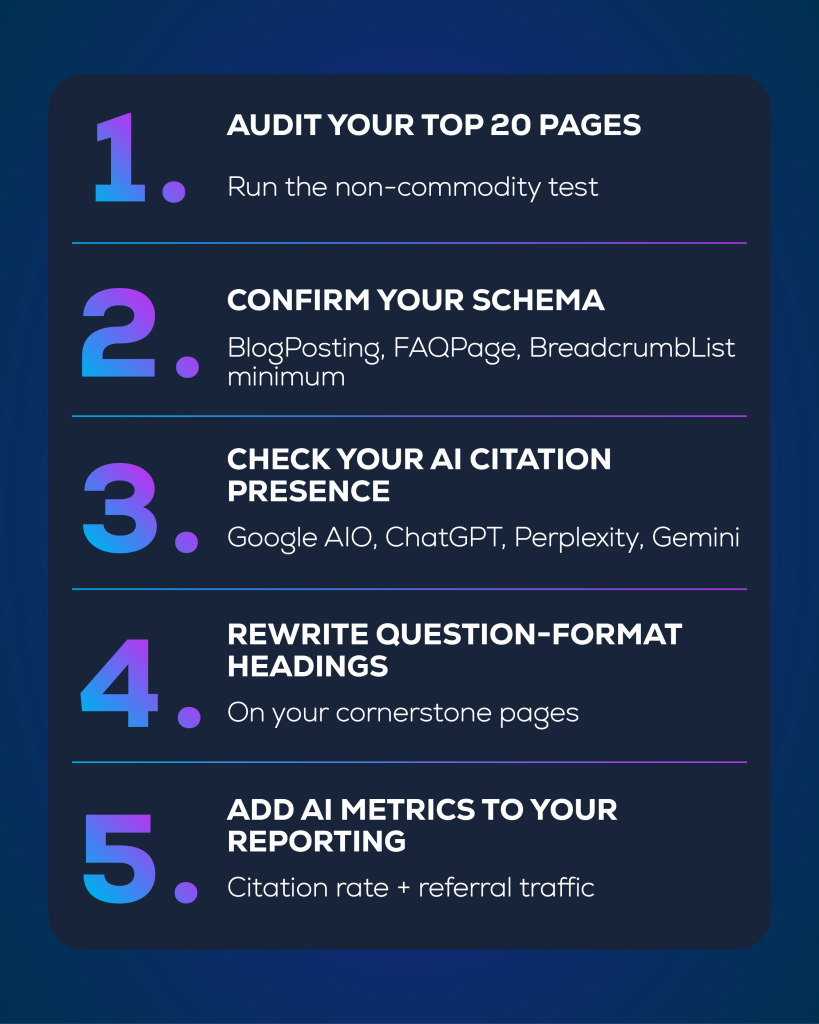
The practical response to Google’s I/O 2026 announcements is not to overhaul your SEO strategy — it is to extend it. Five immediate actions matter: audit your top 20 pages against a non-commodity content test, confirm your schema markup is implemented and validated, check whether you are already being cited in AI Overviews for your priority queries, rewrite question-based H2 and H3 headings on cornerstone pages, and add AI citation rate and AI referral traffic to your reporting. None of these actions require pausing existing SEO work. They build on it.
Here is the calm, practical action list for the week ahead. Run through these in order. None require a strategic pivot. None require pausing your existing SEO investment.
The Five-Step Calm-the-Chaos Checklist
1. Audit your top 20 pages against the non-commodity test
For each of your top-performing pages, ask three questions. Could any AI tool, given a 30-second brief, produce equivalent content? Does the page document a real situation, decision, or outcome that only your team would know? Is there a perspective here that cannot be replicated from research alone? If the answer to all three is no, the page is commodity — and its AI search visibility will reflect that.
2. Confirm your schema markup is implemented and validated
Run your pillar and cluster pages through Google’s Rich Results Test. Confirm BlogPosting, FAQPage, and BreadcrumbList schemas are returning valid results. If you’ve embedded any video content, confirm VideoObject schema is implemented with all required fields (name, description, thumbnailUrl, uploadDate, contentUrl, embedUrl, publisher, duration).
3. Check your AI citation presence
For your top 10 priority queries, manually check Google AI Overviews, Google AI Mode, ChatGPT, Perplexity, and Gemini. Are you appearing? Are your competitors? Document where you appear and where they appear. This becomes your AI citation baseline.
4. Rewrite question-based H2 and H3 headings on cornerstone pages
AI systems index question-format headings as direct answer targets. On your cornerstone pages, rewrite section headings to match real People Also Ask queries: “What is…”, “How does…”, “Why does…”, “When should…”. Place a 50–70 word self-contained answer directly under each question heading.
5. Add AI metrics to your reporting
Stop reporting rankings as your only success metric. Add: AI citation rate (manual or via a tool like Profound or Otterly.ai), AI referral traffic (filter analytics by source for ChatGPT, Perplexity, Gemini), and conversion quality from AI search visitors versus traditional organic.
What Not to Do
Equally important — here is what you should not do, regardless of how many panic-headlines you see in your feed:
- Do not pause your SEO work. The data is clear that top-10 organic rankings remain the strongest predictor of AI visibility. Pausing now compounds the gap.
- Do not pivot entirely to “GEO” as if it were a separate discipline. Generative Engine Optimization is an extension of SEO, not a replacement. The fundamentals overlap by 70%+.
- Do not chase every AI-optimization tactic that appears on LinkedIn this week. Most are repackaged SEO fundamentals presented as something new. Focus on the four-tip framework Google itself published.
- Do not rebuild your site for AI Mode specifically. The technical fundamentals that win in AI also win in traditional search. There is no separate site architecture for AI.
If your team is feeling overwhelmed by the rate of change, you are not alone. The SEO services we offer at Growth Conductor are built specifically for this moment — combining ConductorIQ’s proprietary AI infrastructure with human-led strategy to identify which actions matter most for your specific business. We’ve already done the panic-cycle work. We can help you skip past it.
Frequently Asked Questions
No. SEO is not dead. Google did not announce the end of organic search at I/O 2026, and the underlying mechanics of crawling, indexing, and ranking remain intact. What has changed is that search visibility now requires a higher content quality bar, structured data implementation, and optimization for AI Overview citation in addition to traditional organic ranking. Top-10 organic positioning remains the single strongest predictor of AI Overview citation eligibility, meaning SEO has become a prerequisite for AI visibility — not a replacement for it.
SEO (Search Engine Optimization) is the discipline of earning visibility in traditional search engines through technical health, content quality, and authority signals. GEO (Generative Engine Optimization) is the emerging discipline of earning citations inside AI-powered search experiences like Google AI Overviews, ChatGPT, and Perplexity. The two are not separate disciplines — they share roughly 70% of the same fundamentals. GEO extends SEO with additional focus on self-contained answer passages, question-based headings, structured data, and content freshness. A strong SEO foundation is required to compete in GEO.
Yes. AI Mode and AI Overviews both rely on Google’s indexed web content as their source material. Without crawling, indexing, and ranking, the AI features cannot function. Google has explicitly stated that web content remains the foundation of its AI search experiences. The crawl, the index, and the rank are unchanged. What has changed is how the indexed content is presented to users — sometimes as a list of links, sometimes as an AI-generated summary citing those same links.
Run manual checks: search your priority queries in Google with AI Overviews enabled, and look for your domain in the citations. For systematic monitoring, tools like Profound, Otterly.ai, Athena HQ, and Goodie track AI citation appearance across Google AI Overviews, ChatGPT, Perplexity, and Gemini. You can also filter Google Analytics by source/medium to identify AI referral traffic from ChatGPT, Perplexity, and other AI search surfaces, then trace those visits back to which pages are being cited.
No. The data shows the opposite is true. Brands with strong existing SEO foundations are significantly more likely to be cited in AI Overviews, ChatGPT, and other AI search experiences. Top-10 organic ranking remains the strongest predictor of AI citation. The right move is to extend your SEO investment to include AI optimization signals — structured data, self-contained answer passages, question-based headings, and content freshness — not to pause SEO and pivot entirely. Treat AI optimization as the next layer on your SEO foundation, not a replacement for it.
Immediate changes: the redesigned search box is rolling out globally now, AI Overviews now support follow-up questions that flow into AI Mode, and Gemini 3.5 Flash is the new default model in AI Mode worldwide. Coming summer 2026: information agents (for AI Pro/Ultra subscribers first), generative UI in Search (free for all users), and mini-app building inside Search (Pro/Ultra first). What did not change: Google still crawls and indexes the web, organic results still appear, schema still matters, content quality still drives visibility, and top-10 organic ranking remains the strongest predictor of AI Overview citation eligibility.
Key Takeaways
- SEO is not dead. Google did not announce the end of organic search at I/O 2026. The crawl, index, and rank are intact. The fundamentals still apply.
- Search has evolved, not collapsed. The content quality bar is higher. Generic content gets absorbed into AI summaries. Experience-based content earns citations.
- Google’s own framework — SEO fundamentals + structured data + page experience + non-commodity content — applies equally to traditional search and AI search. There is no separate strategy.
- Top-10 organic ranking remains the strongest predictor of AI Overview citation. AI search and traditional search are not competing channels — they share the same quality assessment.
- Cited brands compound visibility. AI Overview traffic converts at 14.2% versus 2.8% for traditional organic. The rewards for winning are larger than they used to be.
- Human strategy plus AI infrastructure is the model that wins. AI can synthesize anything that already exists. Only humans can document what just happened in the room when a client made a real decision.
Build for the Search Era You’re Actually In
Most agencies are panicking right now. We are not. We have spent the last two years building Growth Conductor specifically for the moment we are now in: proprietary AI infrastructure (ConductorIQ) paired with human-led strategy, content production through our Content Engine that scores non-commodity content against a 110-point matrix, and technical SEO that treats AI citation eligibility as a first-class signal.
If your team is reading panic-headlines and wondering whether to pause SEO, pivot to GEO, or rebuild everything from scratch — we can help you skip past that confusion. Our SEO services are built for the search era we are actually in, not the one we were in two years ago. Let’s talk.