

Heather
Hi! My name is Heather Shoup and I am a web growth engineer.
Share
Marketing didn’t suddenly become complicated because of AI.
It became complicated because scale, data, channels, and customer expectations exploded all at once.
AI-driven marketing strategy isn’t about replacing marketers. It’s about designing systems that can think faster than humans alone, adapt in real time, and turn overwhelming data into clear, confident decisions. When done right, AI becomes the connective tissue between strategy, execution, and growth.
This guide explains what an AI-driven marketing strategy actually is, how it works in practice, and how businesses can use smart automation to grow more efficiently—without losing the human insight that makes marketing work in the first place.
What Is an AI-Driven Marketing Strategy?
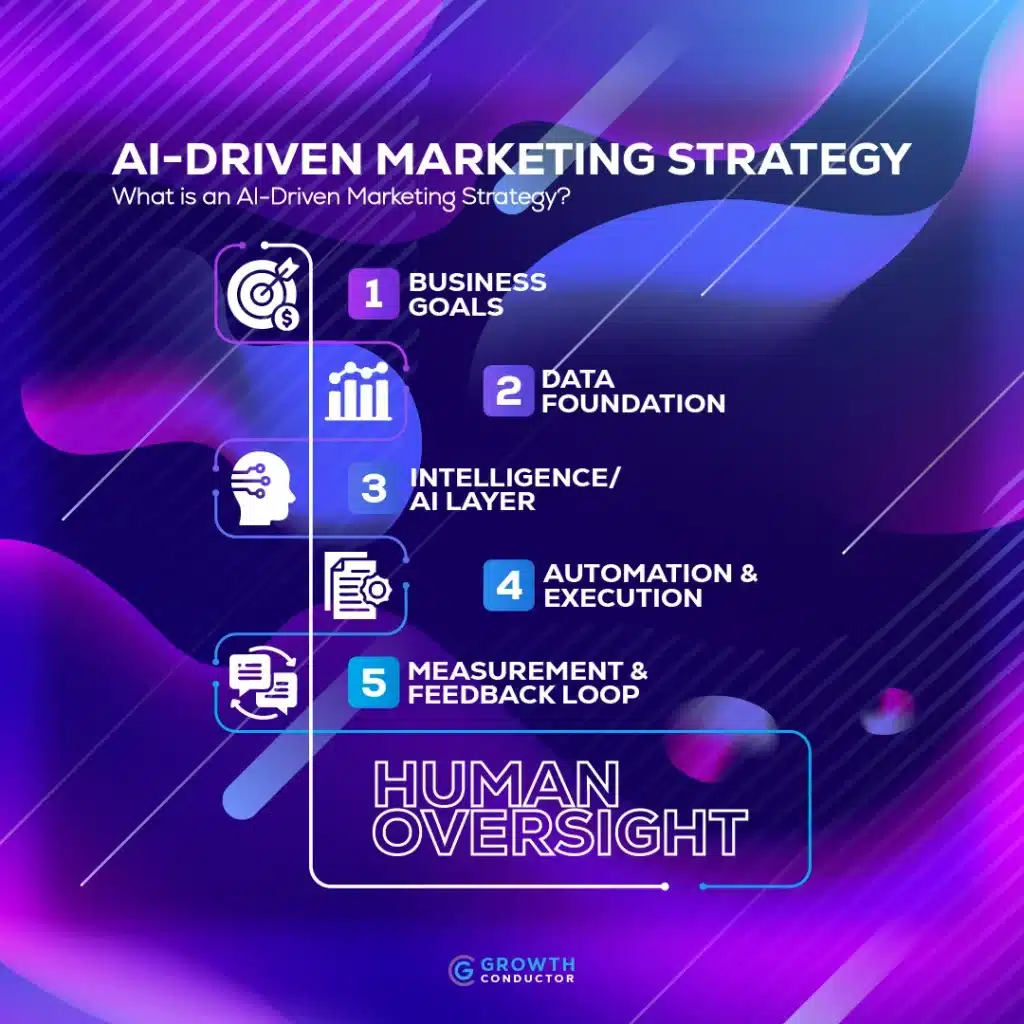
An AI-driven marketing strategy is a framework that uses machine learning, automation, and predictive analytics to guide decisions across channels—while still being directed by human goals, judgment, and creativity.
Instead of relying on static plans, manual optimizations, and historical assumptions, AI-driven strategies adapt continuously. They learn from performance data, customer behavior, and market signals to recommend or execute actions in near real time.
At its core, this type of strategy does three things:
It analyzes massive amounts of data faster than humans can.
It optimizes campaigns, content, and spend dynamically.
It augments human decision-making instead of replacing it.
This is not “set it and forget it” marketing. It’s feedback-loop marketing—where systems learn, humans guide, and growth compounds.
Many teams first notice this shift when comparing legacy campaign planning to modern adaptive systems—covered in AI vs traditional marketing: what’s changed and why it matters.
Why Traditional Marketing Strategies Break at Scale
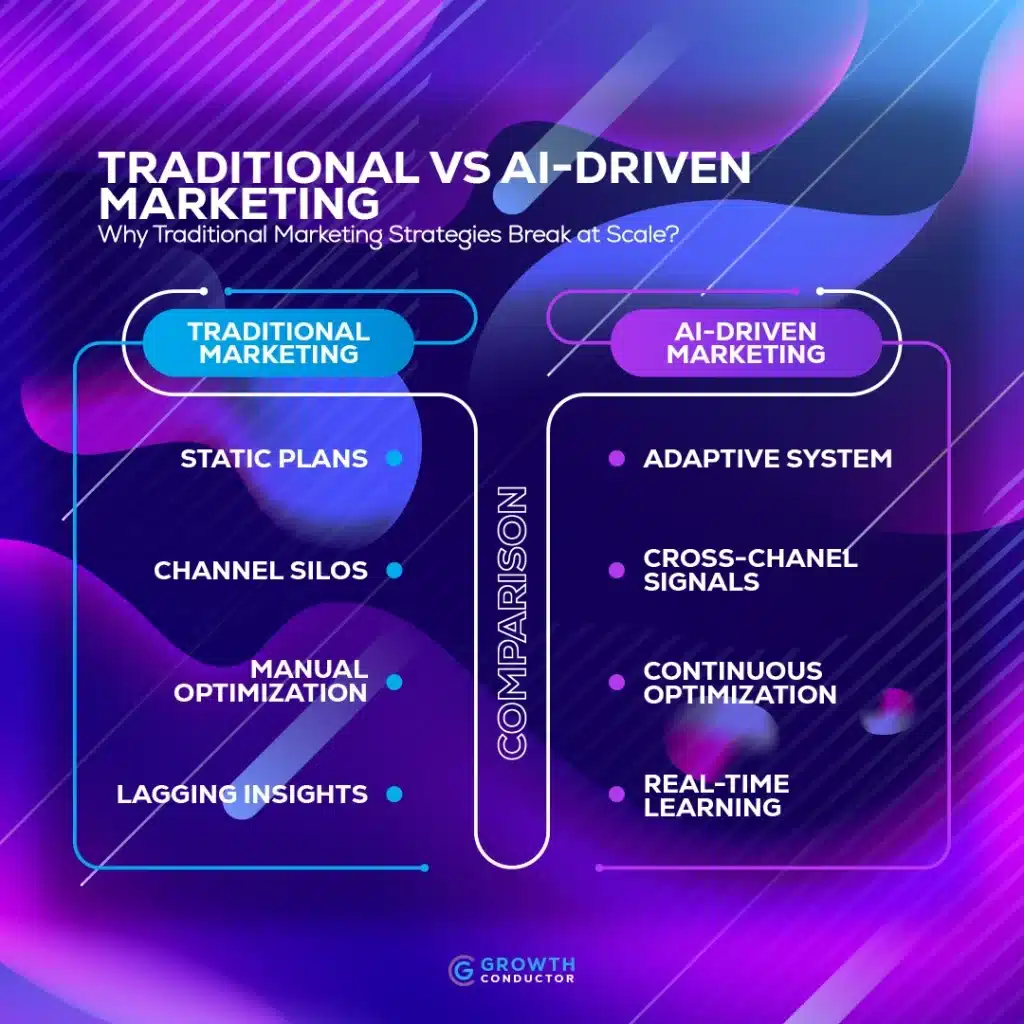
Traditional marketing strategies were built for a slower world.
Plans were created quarterly. Optimizations happened monthly. Insights came after campaigns ended. That approach collapses under modern conditions where audiences shift weekly, platforms update constantly, and competitors move faster than static playbooks allow.
Common failure points include:
Manual analysis that can’t keep up with data volume
Channel silos that prevent unified decision-making
Lagging indicators that reveal problems too late
Over-optimization based on intuition instead of evidence
AI-driven strategies fix these issues by turning marketing into a living system—one that senses change early and responds intelligently.
If you want a clearer contrast between old-school planning and AI-driven systems, explore AI vs traditional marketing: what’s changed and why it matters.
How Smart Automation Changes the Growth Equation
Smart automation isn’t about doing more work faster. It’s about doing less guesswork.
When AI is embedded into a marketing strategy, automation handles tasks like:
Predicting which audiences are most likely to convert
Adjusting bids, budgets, and timing automatically
Identifying content gaps and opportunities
Surfacing insights humans might miss
Personalizing experiences at scale
The compounding effect comes from systems that automate execution and improve decision quality over time—explained in how automation and AI work together to accelerate growth.
This frees human teams to focus on higher-order thinking: strategy, messaging, positioning, creative direction, and experimentation.
Growth accelerates not because machines are “smarter,” but because humans are no longer buried in spreadsheets and dashboards.
AI as a Strategic Layer, Not a Toolset
One of the biggest mistakes companies make is treating AI as a collection of tools rather than a strategic layer.
Buying AI-powered software does not equal having an AI-driven strategy.
A real AI-driven marketing strategy starts with:
Clear business objectives
Defined success metrics
Clean, connected data sources
Human oversight and accountability
AI then becomes the engine that supports those decisions—not the decision-maker itself.
Think of AI like an autopilot system. It can fly the plane efficiently, but humans still decide the destination, respond to turbulence, and override when conditions change.
For a practical breakdown of which tools actually support strategy (without turning your stack into a software junk drawer), see top AI marketing tools for small and mid-size businesses.
The Role of Humans in AI-Driven Marketing
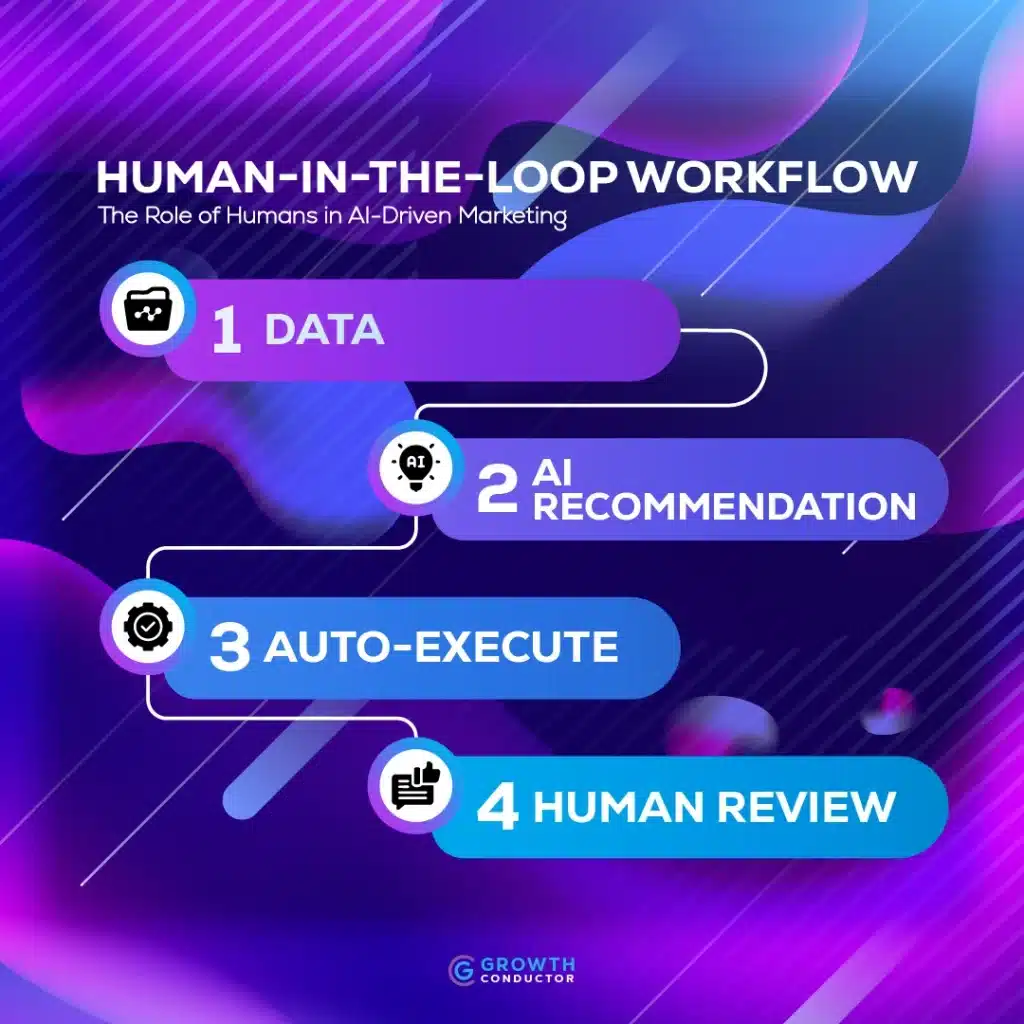
Despite the hype, AI is terrible at context.
It doesn’t understand brand nuance, ethical boundaries, customer trust, or long-term positioning. That’s why the most effective AI-driven strategies are human-led.
Humans define:
- Goals and priorities
- Brand voice and messaging
- What success actually looks like
- When automation should stop
This is why governance, creativity, and oversight remain non-negotiable—covered in the human element in AI-powered marketing.
AI supports:
- Pattern recognition
- Optimization at scale
- Speed and efficiency
- Predictive insight
The competitive advantage isn’t AI alone. It’s humans who know how to direct AI intelligently.
How to Build an AI-Driven Marketing Strategy
An AI-driven marketing strategy isn’t something you install. It’s something you design.
The biggest misconception is that AI strategy starts with tools. In reality, it starts with clarity—about goals, data, constraints, and decision-making authority. Without that foundation, automation simply accelerates chaos.
While this section outlines the strategic progression from intent to execution, the full operational framework is covered in our guide on how to build an AI-driven marketing strategy step by step.
At a high level, building an AI-driven marketing strategy follows a progression from intent to intelligence to execution.
Define Strategy Before Automation
Before any AI enters the picture, the fundamentals must be locked in.
This includes:
- Clear business and growth objectives
- Defined audiences and markets
- Channel priorities
- Success metrics tied to revenue or pipeline, not vanity numbers
AI does not decide what you should optimize for. Humans do. AI decides how efficiently that optimization happens once the goal is clear.
This distinction is one of the key differences between modern AI-driven approaches and traditional models, which are explored in AI vs traditional marketing strategies.
Build a Reliable Data Foundation
AI systems are only as useful as the data they learn from.
An AI-driven strategy requires connected, trustworthy inputs across systems, including CRM data, website analytics, ad platforms, content performance, and revenue signals. If data is siloed, incomplete, or inconsistent, AI recommendations become unreliable—or worse, misleading.
At this stage, the strategic focus is not sophistication. It’s signal quality.
To understand how measurement frameworks support this foundation, see our breakdown of what KPIs to track in an AI marketing strategy.
Identify High-Leverage Use Cases
Not every marketing activity benefits equally from AI.
The smartest strategies begin by identifying areas where automation delivers the most leverage, such as:
- Budget allocation and bid optimization
- Audience segmentation and targeting
- Content ideation and prioritization
- Predictive performance forecasting
- Journey personalization
These are areas where patterns matter more than intuition and where speed creates advantage.
This is where automation shifts from efficiency gains to compounding growth, which is explored further in how automation and AI work together to accelerate growth.
Design Human-in-the-Loop Workflows
AI-driven does not mean AI-controlled.
Every effective AI marketing strategy includes explicit handoff points between machines and people. These checkpoints prevent over-optimization, protect brand integrity, and ensure ethical decision-making.
Human oversight is especially critical when:
- Messaging affects brand trust
- Algorithms influence spend at scale
- Personalization crosses privacy boundaries
- Performance data conflicts with business intuition
This balance between automation and judgment is central to the human element in AI-powered marketing.
Operationalize for Speed and Learning
The real power of AI-driven marketing is not prediction. It’s learning velocity.
Instead of waiting for post-campaign reports, insights emerge during execution. This shifts marketing from reactive optimization to adaptive systems that learn continuously.
To support this, teams must shorten decision cycles, embrace experimentation, and treat controlled failure as a feature—not a flaw.
This ability to move quickly and adjust intelligently is why marketing agility matters in the age of AI.
Align Teams, Tools, and Accountability
AI strategy fails when ownership is unclear.
Someone must be accountable for model performance, data integrity, optimization decisions, and strategic alignment. This often requires new roles, hybrid skill sets, and closer collaboration between marketing, analytics, and operations.
Organizations that succeed treat AI as a shared capability rather than a departmental experiment. A deeper look at this structure is covered in building an AI-ready marketing team.
From Strategy to Execution
Once these components are in place, AI shifts from an abstract concept into an operational advantage.
At that point, questions stop being:
“Should we use AI?”
And start becoming:
“Where should AI be trusted?”
“What decisions should remain human?”
“How fast can we learn and adapt?”
That’s when smart automation stops feeling like technology—and starts feeling like momentum.
Where AI Fits Across the Marketing Funnel
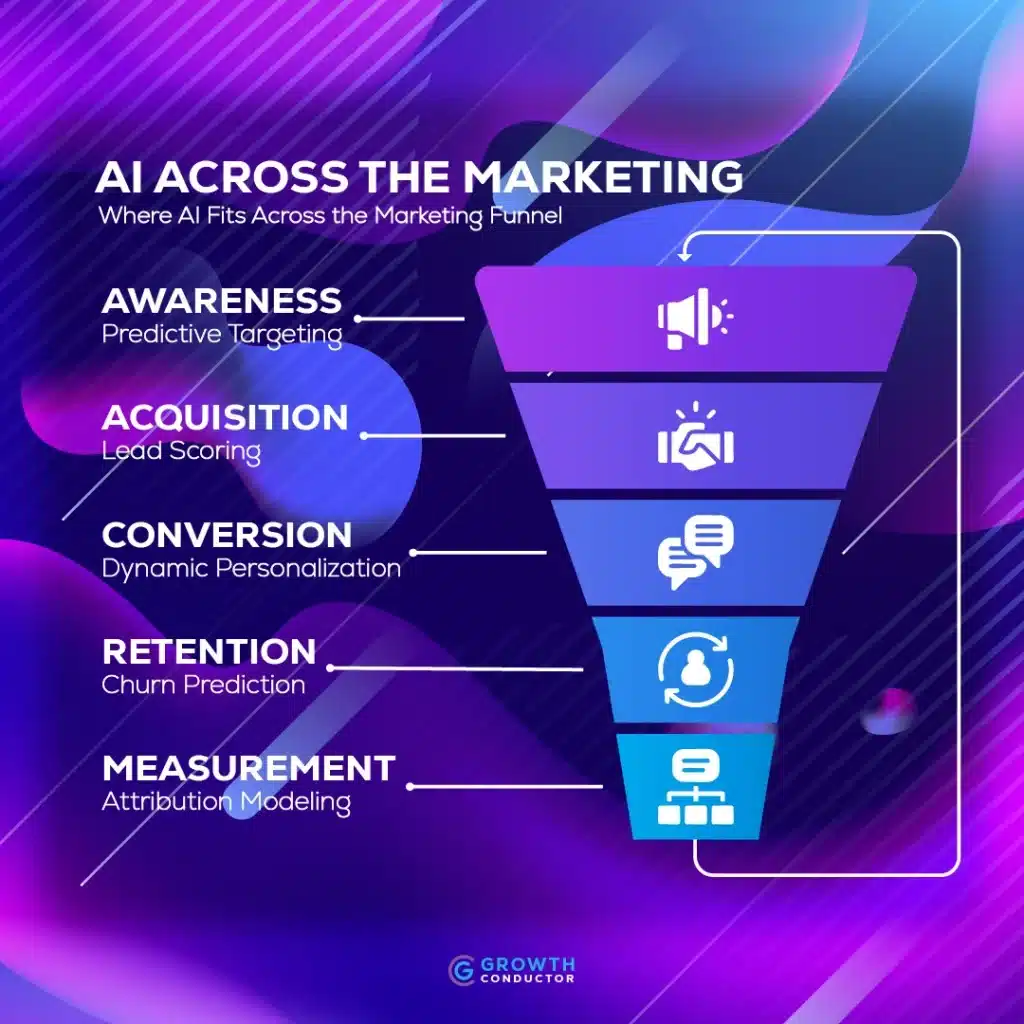
AI doesn’t live in one channel or one stage of marketing. Its real value emerges when it’s applied across the entire funnel, creating continuity between awareness, acquisition, conversion, retention, and growth.
Traditional funnels are often fragmented—each stage owned by different tools, teams, and metrics. AI-driven marketing strategies collapse those silos by treating the funnel as a connected system, not a series of handoffs.
Here’s how that plays out in practice.
AI at the Awareness Stage: Pattern Recognition at Scale
At the top of the funnel, AI excels at detecting what people are paying attention to before it becomes obvious.
Instead of relying solely on historical performance or gut instinct, AI systems analyze:
- Search behavior trends
- Content engagement patterns
- Social signals
- Competitive movement
This allows marketing teams to surface emerging topics, audiences, and channels earlier—often before competitors react.
The strategic benefit here isn’t just reach. It’s relevance at the right moment.
Many teams support this stage with lightweight AI research and trend tools—see top AI marketing tools for small and mid-size businesses.
AI in Acquisition: Precision Over Volume
In acquisition, AI shifts the goal from “more traffic” to “better-fit traffic.”
Machine learning models help:
- Identify high-intent audience segments
- Optimize bids and budgets in real time
- Adjust messaging based on performance signals
- Predict which users are most likely to convert
This reduces waste and improves efficiency—especially in paid channels where speed and accuracy directly affect cost.
AI-driven acquisition strategies don’t just chase clicks. They prioritize probability.
This is where continuous optimization becomes a growth engine—explained in how automation and AI work together to accelerate growth.
AI at Conversion: Removing Friction Intelligently
Conversion optimization is where AI quietly does its best work.
Instead of manual A/B testing alone, AI can:
- Identify friction points across pages and journeys
- Recommend layout, copy, or timing changes
- Personalize experiences based on behavior and context
- Adapt flows dynamically rather than waiting for test results
The result is not a single “winning variant,” but continuously improving performance over time.
This is optimization as a process, not a project.
The deeper system behind this is cross-channel journey design—covered in how AI can personalize customer journeys across channels.
AI in Retention: Learning From Behavior, Not Assumptions
Retention strategies often rely on assumptions—what customers should want next.
AI replaces assumptions with evidence.
By analyzing usage patterns, engagement frequency, and lifecycle signals, AI helps:
- Predict churn risk
- Identify upsell or cross-sell opportunities
- Personalize messaging and timing
- Optimize lifecycle campaigns dynamically
This transforms retention from reactive outreach into proactive relationship management.
Growth becomes less about constantly acquiring new users and more about maximizing lifetime value.
AI in Measurement: Closing the Feedback Loop
Across every stage of the funnel, AI strengthens measurement.
Instead of static reports, AI-driven analytics surface:
- Leading indicators of performance
- Anomalies and emerging issues
- Attribution patterns across channels
- Forecasts for future outcomes
This feedback loop is what allows AI-driven strategies to improve continuously. Without it, automation becomes blind execution.
Measurement isn’t the final step. It’s the system’s nervous system.
To choose the right signals for an AI-driven measurement loop, see what KPIs should you track in an AI marketing strategy.
From Funnel Stages to Connected Systems
The real shift isn’t AI at individual funnel stages—it’s AI connecting those stages.
When awareness data informs acquisition, acquisition insights shape conversion, and conversion behavior guides retention, marketing stops behaving like a funnel and starts behaving like a loop.
That’s where compounding growth happens.
Personalization and Customer Journeys in AI-Driven Marketing
Traditional customer journeys are built as fixed paths. They assume customers move predictably from awareness to conversion, guided by predefined messages, timelines, and triggers.
AI-driven marketing strategies replace that rigidity with adaptive journeys.
Instead of forcing customers through static funnels, AI allows journeys to evolve dynamically based on behavior, context, and intent. Personalization becomes less about rules and segments and more about continuous alignment between customer needs and brand responses.
At the strategy level, this changes how journeys are designed, measured, and governed. For the tactical implementation across channels—data signals, orchestration logic, and measurement—see how AI can personalize customer journeys across channels.
From Static Funnels to Adaptive Systems
In traditional marketing, journeys are mapped in advance. Emails send after fixed delays. Ads follow predetermined sequences. Content is served to broad segments regardless of real-time behavior.
AI introduces feedback into every stage of the journey.
As customers interact with channels, content, and experiences, AI systems identify patterns and adjust paths dynamically. Journeys become probabilistic rather than scripted, guided by likelihoods instead of assumptions.
This does not eliminate planning. It changes what planning means.
Instead of defining exact paths, strategy focuses on:
- Decision boundaries
- Priority signals
- Acceptable variations
- Human intervention points
Journeys become systems that adapt, not storyboards that repeat.
Personalization as a Strategic Capability
In AI-driven marketing, personalization is not a campaign feature layered on top of execution. It is a core strategic capability embedded into how marketing operates.
That capability depends on:
- Unified customer data across channels
- Shared definitions of intent and engagement
- Consistent measurement frameworks
- Governance around automation
Without these foundations, personalization fragments into isolated optimizations that don’t compound.
When designed strategically, personalization enables:
- Messaging that evolves as intent changes
- Channel mix that adapts automatically
- Experiences that respond to behavior, not schedules
- Journeys that converge toward outcomes rather than touchpoints
The objective is relevance with continuity, not hyper-targeting for its own sake.
Where AI Adds Leverage in Journey Design
AI-driven personalization creates leverage in three strategic dimensions.
Timing.
AI helps determine when engagement is most effective, reducing friction and fatigue.
Context.
AI evaluates multiple signals together—behavioral, environmental, and historical—rather than relying on single attributes.
Continuity.
AI maintains coherence across channels so personalization does not reset with every interaction.These advantages do not come from sending more messages. They come from making better decisions about which interactions matter.
Human Guardrails in Personalized Systems
Personalization at scale introduces real risk.
Without constraints, AI systems can:
- Over-optimize short-term engagement
- Erode brand consistency
- Cross privacy or trust boundaries
- Favor efficiency over experience
That is why a personalization strategy must include human-defined guardrails.
Humans determine:
- Which data can and cannot be used
- Which decisions are automated
- How much variation is acceptable
- When automation should pause or stop
AI operates within those boundaries. This preserves trust while allowing systems to adapt intelligently.
Measuring Success Across the Journey
AI-driven journeys require a shift in measurement.
Rather than focusing solely on isolated conversion events, strategy evaluates journey health:
- Engagement quality over time
- Progression velocity through stages
- Drop-off patterns and friction points
- Lifetime value trajectories
These measurements reveal not just whether personalization works, but where it creates or destroys value across the system.
For a deeper framework on how to evaluate performance in AI-driven systems, this section naturally connects to What KPIs Should You Track in an AI Marketing Strategy?
Personalization as a Growth Multiplier
When personalization is treated as a strategic system rather than a campaign tactic, it compounds.
Each interaction informs future decisions.
Each signal sharpens relevance.
Each adjustment improves alignment.
The result is not simply higher conversion rates, but a marketing system that becomes more responsive, resilient, and human-aware over time.
For a practical, channel-level breakdown of how AI enables cross-channel orchestration and adaptive journeys, this section links directly to How AI Can Personalize Customer Journeys Across Channels.
Measurement, KPIs, and Feedback Loops in AI-Driven Marketing
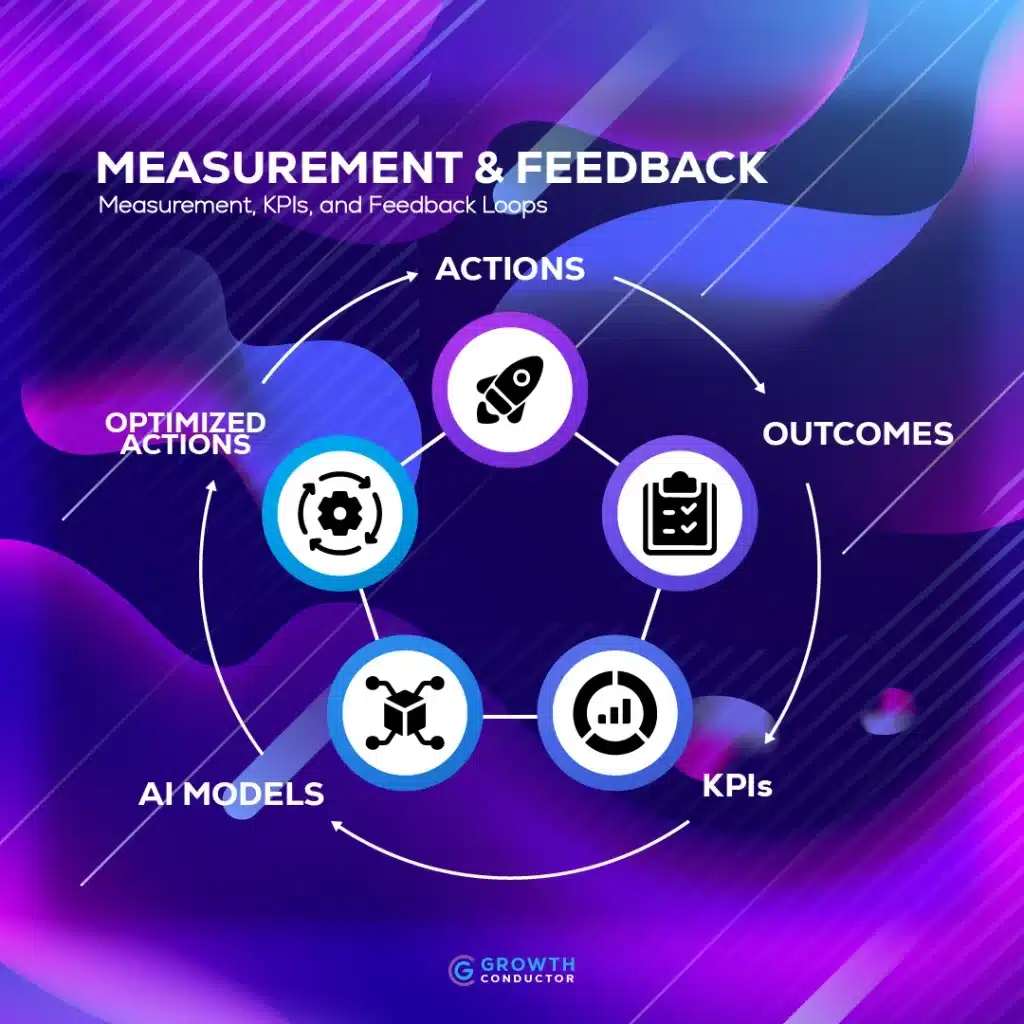
AI-driven marketing strategies live or die by how they measure success.
Traditional measurement frameworks were built for static campaigns: launch, wait, report, repeat. That model breaks down when optimization happens continuously and decisions are made in near real time.
If you want a practical KPI set you can apply immediately, start with what KPIs should you track in an AI marketing strategy.
In an AI-driven system, measurement is not a post-mortem. It is a feedback loop—the mechanism that allows the strategy to learn, adapt, and improve while campaigns are still running.
Why Traditional KPIs Fall Short
Most legacy marketing KPIs were designed to describe performance, not guide decisions.
Metrics like impressions, clicks, and even single-touch conversions tell you what happened, but not:
- Why it happened
- Whether it will happen again
- What should change next
AI systems require signals that are:
- Timely
- Predictive
- Comparable across channels
- Tied to business outcomes
When KPIs lag behind reality, AI optimizes against outdated assumptions.
KPIs as Signals, Not Scorecards
In AI-driven marketing, KPIs are not trophies. They are signals.
Each KPI answers a specific strategic question:
- Is the system learning?
- Is performance improving or degrading?
- Where is friction emerging?
- Which decisions should be automated or overridden?
This shifts the role of measurement from reporting to guidance.The most effective AI-driven strategies define KPIs that inform action, not just accountability.
Core KPI Categories in AI-Driven Systems
Rather than tracking dozens of disconnected metrics, AI-driven strategies organize KPIs into functional groups.
Outcome KPIs
These tie marketing activity directly to business results: revenue, pipeline contribution, lifetime value, retention.
Efficiency KPIs
These measure how effectively resources are being used: cost per acquisition, return on ad spend, conversion efficiency.
Velocity KPIs
These reveal how quickly users move through journeys: time to conversion, stage progression speed, response latency.
Quality KPIs
These assess signal strength and experience health: engagement depth, drop-off patterns, repeat behavior.
Together, these categories allow AI systems to optimize holistically rather than locally.
The Role of Feedback Loops
Feedback loops are what turn KPIs into intelligence.
In an AI-driven strategy:
- Performance data feeds models
- Models generate recommendations or actions
- Actions produce new outcomes
- Outcomes update the system
This loop must be:
- Fast enough to matter
- Accurate enough to trust
- Governed enough to prevent runaway optimization
Without clean feedback loops, AI either stalls or over-corrects.
Measurement becomes the stabilizing force that keeps automation aligned with strategy.
Human Judgment in KPI Design
AI does not decide what success means. Humans do.
Choosing KPIs is a strategic decision, not a technical one. It requires clarity about:
- Long-term vs short-term tradeoffs
- Growth vs efficiency priorities
- Brand impact vs immediate performance
Humans define which metrics matter and which are ignored. AI optimizes within those constraints.
This is how teams avoid chasing vanity metrics or sacrificing long-term value for short-term gains.
From Measurement to Adaptation
The ultimate purpose of KPIs in AI-driven marketing is adaptation.
Well-designed measurement systems allow teams to:
- Detect change early
- Respond before performance degrades
- Test assumptions continuously
- Improve decision quality over time
Marketing becomes less reactive and more anticipatory.
This is where AI-driven strategies outperform traditional ones—not because they predict the future perfectly, but because they learn faster than the environment changes.
Where This Connects Next
This section directly anchors the cluster article What KPIs Should You Track in an AI Marketing Strategy?, which dives into specific metrics, frameworks, and examples.
Strategically, it also sets up the next two pillar sections:
- Tools and Technology in AI-Driven Marketing (what enables measurement and automation)
- Teams, Governance, and Accountability (who owns decisions and oversight)
Measurement is the nervous system.
What comes next is the machinery—and the people who operate it.
Tools, Technology, and the AI Marketing Stack
An AI-driven marketing strategy is not defined by the tools it uses—but it is enabled by them.
Technology provides the infrastructure that allows data to flow, models to learn, and decisions to scale. Without the right stack, even the best strategy collapses under operational friction. With the right stack, strategy becomes executable, measurable, and adaptive.
At the pillar level, the goal is not to recommend software. For specific platforms and use cases (without losing the strategy), see top AI marketing tools for small and mid-size businesses. It’s to understand what capabilities the stack must provide and how those capabilities work together.
From Isolated Tools to Integrated Systems
Traditional marketing stacks often grow organically—one tool for email, another for ads, another for analytics, each operating in partial isolation.
AI-driven strategies require a different approach.
Instead of disconnected tools, the stack must function as an integrated system, where data moves freely and insights compound across channels. AI systems cannot learn effectively when signals are fragmented or delayed.
Strategic alignment matters more than feature depth.The question is not “What tool should we buy?”
It’s “What decisions must this system support?”
Core Capability Layers in an AI Marketing Stack
Rather than thinking in terms of vendors, AI-driven stacks are best understood in layers.
Data Layer
This includes systems that collect, normalize, and unify data from multiple sources—web, CRM, ads, content, and conversions. Clean data is the foundation for all downstream intelligence.
Intelligence Layer
This is where machine learning, predictive models, and analytics operate. These systems surface patterns, forecasts, anomalies, and recommendations.
Execution Layer
This layer activates decisions across channels—ads, content, email, personalization, and automation workflows.
Measurement Layer
This layer closes the loop by tracking outcomes, feeding results back into the system, and enabling continuous learning.
When these layers work together, AI becomes a force multiplier rather than a disconnected experiment.
Why Tool Proliferation Fails AI Strategies
More tools do not create better AI strategies.
In fact, excessive tooling often creates:
- Conflicting data definitions
- Slower decision cycles
- Fragmented reporting
- Reduced trust in outputs
AI systems thrive on clarity and consistency. Fewer, well-integrated platforms outperform sprawling stacks with overlapping functionality.
Strategically, restraint is an advantage.
Automation vs Intelligence: A Critical Distinction
Not all “AI-powered” tools are intelligent.
Many platforms automate predefined rules. Others genuinely learn from data. Confusing the two leads to misplaced expectations.
Automation executes decisions faster.
Intelligence improves decision quality over time.
An AI-driven marketing stack must support both—but strategy dictates where learning is required and where simple automation is sufficient.
This distinction prevents teams from over-engineering workflows that don’t need prediction.
Human Oversight in the Technology Stack
No stack operates autonomously.
Humans are responsible for:
- Selecting which decisions are automated
- Interpreting AI-generated insights
- Auditing outputs for bias or error
- Overriding systems when context demands it
Technology amplifies intent. It does not replace accountability.
That’s why governance and access control are part of stack design—not afterthoughts.
Designing for Change, Not Perfection
AI-driven marketing stacks must be designed for evolution.
Models improve. Platforms change. Channels rise and fall. The stack must support:
- Modularity instead of rigidity
- Interoperability instead of lock-in
- Experimentation instead of static workflows
The best stacks are not the most advanced—they’re the most adaptable.
Teams, Governance, and Accountability in AI-Driven Marketing
AI-driven marketing strategies do not fail because of technology.
They fail because ownership is unclear.
A deeper breakdown of roles, workflows, and operating models is covered in building an AI-ready team structure for your marketing department. (Cluster: Team Structure)
When decisions are automated, data flows continuously, and optimization happens in real time, traditional team structures break down. Roles blur. Accountability fragments. Oversight becomes reactive instead of intentional.
That’s why AI-driven marketing requires a deliberate approach to teams, governance, and decision rights.
Why AI Changes Team Design
In traditional marketing organizations, teams are often organized by channel or function: SEO, paid media, content, analytics. Each team optimizes its own slice of performance.
AI-driven strategies reward a different structure.
Because AI systems optimize across signals and channels, teams must be aligned around:
- Shared objectives
- Shared data definitions
- Shared accountability for outcomes
The strategy shifts from “who owns the channel” to “who owns the decision.”
New Roles in AI-Driven Marketing Organizations
AI does not eliminate roles. It reshapes them.
Effective AI-driven teams often introduce hybrid responsibilities that didn’t exist before, such as:
- Strategy owners who define objectives and guardrails
- Data stewards responsible for signal quality and integrity
- Operators who manage automation and experimentation
- Analysts who interpret AI outputs and challenge assumptions
These roles don’t require everyone to become technical experts. They require clarity about who is responsible for what—and why.
Decision Rights: What AI Can Do vs What Humans Must Do
One of the most important governance questions in AI-driven marketing is decision authority.
Strategy must explicitly define:
- Which decisions are automated
- Which decisions require human approval
- Which decisions are advisory only
- When automation should be paused or overridden
This prevents both extremes: over-automation that erodes trust and under-automation that wastes opportunity.
Clear decision rights turn AI from a risk into a controlled advantage.
Ethics, Trust, and Long-Term Thinking
AI-driven marketing introduces ethical considerations that cannot be delegated to algorithms.
Humans are responsible for:
- Privacy boundaries
- Fairness and bias prevention
- Brand consistency
- Customer trust
Short-term gains achieved through aggressive personalization or opaque automation often come at long-term cost.
Governance frameworks exist to protect value over time—not to slow progress, but to guide it responsibly.
Accountability in Continuous Optimization
In AI-driven systems, outcomes emerge from many small decisions rather than single campaigns.
That makes accountability more important, not less.
High-performing teams:
- Assign clear owners to systems, not just projects
- Review AI-driven decisions regularly
- Treat optimization as an ongoing discipline
- Encourage questioning of model outputs
AI improves performance, but humans remain accountable for results.
Culture as the Hidden Multiplier
Perhaps the most overlooked component of AI-driven marketing is culture.
Organizations that succeed with AI share common traits:
- Comfort with experimentation
- Willingness to learn from failure
- Respect for data without blind faith in it
- Collaboration across functions
AI thrives in environments that reward learning velocity over certainty.
Bringing It All Together
An AI-driven marketing strategy is not a toolset.
It is not a workflow.
It is not a one-time transformation.
It is a system—one that combines:
- Clear strategic intent
- Intelligent automation
- Continuous measurement
- Human judgment
- Responsible governance
When these elements work together, marketing becomes faster, smarter, and more resilient. Growth compounds not because machines are smarter than people, but because people have designed systems that learn.
An AI-driven marketing strategy isn’t about chasing tools or trends—it’s about designing systems that learn, adapt, and scale with your business.
Learn how Growth Conductor supports growth across strategy, execution, and optimization.
Key Takeaways
An AI-driven marketing strategy is a system, not a toolset. It combines automation, data, and human judgment into a continuous learning loop.
AI works best when it augments human decision-making, not when it replaces strategic thinking or accountability.
Traditional marketing strategies fail at scale because they rely on static plans, delayed insights, and siloed execution.
Smart automation accelerates growth by reducing guesswork, improving decision speed, and reallocating human effort toward higher-impact work.
Personalization in AI-driven marketing is a strategic capability, not a campaign tactic—it depends on unified data, governance, and clear boundaries.
Measurement is the nervous system of AI-driven marketing. KPIs must act as signals that guide adaptation, not just score performance.
The most effective AI marketing stacks prioritize integration, clarity, and adaptability over tool quantity.
Long-term success depends on teams, governance, and culture as much as technology. AI amplifies intent—it does not replace responsibility.
Frequently Asked Questions
What is an AI-driven marketing strategy?
An AI-driven marketing strategy is a framework that uses machine learning, automation, and predictive analytics to guide marketing decisions across channels—while remaining directed by human goals, judgment, and oversight. It focuses on continuous learning and adaptation rather than static planning.
How is AI-driven marketing different from traditional marketing?
Traditional marketing relies on fixed campaigns, manual optimization, and historical assumptions. AI-driven marketing adapts in real time, learns from ongoing performance data, and optimizes continuously based on predictive signals rather than delayed reports.
Does AI-driven marketing replace human marketers?
No. AI-driven marketing depends on humans to define strategy, set boundaries, interpret insights, and maintain brand integrity. AI accelerates analysis and execution, but humans remain responsible for direction and accountability.
What are the biggest benefits of using AI in marketing strategy?
Key benefits include faster decision-making, improved efficiency, better personalization, earlier detection of performance changes, and the ability to scale optimization across channels without increasing manual workload.
What KPIs matter most in an AI-driven marketing system?
AI-driven strategies prioritize outcome, efficiency, velocity, and quality KPIs—metrics that guide decisions and enable learning—rather than relying solely on vanity metrics like impressions or clicks.
Is AI-driven marketing only for large enterprises?
No. Small and mid-size businesses can benefit significantly from AI-driven strategies, especially when focused on high-leverage use cases like automation, personalization, and performance optimization with clear goals and clean data.
How do you prevent AI from making bad or biased decisions?
By implementing human-defined guardrails, governance frameworks, regular reviews, and clear decision rights. AI should operate within boundaries set by people, not independently of them.
Share
Heather
Hi! My name is Heather Shoup and I am a web growth engineer.
Get tips delivered straight to your inbox
By clicking “Subscribe” you agree to GrowthConductor Privacy Policy and consent to GrowthConductor using your contact data for newsletter purposes